
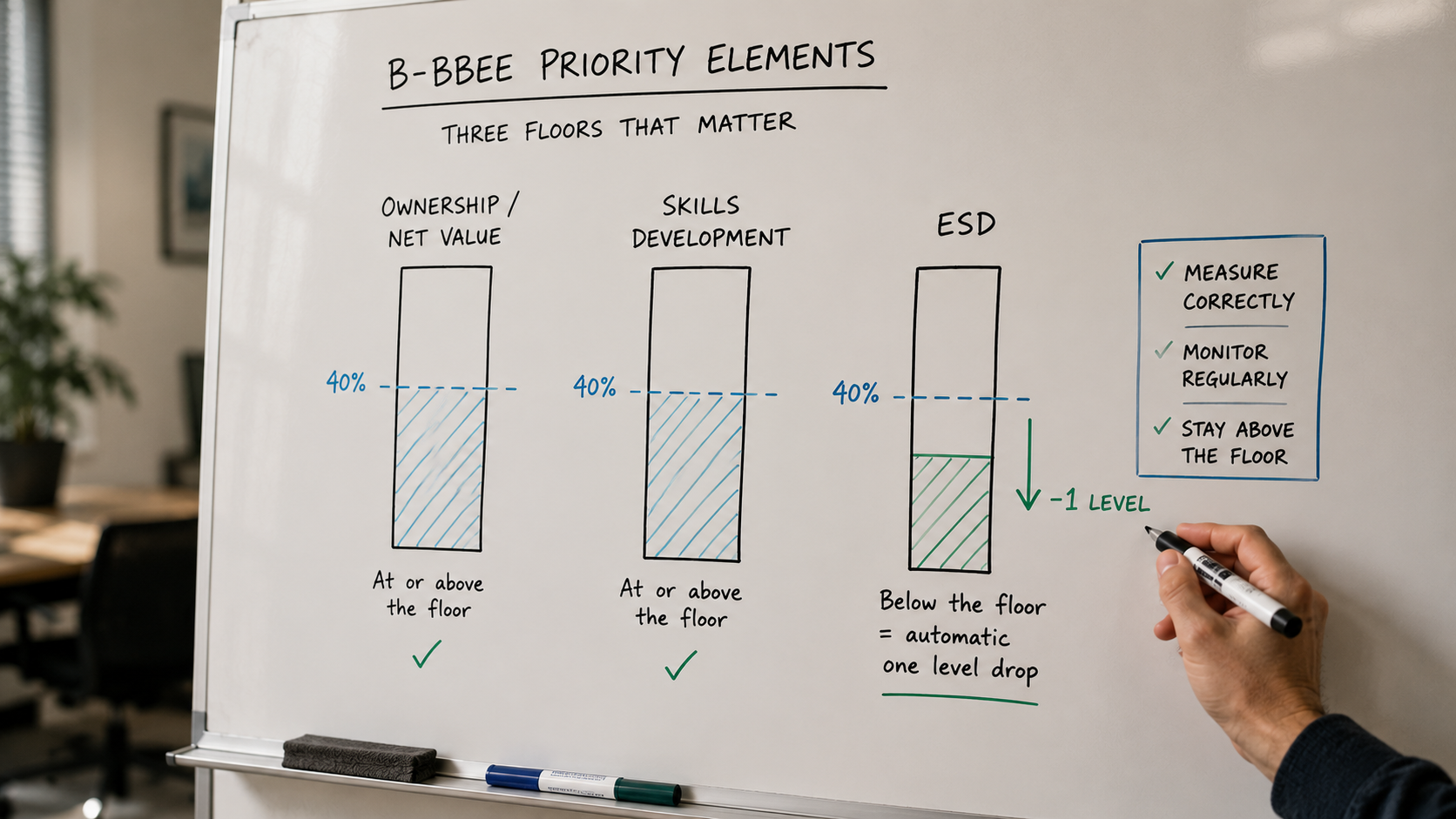
B-BBEE priority elements carry a penalty that catches more corporates off guard than any other rule on the scorecard. Miss the 40% sub-minimum on Ownership, Skills Development, or Enterprise & Supplier Development, and the certificate level drops by one — regardless of how strong the total score is. A corporate scoring a clean Level 2 on points can certify at Level 3 because a single sub-target came in at 38% instead of 40%.
This guide explains which elements carry the penalty, exactly where each 40% threshold sits, how the discounting principle works in practice, and how to protect against an accidental drop. The broader scorecard improvement framework covers total-score strategy; this article covers the specific thresholds that override the total score when missed.
Quick Answer
B-BBEE priority elements are the three scorecard elements — Ownership, Skills Development, and Enterprise & Supplier Development — that carry a mandatory 40% sub-minimum threshold. Under the discounting principle, a Generic entity that fails any one of these sub-minimums has its B-BBEE status level dropped by one level, even if the total points would otherwise qualify for a higher level. Large/Generic entities must meet all three; QSEs must meet Ownership plus one of the other two.
Worried a sub-target might be quietly costing you a level? Request a priority threshold check on your scorecard →
What the B-BBEE Priority Elements Are and Why They Exist
The scorecard has five elements, but three of them carry extra weight in the form of a compulsory floor. Ownership, Skills Development, and Enterprise & Supplier Development are the three that the Codes single out — and the reason is policy intent. These are the elements where transformation is hardest to fake with paperwork and where the government most wants to see substantive movement.
The mechanism is the 40% sub-minimum. Each of the three carries a threshold set at 40% of its achievable points (with specific calculation rules per element). A corporate can score brilliantly across Management Control and Socio-Economic Development, but if its Ownership Net Value comes in below the 40% floor, the discounting principle activates and the whole certificate drops a level.
The logic is deliberate. Without the floor, corporates could ignore the hard areas (real ownership transfer, genuine skills investment, supplier development that creates new black-owned businesses) and load up on the easier ones. The sub-minimum forces minimum effort on the elements the policy cares about most. The B-BBEE Commission’s guidance on calculating the 40% sub-minimum sets out the exact calculation for each.
B-BBEE Priority Elements: Where Each 40% Floor Actually Sits
The 40% is not applied to the same base in each element — and this is where most corporates miscalculate their exposure. The threshold attaches to a specific points sub-set within each element, not to the area’s full weighting.
For Ownership, the floor is 40% of the Net Value points — specifically 40% of the 8 Net Value points, calculated against the Time Graduation Factor in the Codes. Net Value measures the unencumbered value of black ownership after debt, so a corporate with strong headline black shareholding but a heavily financed ownership deal can still fail this floor. The Ownership percentage looks healthy; the Net Value is thin.
For Skills Development, the floor is 40% of the total weighting points — 40% of the 20 points available, excluding any bonus credits. This is the most commonly missed of the three because Skills Development spend is calculated against the SARS Leviable Amount, and an outdated Leviable Amount baseline can push the score below the 40% floor without anyone noticing until verification.
For Enterprise & Supplier Development, the floor is the most complex: 40% must be achieved on each of the three sub-categories — Preferential Procurement, Supplier Development, and Enterprise Development — independently. A corporate can pass two of the three ESD sub-categories comfortably and still trigger the discount by missing the third.
| Priority Element | What the 40% Attaches To | The Floor | Common Reason for Missing It |
|---|---|---|---|
| Ownership | Net Value points (Time Graduation Factor) | 40% of the 8 Net Value points | Strong headline ownership but thin Net Value after debt |
| Skills Development | Total weighting points, excluding bonus | 40% of the 20 points | Outdated Leviable Amount baseline understates spend |
| ESD — Preferential Procurement | Preferential Procurement points | 40% of the 27 points | Supplier panel not weighted to empowering suppliers |
| ESD — Supplier Development | Supplier Development points | 40% of the 10 points | Supplier development partners not formally contracted |
| ESD — Enterprise Development | Enterprise Development points | 40% of the achievable points | ED spend made but not documented to claim standard |
Takeaway
The 40% floor attaches to a sub-set of points inside each area — Net Value for Ownership, total weighting for Skills Development, and each of three sub-categories for ESD — not to the headline score. A corporate can score well on a total and still fail the specific sub-minimum that the floor measures.
How the Discounting Principle Works in Practice
Mechanical and unforgiving is the best description of how the discounting principle operates. When a Generic entity fails any one of the three sub-minimums, the verification agency calculates the corporate’s total points as normal, determines the level that total would produce, and then drops that level by one. The corporate still gets recognition for the actual points achieved below the floor — but the final certificate records the discounted level.
The worked example makes the cost clear. A corporate scores 96 total points, which maps to Level 2 on the recognition table. During verification, its Skills Development comes in at 39% of the 20-point weighting — one point under the floor.
At that point the discounting principle activates. The total stays at 96, but the certified level drops from Level 2 to Level 3. That one-point Skills Development shortfall costs a full level — and every procurement recognition benefit that comes with it.
Takeaway
The discounting principle treats a one-point miss and a ten-point miss identically — both drop the certified level by exactly one. This makes the marginal floor case (tracking at 38-39%) the most expensive position on the scorecard: a tiny shortfall carries the same penalty as a large one, so the return on closing that last point or two is enormous.
For QSEs (turnover R10m–R50m), the rule is lighter but still binding. A QSE must meet the Ownership sub-minimum (compulsory) plus one of either Skills Development or ESD. Missing the required combination triggers the same one-level discount. The compulsory Ownership floor is the trap for QSEs — many assume the lighter QSE regime exempts them from these rules entirely, which it does not.
Not sure whether your entity is exposed to the discounting principle? Get a free discounting-risk assessment →
The Most Expensive Mistake: Discovering the Discount at Verification
The structural problem with the discounting principle is timing. A corporate doesn’t find out it has missed a sub-minimum until the verification agency runs the numbers — by which point the cycle is over and the points can’t be recovered until the next 12-month period. The discount is locked in for a full year.
The corporates that avoid this run the sub-minimum check internally, mid-cycle, with at least two quarters of runway before verification. The mid-cycle check models each of the three floors against current data: where is Net Value tracking against the 40% Ownership floor? Is Skills Development spend on pace against the current Leviable Amount?
Are all three ESD sub-categories above 40%? Any floor tracking below 45% with two quarters to go gets a remediation plan while there’s still time to act.
The Ownership floor deserves particular mid-cycle attention because it’s the hardest to fix late. Skills Development and ESD respond to spend decisions that can be accelerated in a final quarter. Net Value is a function of the ownership structure and the financing attached to it — and that can’t be restructured in 90 days. A corporate tracking below the Ownership floor at mid-cycle has a structural problem that needs strategic intervention, not a spending sprint.
Who This Is NOT For
Why Insignis Treats the Sub-Minimum Floors as the First Diagnostic Test
When the Insignis team scopes a scorecard engagement, the three floors are tested before any total-score optimisation work begins. The reasoning is simple: a corporate working hard to add total points while a sub-minimum sits below 40% is building a better score that will still be discounted. The floor defence comes first; the optimisation comes second.
Dr. Este Welman’s CA(SA) and M.Comm in Taxation background shapes the Ownership Net Value analysis in particular — the Net Value floor is fundamentally a financial calculation involving the unencumbered value of black shareholding after debt, and getting it right requires reading the ownership transaction’s financing structure the way an accountant reads a balance sheet, not the way a generalist reads a shareholding percentage.
For the broader engagement model on this work, the Insignis B-BBEE compliance strategy development service page sets out how floor defence and total-score work are sequenced across a verification cycle, with mid-cycle checkpoint reviews built into every engagement.
A Discounting Near-Miss: What the Mid-Cycle Check Caught
An Insignis client — a Gauteng manufacturing group — came in for a scorecard engagement projecting a comfortable Level 2 on total points. The mid-cycle floor check, run with two quarters of runway, surfaced a problem the corporate hadn’t seen: ESD Supplier Development was tracking at 36% of its sub-category floor, one of the three ESD thresholds that each independently must clear 40%.
The cause was procedural. The corporate had committed real supplier development funding, but two of its three supplier development partnerships hadn’t been formally contracted to the standard the Codes require for the points to count. The spend was happening; the evidence wasn’t claimable. Left unaddressed, the 36% sub-category would have triggered the discounting principle and dropped the projected Level 2 to Level 3.
| Scorecard Position | Before Mid-Cycle Intervention | After Remediation |
|---|---|---|
| Total points | 96 (maps to Level 2) | 96 (maps to Level 2) |
| ESD Supplier Development floor | 36% (below 40% floor) | 47% (above floor) |
| Discounting principle status | Would activate — drop to Level 3 | Does not activate |
| Certified level | Level 3 (discounted) | Level 2 (full) |
| Remediation cost | — | R0 new spend — existing partnerships contracted correctly |
The remediation cost line is the important one. The fix required no new spend — only formalising the supplier development partnership agreements to the standard the Codes require, so the funding already committed became claimable points. The mid-cycle timing was what made it possible; caught at verification, the same problem would have locked in a discounted level for a full year.
Three Questions to Test Your Discounting Exposure
Corporates wanting to assess their floor exposure can start with three diagnostic questions. The answers indicate whether floor defence needs to be an active part of the scorecard strategy or whether the floors are comfortably clear.
Where is Ownership Net Value tracking against the 40% floor right now? This is the structural floor — the one that can’t be fixed late. If Net Value is tracking below 50% with the current ownership structure, it needs a strategic review well ahead of verification, because the financing attached to the ownership deal determines the outcome and that can’t be changed quickly.
Is the Skills Development spend pacing against a current Leviable Amount baseline? An outdated baseline is the single most common cause of a Skills Development floor miss. The Leviable Amount reconciliation against the most recent SARS payroll data is the first defensive check, because an understated baseline silently pushes the percentage toward the floor.
Are all three ESD sub-categories independently above 40%? The ESD floor is missed most often because corporates check the total rather than each sub-category. Preferential Procurement, Supplier Development, and Enterprise Development each carry their own 40% floor, and passing two doesn’t protect against the third triggering the discount.
Want these three questions run against your live scorecard data with structured advisory support? Book a mid-cycle floor diagnostic →
Frequently Asked Questions on B-BBEE Priority Elements
Which elements are the B-BBEE priority elements?
The three priority elements are Ownership, Skills Development, and Enterprise & Supplier Development. These carry the 40% sub-minimum thresholds under the discounting principle. Management Control and Socio-Economic Development are the two non-priority elements — they contribute to the total score but don’t carry a sub-minimum floor that can trigger a level discount.
What happens if you miss a sub-minimum?
The discount activates automatically. The verification agency calculates the total points as normal, determines the level that total would produce, and then drops the certified level by one. The corporate still receives recognition for the actual points achieved below the floor, but the final certificate records the discounted level. Missing one floor and missing all three produce the same one-level discount.
Do QSEs have to meet all three sub-minimums?
No. QSEs (turnover R10m–R50m) must meet the Ownership sub-minimum, which is compulsory, plus one of either Skills Development or Enterprise & Supplier Development. Generic entities (turnover above R50m) must meet all three. The compulsory Ownership floor catches many QSEs that assume the lighter QSE regime exempts them from these rules entirely.
How is the 40% Ownership sub-minimum calculated?
The Ownership floor is 40% of the Net Value points — specifically 40% of the 8 Net Value points, calculated against the Time Graduation Factor set out in the Codes. Net Value measures the unencumbered value of black ownership after the debt attached to the ownership deal. A corporate with strong headline black shareholding but a heavily financed transaction can pass the Ownership percentage and still fail the Net Value floor.
Can you recover from a missed sub-minimum within the same cycle?
It depends on the element. Skills Development and ESD floors can sometimes be recovered with accelerated spend in a final quarter, if caught early enough. The Ownership Net Value floor generally cannot — it’s a function of the ownership structure and financing, which can’t be restructured in 90 days.
This is why the mid-cycle floor check matters: it surfaces a developing miss while there’s still time to act on the elements that respond to spend decisions.
Why does the discounting principle exist?
The discounting principle forces minimum effort on the elements where the policy most wants substantive transformation — real ownership transfer, genuine skills investment, and supplier development that creates new black-owned businesses. Without the floor, corporates could ignore the hard areas and load up on the easier Management Control and Socio-Economic Development points. The sub-minimum prevents a strong total score from masking weak performance on the elements that matter most to the policy intent.
Run a Priority Element Floor Check Before Verification
The cheapest level a corporate can lose is the one lost to an accidental sub-minimum miss — because the fix is almost always cheaper than the procurement value the discount costs. A mid-cycle floor check, run with runway to act, is the single highest-return defensive exercise on the scorecard.
Request a Priority Element Floor Check
Schedule a no-cost initial conversation with Dr. Este Welman, CA(SA), and the Insignis team. We model each of the three sub-minimum floors against your current data, flag any tracking below the 40% threshold, and quote a phase-priced remediation engagement timed to your verification cycle.
No obligation. We will get back to you within 24 hours.
Request Your Floor Check
About the Author
Dr. Este Welman, CA(SA) — Founding Director, Insignis Solutions
A Chartered Accountant (SA) holding a PhD in Economic Transformation from the Da Vinci Institute, an M.Comm in Taxation, a B-BBEE Management Diploma from Wits, and registered SAICA membership.
Her work on the Ownership Net Value floor draws directly on the financial-analysis discipline of the CA(SA) qualification — reading the financing structure of an ownership transaction to determine whether the unencumbered value clears the sub-minimum the discounting principle measures.