
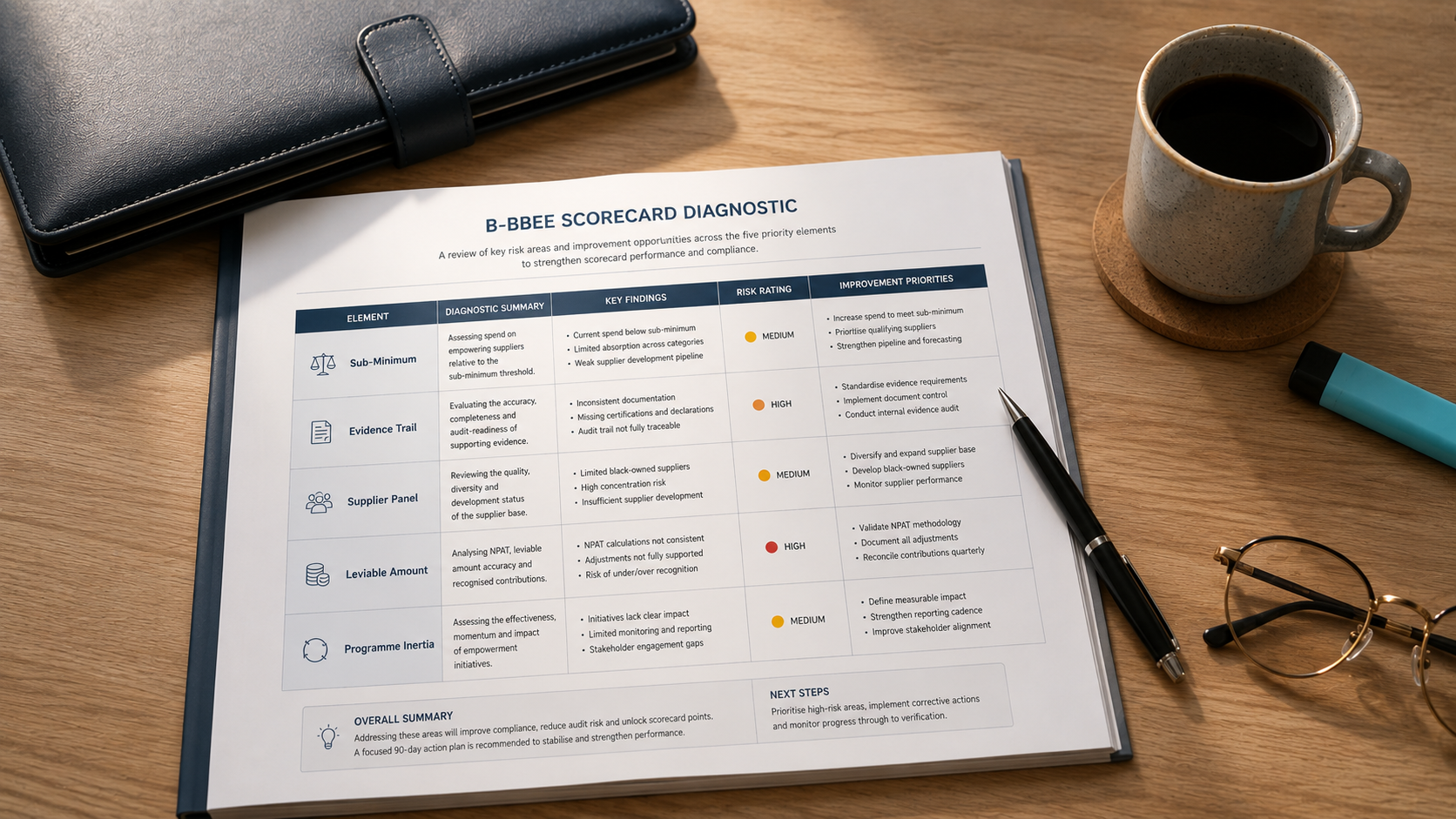
B-BBEE scorecard problems rarely surface where corporates expect them. The CFO inherits a Level 4 certificate after two cycles of disciplined activity spend and assumes the issue is budget — when the diagnostic typically reveals five systemic causes, none of which are about more money. The fix isn’t extra programme spend. The fix is targeted intervention against whichever cause is actually binding.
This guide walks through the five recurring reasons certificates stall — and what specifically to do about each. The broader certificate improvement framework sits above this work; the post below is the diagnostic layer beneath the framework, useful when annual spend isn’t translating into level movement.
Quick Answer
B-BBEE scorecard problems almost always trace back to one of five causes: priority element sub-minimum misses (the biggest single failure mode), evidence trail gaps that disqualify legitimate spend, supplier panel drift between verification cycles, SARS Leviable Amount baseline drift that understates Skills Development entitlement, and programme inertia where compliance activity isn’t tied to certificate scoring mechanics. Diagnostic work — not more spend — is what unlocks the next level.
Stuck at the same level despite year-on-year programme spend? Get a structured B-BBEE certificate diagnostic →
B-BBEE Scorecard Problems #1: The Priority Element Sub-Minimum Trap
The single most common reason certificates stall isn’t a points-total failure — it’s a sub-minimum miss on one of the three priority elements. The Codes of Good Practice require corporates to score at least 40% of the available points on each of Ownership, Skills Development, and Enterprise and Supplier Development. Miss any one of these floors, and the entire certificate drops a level regardless of total points.
The arithmetic surprises corporates the first time. A certificate producing 95 raw points with a Skills Development sub-minimum miss certifies at Level 2, not Level 1. A 90-point result with two sub-minimum misses can certify at Level 3 or worse. The sub-minimum failure pattern looks like this: the Commission’s Codes test the sub-minimums first; the points total is the secondary calculation.
Most corporates discover this at verification, after twelve months of activity. The diagnostic fix: model the three sub-minimum positions as the first exercise of the new cycle, not as part of the year-end evidence-pack assembly. The cost of identifying a sub-minimum risk in Month 1 is small; the cost of missing it at Month 12 is a level downgrade.
| Priority Element | Available Points | 40% Sub-Minimum | Diagnostic Question |
|---|---|---|---|
| Ownership | 25 | 10 points | Does the broad-based scheme produce real economic interest, voting rights, and modified net value above the floor? |
| Skills Development | 20 | 8 points | Does the Leviable Amount baseline match current payroll, and is programme spend hitting the SARS-aligned target? |
| Enterprise & Supplier Development | 40 | 16 points | Does Preferential Procurement spend on EME/QSE-owned suppliers clear the floor, and is ESD partnership investment producing documented beneficiary outcomes? |
B-BBEE Scorecard Problems #2: Evidence Trail Gaps That Disqualify Legitimate Spend
The second recurring failure mode involves transformation spend that’s been incurred — sometimes substantial spend — but doesn’t translate into recognition points because the supporting evidence doesn’t survive the verification agency’s testing. SANAS-accredited agencies test evidence to defensible documentation standards. Legitimate activity without legitimate evidence doesn’t count.
The four typical evidence gaps that surface in diagnostic work: supplier B-BBEE certificate currency mismatched to invoice dates, beneficiary outcome documentation missing on ESD partnerships, Skills Development programme attendance records inadequate against SETA reporting standards, and SED spend lacking proof-of-receipt confirmation from the beneficiary entity. Each of these can disqualify hundreds of thousands in legitimate transformation spend.
Fixing this category of issue is procedural rather than financial. The supplier panel evidence collection moves from year-end scramble to monthly discipline. ESD partnerships get scoped with evidence-trail requirements built into the partnership agreement. SED contributions get acknowledged in writing at the point of the contribution rather than reconstructed at year-end.
Takeaway
Most evidence-side failures aren’t about spending more — they’re about documenting better. A corporate that invests R3m in Skills Development without proper SETA-aligned reporting will lose points that a corporate spending R2m with disciplined documentation will capture. Where certificates stall despite consistent spend, the evidence trail is the first place to look.
B-BBEE Scorecard Problems #3: Supplier Panel Drift Between Verification Cycles
The third systemic cause sits in the Enterprise and Supplier Development element. Supplier panels drift over a 12-month period in predictable ways: small Black-owned suppliers grow into Generic Codes territory and lose the recognition multiplier, supplier certificates expire mid-cycle and aren’t refreshed, procurement teams default to the easiest panel choice rather than the highest-rated alternative, and new suppliers get onboarded without certificate level verification.
The cumulative effect is a Preferential Procurement score lower than it should be — sometimes substantially. A corporate that ended its previous cycle with R45m of spend at average 110% recognition can drift to R45m at 95% recognition within twelve months without any deliberate procurement decision changing. The drift is silent, and these silent drifts show up only at the next verification.
Supplier panel discipline is the fix here. Monthly supplier B-BBEE certificate currency checks, supplier panel reviews at each quarterly procurement committee, and explicit procurement targets that weight certificate level alongside price and quality. Corporates that institutionalise this discipline see their Preferential Procurement score stabilise and trend upward over multiple cycles.
Need a supplier panel audit before the next verification cycle? Request a Preferential Procurement diagnostic →
B-BBEE Scorecard Problems #4: SARS Leviable Amount Baseline Drift
The fourth recurring B-BBEE compliance issue affects the Skills Development element specifically, and it’s the cause Insignis diagnostic work flags most frequently. The SARS Leviable Amount — the salary-and-wage baseline used to calculate the 6% Skills Development spend target — drifts as payroll changes year-on-year. Corporates that calculated their Leviable Amount in 2019 and haven’t updated the baseline are typically understating their target by 10-20%.
The mechanical effect is twofold. The Skills Development spend target is lower than it should be, so the points scored on programme investment are lower. And because the corporate appears to be hitting the (outdated) target, the strategic conversation about increasing Skills Development investment doesn’t surface — the team believes the element is performing. This is among the most expensive silent failures because nothing in management reporting flags it.
Fixing the Leviable Amount baseline is straightforward but rarely happens without prompt: recalculate the Leviable Amount against the most recent SARS Skills Development Levy return (the EMP501) every year as the first task of the new compliance cycle. National Treasury and SARS publish the relevant payroll-tax baseline definitions; the corporate’s payroll system holds the data.
The reconciliation typically takes a finance team a half-day per year and prevents one of the most expensive forms of silent recognition erosion.
B-BBEE Scorecard Problems #5: Programme Inertia Disconnected From Certificate Scoring Mechanics
The fifth pattern is structural. Transformation programmes run on momentum from previous cycles rather than against the current Codes scoring mechanics. The Skills Development budget rolls forward year-on-year. The ESD partnership list stays stable. The SED programme renews without review. The certificate scoring mechanics, meanwhile, have shifted — through Codes amendments, sector code changes, or simply because the corporate’s revenue base has grown.
The 2026 Codes amendments will compound this failure pattern for many corporates. The shift in ESD weighting toward 100% Black-owned and Black women-owned suppliers means programme allocations designed against the 2013 Codes will produce lower scores against the amended Codes — sometimes materially lower. Corporates whose programme allocations were last reviewed before 2025 are walking into the new framework with a Codes-outdated activity mix.
Addressing this requires annual programme realignment to certificate scoring mechanics. Each transformation programme line gets reviewed against the points it actually produces under the current Codes, not the points it produced under a prior version. Lines that have lost scoring efficiency get reduced or redirected. Lines that the amended Codes weight more heavily get expanded. The exercise typically reshapes 15-25% of the programme allocation in the first year of disciplined review.
Who This Is NOT For
How the Insignis Diagnostic Surfaces Hidden compliance issues
The Insignis diagnostic methodology was built around the recurring failure patterns described above. Dr. Este Welman’s CA(SA) and M.Comm in Taxation backgrounds anchor the financial reconciliation work — particularly the SARS Leviable Amount recalculation and the modified net value testing on Ownership transactions — that surfaces the silent failures other diagnostic frameworks miss.
The standard Insignis diagnostic phase tests all five categories explicitly: sub-minimum modelling on the three priority elements, evidence-trail audit against current SANAS-accredited verification standards, supplier panel drift analysis across the last 12 months of procurement spend, Leviable Amount recalculation against the most recent EMP501, and programme allocation review against current Codes scoring mechanics. The output is a written diagnostic report with element-by-element findings and Rand-quantified recovery opportunities.
For the broader engagement model on diagnostic work, see our B-BBEE gap assessments and compliance status analysis service page. Diagnostic engagements are scoped against the corporate’s verification cycle so the findings translate into the next certificate position.
What a Diagnostic-Driven Recovery Actually Delivers
A Gauteng-based engineering services group engaged Insignis after two consecutive Level 4 certificates despite annual transformation spend of R5.8m. Diagnostic work surfaced four of the five failure-cause categories simultaneously.
The findings: a Skills Development sub-minimum miss (38% against the 40% floor), a Leviable Amount baseline three years out of date understating the target by R2.1m, supplier panel drift losing R900k of recognition value, and ESD partnership documentation gaps that had disqualified R1.2m of legitimate beneficiary spend at the prior verification.
The intervention package took ten months — well inside a single verification cycle — and the next certificate moved to Level 2.
| certificate metric | Before Diagnostic | After 10-Month Intervention |
|---|---|---|
| Certificate level | Level 4 | Level 2 |
| Skills Development sub-minimum position | 38% (failing the floor) | 54% (cleared the floor with margin) |
| Skills Development points | 9 of 20 | 17 of 20 |
| Preferential Procurement points | 16 of 25 | 22 of 25 |
| ESD points (after evidence trail rebuild) | 11 of 15 | 14 of 15 |
| Recovery value from diagnostic-driven fixes | — | R3.2m in legitimate spend re-captured |
The R3.2m recovery wasn’t new spend — it was existing transformation activity that had been losing points to evidence-trail and methodology problems. The diagnostic identified the recovery; the intervention rebuilt the documentation and processes that captured it. Most stalled certificates have similar recovery opportunities hiding behind activity the corporate is already paying for.
Takeaway
The expensive failures are almost always the silent ones — Leviable Amount drift, supplier panel drift, evidence-trail gaps — that don’t show up in management reporting until verification fails. The CFO whose engagement has stalled despite consistent budget is rarely facing a spending issue. They’re facing a diagnostic challenge, and the fix is structural rather than financial. Test all five failure-cause categories before adding any new programme line.
Four Steps Before Committing to More Programme Spend
Corporates whose certificates aren’t moving despite consistent spend typically reach for the same answer: increase the budget. The diagnostic discipline runs in the opposite direction — test the existing spend first, before adding new spend.
Step one: model the three priority element sub-minimum positions for the current cycle. If any sub-minimum is at risk, address that gap before any other intervention. New spend doesn’t help a sub-minimum miss; structural element work does.
Step two: audit the last 12 months of evidence trails. Pull the supplier B-BBEE certificate currency log, the Skills Development programme attendance records, the ESD beneficiary outcome documentation, and the SED proof-of-receipt files. Identify the gaps that would disqualify spend at verification.
Step three: reconcile the SARS Leviable Amount against the most recent EMP501. If the baseline is out of date, the Skills Development target is understated and the programme allocation needs review against the corrected baseline.
Step four: realign each transformation programme line against current Codes scoring mechanics. Programme lines that have lost scoring efficiency under the 2025 amendments or sector code changes should be redirected, not renewed.
Want to run all four steps against your current result with structured diagnostic support? Book a scoping conversation with the Insignis team →
Frequently Asked Questions on B-BBEE Scorecard Problems
How do I know if my scorecard issue is structural or just timing?
The structural test is whether the same level repeats across two or more consecutive verification cycles despite year-on-year transformation spend. Single-cycle level drops can be timing-related — a verification slot that fell early, a supplier that lost their level mid-year, an ESD partnership that delayed beneficiary outcome reporting. Two-cycle repeats almost always point to one of the five systemic causes covered above.
Can a diagnostic be run inside the verification cycle, or does it need to happen before?
Inside is acceptable but limited. A diagnostic at Month 8 of a 12-month cycle can identify gaps but can’t always remediate them before the certificate is issued. Diagnostic work at Month 1-3 of the new cycle is dramatically more valuable because the findings have time to flow into corrective programme spend, supplier panel restructuring, and evidence trail rebuilds before the year-end testing.
How long does a structured diagnostic engagement take?
A standard Insignis diagnostic phase covering all five failure modes runs three to five weeks for a single-entity Generic Codes corporate, depending on data availability and the number of priority elements that need deep modelling. The output is a written diagnostic report and a verbal exec committee briefing. The downstream remediation work runs separately on its own scope, sequenced against the verification calendar.
What does a diagnostic cost relative to the recovery it produces?
Insignis diagnostic engagements range from R45,000 to R125,000 depending on entity complexity and certificate scope. The recovery value identified in the diagnostic — captured at the next verification cycle — typically ranges from R500,000 to R3m+ of recovery and forgone-points value, depending on how stalled the certificate had become. Most diagnostics pay back their fee at the first post-diagnostic verification.
Do the 2026 Codes amendments make these scorecard issues worse?
Yes, particularly on Causes 4 and 5. The tightened modified net value testing on Ownership transactions affects how legitimately structured ownership programmes get scored. The amended ESD weighting toward 100% Black-owned and Black women-owned suppliers means programme allocations designed against the 2013 Codes will produce lower points against the amended framework.
Corporates whose diagnostic discipline hasn’t kept pace with Codes amendments enter the new framework facing fresh point losses on programme lines that scored well under the 2013 framework.
Should we engage a diagnostic consultant or run it internally?
Internal diagnostic work can identify gaps the corporate already knows are gaps. External diagnostic work typically identifies gaps the corporate doesn’t know exist — particularly around evidence-trail discipline against current verification agency standards, Leviable Amount drift, and supplier panel recognition value modelling. The case for external diagnostic work is strongest when the engagement has stalled across two cycles and internal review hasn’t surfaced the cause.
Get a Diagnostic That Surfaces the Real Cause
The most expensive of these failures is the one the corporate has been spending money to fix without success. A structured diagnostic separates the binding constraint from the symptoms — and produces an intervention plan that targets the actual cause rather than the surface activity.
Request a B-BBEE certificate diagnostic
Get a free initial scoping conversation with Dr. Este Welman, CA(SA), and the Insignis team. We map your current certificate against all five failure-cause categories, identify the binding constraints, and quote a phase-priced diagnostic engagement aligned to your verification cycle.
No obligation. We will get back to you within 24 hours.
Request Your certificate diagnostic
About the Author
Dr. Este Welman, CA(SA) — Founding Director, Insignis Solutions
A Chartered Accountant (SA) with a PhD in Economic Transformation from the Da Vinci Institute, Dr. Welman holds an M.Comm in Taxation, a B-BBEE Management Diploma from Wits, and is a registered SAICA member.
Her diagnostic work spans engineering, financial services, mining-adjacent, and JSE-listed corporates — with particular depth on the SARS Leviable Amount reconciliation and Ownership modified net value testing that surface the most expensive silent certificate problems.