
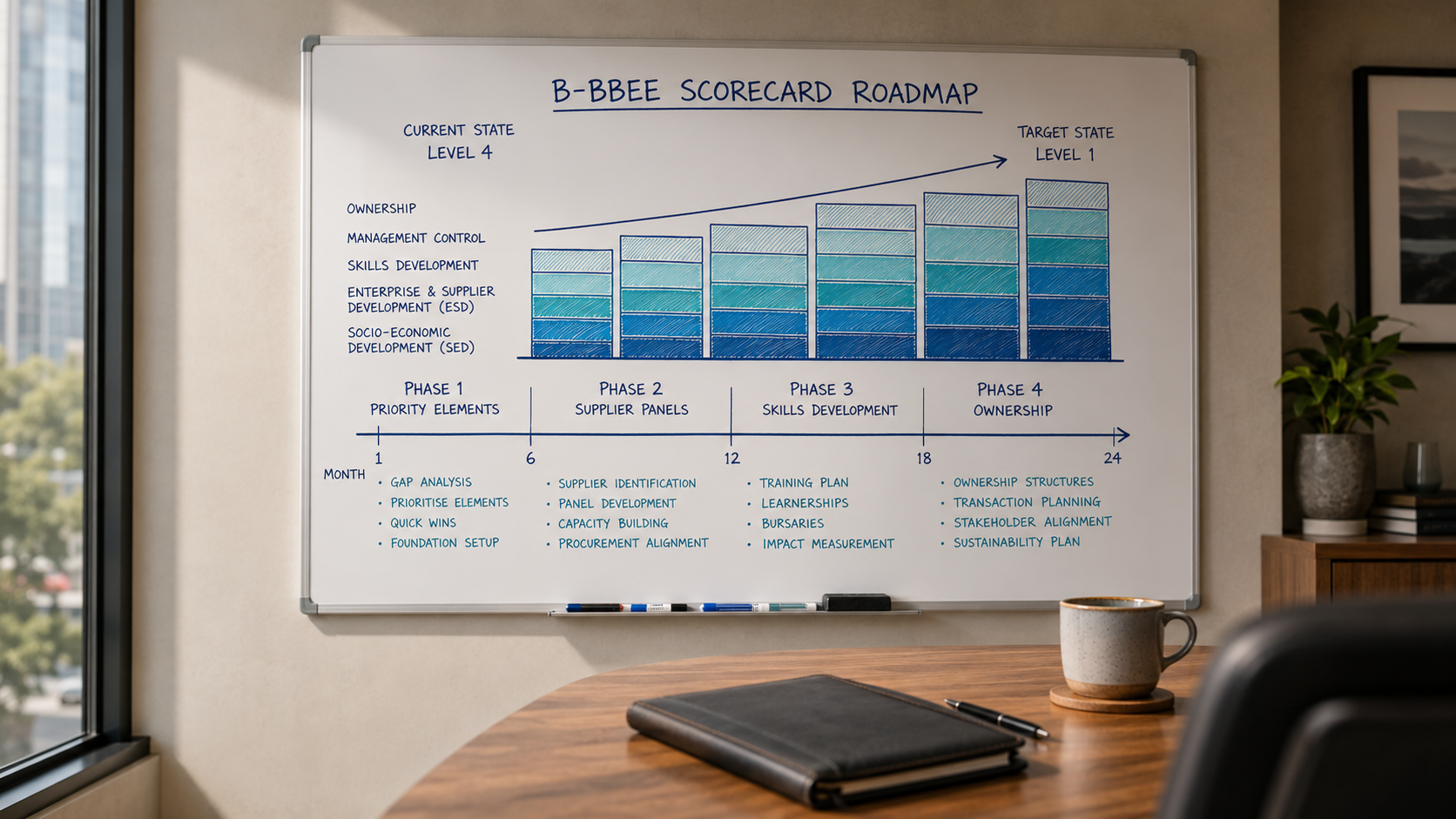
Moving from Level 4 to Level 1 isn’t a paperwork upgrade — it’s a 65-point scorecard climb that takes most corporates 18 to 24 months of structured work to deliver. The Codes of Good Practice award Level 4 at 75 points and Level 1 at 100+ points, with the climb concentrated in the three priority elements (Ownership, Skills Development, Enterprise and Supplier Development) where sub-minimum thresholds gate the upgrade entirely.
This guide explains the strategic roadmap that moves an R50m+ corporate scorecard from Level 4 to Level 1, where the points actually live, what the 18-24 month cycle should look like, and where most upgrade attempts stall. The broader scorecard improvement framework sits above this work — this post is the level-specific upgrade journey.
Quick Answer
Climbing from Level 4 to Level 1 involves four sequenced phases: priority element gap closure (months 1-6), supplier panel restructuring (months 4-12), Skills Development programme scaling (months 6-18), and Ownership transaction structuring where applicable (months 12-24). Most corporates that succeed have committed to the full 18-24 month runway. Most that fail attempted compression to 12 months — at which point the Ownership sub-minimum becomes mathematically unreachable without forced transactions that fail Codes substance testing.
Already at Level 4 and wondering whether the Level 1 climb is realistic for your entity? Request a level-upgrade feasibility assessment →
Where the 65-Point Climb Actually Lives
The gap between Level 4 and Level 1 isn’t evenly distributed across the five scorecard elements. The Codes of Good Practice (Generic Codes, 2013 amendments) allocate a maximum of 109 points across Ownership (25), Management Control (15), Skills Development (20), Enterprise and Supplier Development (40), and Socio-Economic Development (5), with a 5-point bonus available for new entrant equity ownership. Level 1 sits at 100+ points; Level 4 sits at 75-79 points.
A typical Level 4 scorecard breakdown looks roughly like this: Ownership 14 of 25, Management Control 8 of 15, Skills Development 11 of 20, ESD 24 of 40, SED 3 of 5, plus 5 bonus points where claimed.
Total: 65 points before bonus, 70 with bonus — borderline Level 4. The Level 1 version of the same corporate needs every element pulling closer to its ceiling, but the lift is concentrated heavily in ESD and Skills Development.
| Scorecard Element | Maximum Points | Typical Level 4 Score | Level 1 Target | Points to Recover |
|---|---|---|---|---|
| Ownership | 25 + 5 bonus | 14 | 21+ | 7 |
| Management Control | 15 | 8 | 11+ | 3 |
| Skills Development | 20 | 11 | 17+ | 6 |
| Enterprise & Supplier Development | 40 | 24 | 36+ | 12 |
| Socio-Economic Development | 5 | 3 | 5 | 2 |
The 30-point recovery doesn’t happen by pushing every element uniformly. It happens by treating ESD and Skills Development as the heavy lift (18 of the 30 points), Ownership as the structural unlock that gates the priority element sub-minimums, and Management Control plus SED as smaller catch-ups. The strategic question on every Level 4 to Level 1 climb is the same: where does the corporate already have momentum, and which element needs the most foundational rebuild?
Why Most Corporates Stall Before Reaching Level 1
The B-BBEE Commission’s latest National Status and Trends report shows that the majority of measured entities cluster between Level 4 and non-compliant status — and that overall transformation has stagnated rather than progressed across the most recent reporting cycles. The reason isn’t budget. It’s structural sequencing — corporates committing to surface-level interventions on every element simultaneously, instead of fixing the priority element sub-minimums first.
The 40% sub-minimum trap is the most common failure mode. If a corporate misses the 40% sub-minimum on any one of Ownership, Skills Development, or ESD, the entire scorecard drops one full level regardless of how strong the other elements are. A 95-point scorecard with a sub-minimum miss on Skills Development becomes a Level 2 outcome, not Level 1. Most corporates discover this only at verification — when the certificate arrives.
The runway-compression failure is the second mode. Corporates that commit 12 months to a Level 4 to Level 1 climb can move scorecards by 15 points, sometimes 20 — enough to reach Level 2, occasionally Level 3, almost never Level 1.
The 18-24 month runway exists for structural reasons: Ownership transactions need time to settle, Skills Development programmes need a full Leviable Amount cycle to count, and ESD partnerships need at least two reporting cycles to mature their beneficiary outcome documentation.
Takeaway
This climb fails most often at the sub-minimum gate, not at the points-total gate. A corporate scoring 105 raw points with a Skills Development sub-minimum miss certifies at Level 2, not Level 1. The first six months of any structured upgrade should focus exclusively on lifting the three priority elements above their sub-minimum thresholds — only then does the broader point-total work start to compound.
The 18-24 Month Roadmap Phases
A defensible Level 4 to Level 1 climb runs across four sequenced phases. Phase compression is possible where a corporate enters with one element already strong, but the sequencing logic doesn’t change.
Phase 1: Priority Element Gap Closure (Months 1-6)
The opening six months establish the sub-minimum compliance position on Ownership, Skills Development, and ESD. The work involves explicit modelling of where each priority element currently sits, where the 40% sub-minimum thresholds bite, and what remediation each element needs to clear the floor.
For Skills Development specifically, this is the phase where the SARS Leviable Amount calculation gets reconciled against current programme spend. Most Level 4 corporates discover their Skills Development spend is understated by 10-20% because the Leviable Amount baseline was never recalculated against current payroll. The recalculation alone often lifts the element to its sub-minimum without new programme investment.
Phase 2: Supplier Panel Restructuring (Months 4-12)
Phase 2 overlaps Phase 1 by two months because supplier panel work has its own runway. Restructuring a corporate’s supplier panel to lift Preferential Procurement scoring requires identifying current panel B-BBEE recognition values, sourcing higher-rated alternatives where available, and rebuilding the procurement evidence trail so that every supplier B-BBEE certificate is current at invoice date rather than financial year-end.
The economic argument that justifies this work is the recognition value multiplier. A Level 1 supplier delivering R1m of spend produces R1.35m of recognition value (135% recognition). A Level 4 supplier delivering the same R1m produces R1.0m recognition. Over a year of procurement, redirecting R20m of spend from Level 4 to Level 1 suppliers produces R7m of additional recognition value — directly into the corporate’s Preferential Procurement points.
Phase 3: Skills Development Programme Scaling (Months 6-18)
Phase 3 builds out the Skills Development element from sub-minimum compliance to the upper points range. The work moves beyond Leviable Amount recalculation into substantive programme investment — learnership uptake at the relevant SETA, bursary programmes for designated groups, internships aligned to scarce skills, and mentor-coach programmes for Black professional development.
This is the longest phase because Skills Development programmes need a full year of activity to count against the scorecard. A learnership initiated in Month 6 produces evidence at Month 12, gets scored at the next verification. The 12-18 month runway exists because the SETA reporting cycles and the verification evidence requirements both run on calendar disciplines that can’t be compressed.
Phase 4: Ownership Transaction Structuring (Months 12-24)
Phase 4 applies where the Ownership element gap is the binding constraint. For corporates where Ownership sits at 14 of 25 points (typical Level 4), moving to 21+ points typically requires structural action — broad-based ownership scheme implementation, employee share ownership programme (ESOP) introduction, or strategic equity placement with a Black-owned investment vehicle.
These transactions take 12 to 18 months from concept to verification-defensible implementation because the Codes substance tests interrogate the economic interest, voting rights, and modified net value of the transaction — paperwork structures that don’t produce real economic transfer fail at verification and trigger Section 13O Commission attention.
Need to model whether your specific Level 4 entity has a defensible Level 1 path? Speak to an Insignis level-upgrade strategist →
The Commercial Math That Justifies the Climb
The Level 4 to Level 1 climb is expensive — a typical full-service engagement runs R350,000 to R650,000 across the 18-24 month cycle, plus programme investment that varies by scorecard gap. The commercial argument has to justify that spend, and for most R50m+ corporates, it does — but only when the level shift is tied to specific revenue or tender outcomes.
The recognition value mathematics is the first commercial driver. A Level 1 corporate offers customers 135% recognition on B-BBEE-spend; a Level 4 corporate offers 100%. For a corporate selling R200m annually into B-BBEE-conscious customers, the difference is R70m of additional customer-side recognition value annually — value that translates directly into supplier panel positioning, tender competitiveness, and pricing power.
The tender pre-qualification effect is the second driver. Government and parastatal tenders increasingly use minimum B-BBEE level pre-qualification — Level 1 or 2 — to even enter the bid process. Corporates that hold Level 4 are locked out of these opportunities entirely. Moving from Level 4 to Level 1 unlocks the tender market for corporates whose customer mix includes meaningful government, parastatal, or B-BBEE-conscious private-sector exposure.
| Commercial Metric | Before (Level 4) | After (Level 1) |
|---|---|---|
| Customer-side B-BBEE recognition multiplier | 100% | 135% |
| Annual recognition value uplift on R200m B-BBEE-aware sales | — | R70m+ |
| Government tender pre-qualification eligibility (Level ≥2) | Excluded | Eligible across all tier-1 categories |
| Preferential Procurement bid points (80/20 system) | Mid-pack | Top of band — maximum preference |
| OEM supplier panel positioning (automotive, mining, financial services) | At-risk | Secured, multi-year preferential terms |
The economic case has to be made in the corporate’s own commercial context. A corporate selling primarily into B-BBEE-indifferent international customers won’t recover the upgrade investment as quickly as one selling into Transnet, Eskom, or major OEM supplier networks. The diagnostic phase explicitly tests this commercial logic before any major investment commits.
Takeaway
The commercial case for a Level 4 to Level 1 climb only works when the level shift is tied to specific customer-side outcomes that the corporate can name in advance. The recognition value uplift (100% to 135%) compounds annually on the existing B-BBEE-aware revenue base. The tender pre-qualification unlock opens markets that were closed at Level 4. If the corporate can’t quantify either effect in its own commercial context, the engagement economics don’t justify the spend — and the strategic answer is Level 2, not Level 1.
Who This Is NOT For
Why Level-Upgrade Work Sits at the Heart of the Insignis Practice
The level-upgrade engagement is the work Insignis Solutions was built for. Dr. Este Welman’s CA(SA), M.Comm in Taxation, and PhD-level credentials anchor a methodology that treats Level 4 to Level 1 work as a multi-year compounding programme rather than an annual scorecard exercise.
The Insignis approach explicitly tests the commercial case before committing to the engagement. The diagnostic phase models the level-shift revenue impact against the engagement and programme investment, so the corporate is signing on for a quantified business case rather than a generic compliance hope. Engagement letters specify the customer-side recognition value uplift expected at Level 1, not just the certificate outcome.
For the broader engagement model on compliance strategy work, see our B-BBEE compliance strategy development service page. Multi-year level-upgrade engagements are scoped against the 18-24 month runway with phase-by-phase deliverables and quarterly checkpoint reviews.
What a Completed Level 4 to Level 1 Engagement Delivers
A Johannesburg-headquartered mid-market industrial supplier engaged Insignis after holding Level 4 for three consecutive verification cycles despite annual transformation activity spend of R8m. Diagnostic work identified that the Ownership element was sitting at 13 of 25 points (no broad-based scheme), that Skills Development was understating Leviable Amount by R3.2m due to a 2019 baseline that hadn’t been updated, and that the supplier panel was clustered around Level 4 suppliers rather than higher-rated alternatives.
Twenty-two months later, after a sequenced Phase 1-4 engagement, the corporate held Level 1 — and the customer-side recognition value uplift had unlocked supplier panel preference at three major B-BBEE-conscious customers.
| Scorecard Metric | Before Engagement | After 22 Months |
|---|---|---|
| Certificate level | Level 4 (75 points) | Level 1 (104 points) |
| Ownership points | 13 of 25 | 22 of 25 |
| Skills Development points | 10 of 20 | 18 of 20 |
| Enterprise and Supplier Development points | 23 of 40 | 37 of 40 |
| Customer-side recognition multiplier | 100% | 135% |
| Major customer supplier panel positions secured/retained | — | 3 new mandates, R45m+ revenue uplift |
The Ownership lift came from a broad-based employee share ownership programme implemented in Phase 4. The Skills Development lift came largely from Leviable Amount recalculation and a substantive learnership uptake. The ESD lift came from supplier panel restructuring across Phases 2-3. None of the work was a single intervention — the Level 4 to Level 1 outcome required all four phases sequenced correctly.
Four Questions Before Committing to the Climb
Four questions separate corporates that successfully complete this climb from those that stall mid-cycle. Apply all four before signing any engagement letter.
Quantify the commercial unlock. Can you name three customers, tender categories, or supplier panels where moving to Level 1 produces specific revenue or pricing outcomes? If not, the engagement economics may not work — the level upgrade is decorative without a tied commercial outcome.
Confirm Ownership runway. Does your shareholder base support a broad-based ownership transaction within 18-24 months, or is the Ownership element capped by structural constraints? If Ownership can’t move materially, the Level 1 outcome may not be reachable regardless of how the other elements perform — and the strategy work should target Level 2 instead.
Test internal commitment. Does your executive committee understand that the 18-24 month runway requires sustained programme investment across multiple budget cycles? Level 4 to Level 1 work that loses budget commitment at the 12-month mark almost always reverts — typically settling at Level 2 or Level 3 rather than completing the climb.
Verify methodology depth. Does the consultant engagement scope explicitly address the sub-minimum trap, the Leviable Amount recalculation, and the modified net value test on Ownership transactions? Engagement scopes that skip these specifics are working from generic frameworks rather than the verification reality.
Want to run these four questions against your specific entity profile? Book a strategic upgrade scoping conversation →
Frequently Asked Questions on Moving from Level 4 to Level 1
How long does a Level 4 to Level 1 upgrade actually take?
For most R50m+ corporates, the realistic runway is 18-24 months from diagnostic kick-off to Level 1 verification. Shorter timelines (12 months) typically achieve Level 2 or Level 3 outcomes, then require a second 12-month cycle to complete the climb. The 18-24 month runway accommodates the Ownership transaction window, the Skills Development programme cycle, and the supplier panel restructuring needed to lift ESD scoring.
How much does the engagement cost?
Insignis full-service Level 4 to Level 1 engagements typically run R350,000 to R650,000 across the 18-24 month cycle, plus the programme investment required to lift each element (Skills Development spend at SARS Leviable Amount targets, ESD partnership investment, SED contributions, Ownership transaction structuring costs). The engagement fee is the smaller component — programme investment is where the substantive scorecard movement comes from.
Which element is hardest to move?
Ownership, typically. Skills Development and ESD respond to programme spend and supplier panel discipline within 12-18 months. Ownership requires structural shareholder action — broad-based schemes, ESOPs, or strategic equity placements — which carries legal, tax, and corporate governance complexity that the other elements don’t. Corporates whose existing shareholder structure resists broad-based transactions sometimes can’t reach Level 1 at all and target Level 2 as the achievable outcome.
Can a Level 4 corporate reach Level 1 in a single verification cycle?
Almost never. A single verification cycle (12 months) supports a 15-20 point lift in the best cases. The Level 4 to Level 1 gap is 30+ points after accounting for the sub-minimum traps. The expected single-cycle outcome is Level 2 or Level 3, with the second cycle completing the climb to Level 1. Planning for a single-cycle Level 1 outcome typically produces disappointment at verification.
Do the 2026 Codes amendments change the level-upgrade economics?
Yes, particularly on the Ownership and ESD elements. The amended Ownership scoring tightens the modified net value test, which raises the bar on what transactions count toward the points. The amended ESD scoring shifts weight toward 100% Black-owned and Black women-owned suppliers, which restructures the supplier panel work.
Corporates currently scoping a Level 4 to Level 1 climb should model both the current Codes and the amended Codes scoring before committing — the right strategy depends on which framework is in force at the target verification date.
What happens if we miss Level 1 by 2-3 points?
You certify at Level 2 (90-94 points) or Level 3 (85-89 points). The good news is that Level 2 already unlocks most of the commercial value Level 1 offers — the customer-side recognition multiplier moves to 125%, and Level 2 already meets the pre-qualification threshold for most government tenders. The remaining climb to Level 1 in a subsequent cycle is incremental and lower-cost than the original Level 4 to Level 2 work.
Map Your Specific Level 4 to Level 1 Path
Most level-upgrade conversations stall at the question of whether the climb is realistic for the specific entity in question. We address that question explicitly in the diagnostic phase — modelling the current scorecard position, the sub-minimum gap, the Ownership transaction options, and the customer-side commercial unlock before scoping the engagement.
Request a Level 4 to Level 1 Feasibility Diagnostic
Get a free initial scoping conversation with Dr. Este Welman, CA(SA), and the Insignis team. We map your current scorecard against the Level 1 target, model the realistic runway and investment requirement, and quote a phase-priced engagement aligned to your verification cycle and commercial unlock points.
No obligation. We will get back to you within 24 hours.
Request Your Feasibility Diagnostic
About the Author
Dr. Este Welman, CA(SA) — Founding Director, Insignis Solutions
A Chartered Accountant (SA) with a PhD in Economic Transformation from the Da Vinci Institute, Dr. Welman holds an M.Comm in Taxation, a B-BBEE Management Diploma from Wits, and is a registered SAICA member.
Her work on multi-year level-upgrade engagements has shaped the Insignis methodology for sequenced Phase 1-4 transformation programmes — particularly for corporates whose Ownership element requires structural shareholder action alongside the operational scorecard work.