
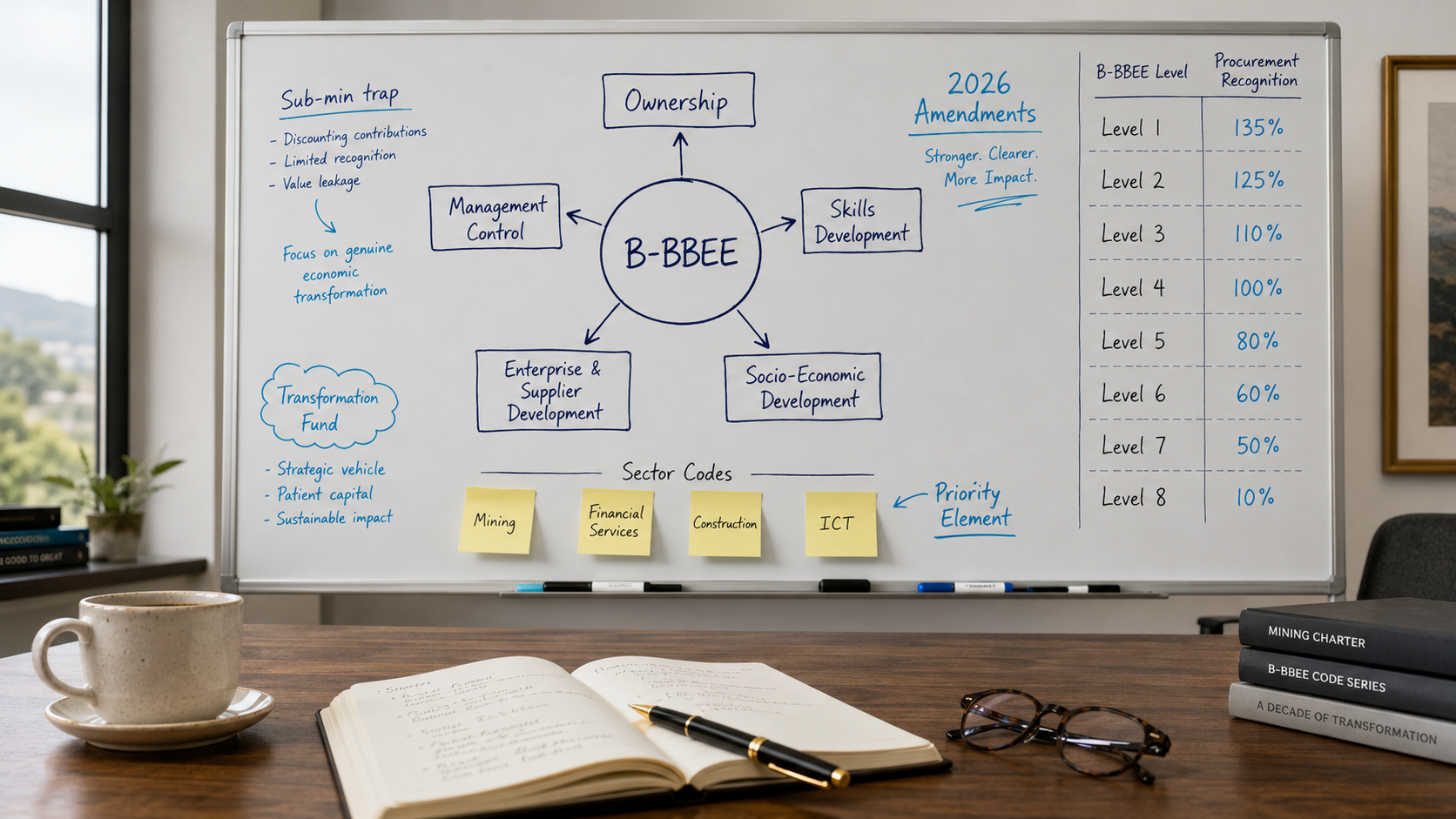
B-BBEE in South Africa shapes how every R50m+ corporate competes for tenders, joins listed supply chains, and meets its annual reporting obligations. Get the level right and a procurement multiplier works in your favour every time a customer buys from you. Get it wrong, and the cost shows up as lost contracts and supplier panel exclusions you’ll never see itemised.
This guide is the corporate-level orientation to the framework — what the levels mean, how the scorecard adds up, when sector codes override the Generic Codes, what the January 2026 amendments propose, and where the strategic leverage actually sits. Each section links out to a dedicated deep-dive where the detail lives.
Quick Answer
B-BBEE South Africa is governed by the Broad-Based Black Economic Empowerment Act 53 of 2003 (as amended) and measured through the Generic Codes of Good Practice or one of ten gazetted sector codes. Businesses are rated from Level 1 (highest, 100+ points) down to Level 8 and Non-Compliant. The level determines the procurement recognition multiplier customers receive when buying from the business — a Level 1 supplier delivers 135% recognition, a Non-Compliant supplier delivers zero.
Wondering where your business actually sits in the framework? Book a free 30-minute B-BBEE position review →
What B-BBEE in South Africa Actually Does
Broad-Based Black Economic Empowerment was published as a strategy in 2003 and codified through Act 53 of 2003, then amended by Act 46 of 2013. The framework emerged from a recognition that the original ownership-only BEE had produced a narrow Black elite without delivering broader economic participation. The “broad-based” label captures the intent to measure transformation across five elements rather than ownership alone.
The B-BBEE Commission, a statutory body under the dtic, administers the framework day to day. They monitor compliance, investigate fronting, and maintain the registry of major B-BBEE transactions. The Commission has tightened materially since 2016 — JSE-listed entities and state organs now face mandatory annual reporting obligations that simply didn’t exist a decade ago.
For corporates, the practical effect is straightforward. A B-BBEE level rating determines tender eligibility, supplier panel access, and the procurement recognition that customers receive when they buy from the business. Treating the framework as paperwork rather than strategy is how Level 2-eligible corporates end up with Level 4 certificates.
Who the Framework Applies To
Every business operating in South Africa is technically in scope, but the intensity scales with annual turnover. Three tiers:
Exempted Micro Enterprises (EME) — turnover below R10 million — qualify for automatic Level 4 via a sworn affidavit. No verification, no scorecard calculation, no consultant fees. For most genuine micro-businesses, that’s the end of the story.
Qualifying Small Enterprises (QSE) — turnover between R10 million and R50 million — face a simplified scorecard. Those that are 51%+ Black-owned also qualify for affidavit recognition. Everyone else needs SANAS-accredited verification, but on a lighter scorecard than the Generic enterprises face.
Generic enterprises — turnover above R50 million — face the full Codes (or the relevant sector code) with mandatory annual verification. This is where the corporate work sits, and this is the audience this guide addresses.
Takeaway
The framework’s commercial weight rises sharply at each turnover tier. EMEs walk away with an affidavit. QSEs deal with a simplified scorecard. Above R50m, the full Generic Codes apply with mandatory SANAS-accredited verification — and at that point B-BBEE strategy becomes a board-level concern, not an HR or compliance task.
The Eight Levels and What They’re Worth
Everything in B-BBEE distils to a single number at the end: the level. It runs from Level 1 down through Level 8, with Non-Compliant below that for businesses scoring under 40 points.
What the level converts to is the procurement recognition multiplier. When another B-BBEE-rated entity buys from the business, this multiplier determines how those purchases count on the buyer’s own scorecard. The mechanics matter because the multiplier is why procurement managers actively prefer Level 1 and Level 2 suppliers — every R1 spent with a Level 1 supplier counts as R1.35 toward the buyer’s Preferential Procurement element.
| B-BBEE Level | Points Required (Generic) | Procurement Recognition |
|---|---|---|
| Level 1 | ≥ 100 points | 135% |
| Level 2 | ≥ 95 points | 125% |
| Level 3 | ≥ 90 points | 110% |
| Level 4 | ≥ 80 points | 100% |
| Level 5 | ≥ 75 points | 80% |
| Level 6 | ≥ 70 points | 60% |
| Level 7 | ≥ 55 points | 50% |
| Level 8 | ≥ 40 points | 10% |
| Non-Compliant | < 40 points | 0% |
Notice the step-change between Level 4 and Level 5: from 100% recognition down to 80%. That single drop is why so many corporates fight to defend Level 4 status — falling to Level 5 means their customers lose 20 cents in scorecard value for every Rand of business they do together. For a supplier with R50m of B-BBEE-conscious revenue, that’s a R10m drop in scorecard value flowing to customers, and customers notice.
For the full mechanics — how QSE level thresholds differ from Generic, how sub-minimum failures cause level discounting, how level upgrades cascade into bonus point eligibility — see our complete B-BBEE levels guide.
The Five Elements That Build the B-BBEE South Africa Scorecard
Under the Generic Codes, the scorecard sums five measurement elements to a total of 100+ points (bonuses can push it to ~109). The weighting tells you where the regulator wants behaviour to change.
| Element | Points | What It Measures |
|---|---|---|
| Ownership | 25 | Black voting rights, economic interest, net value, new entrants |
| Management Control | 15 | Board, executive, senior, middle and junior management demographics |
| Skills Development | 20 | Training spend as % of payroll, learnerships, bursaries, disabilities |
| Enterprise & Supplier Development | 40 | Preferential procurement, supplier development, enterprise development |
| Socio-Economic Development | 5 | Contribution to Black beneficiary communities (1 percent of NPAT) |
Three of these elements carry an extra rule that catches more corporates than it should: they are priority elements. Ownership, Skills Development, and Enterprise & Supplier Development each have a sub-minimum threshold — broadly, 40% of the points available within the element. Miss the sub-minimum on any one priority element and the scorecard is discounted by one full level regardless of total points scored.
The trap is that a business can score 95 points overall (Level 2 territory) yet end up with a Level 3 certificate because it fell short on the Ownership sub-minimum. The points were there. The level wasn’t. We see this happen at verification more often than any other single failure mode.
Worried you might be sitting on a hidden sub-minimum gap? Get a B-BBEE scorecard gap analysis from the Insignis team →
For each element broken down to the indicator level — including weighting points, target percentages, bonus opportunities, and the specific evidence verification agencies look for — see our 5 scorecard elements guide.
When Sector Codes Override the Generic Codes
The Generic Codes are the default framework for B-BBEE South Africa. They get overridden when a business’s dominant activity falls within one of the ten gazetted sector codes: mining, financial services, construction, ICT, agriculture, tourism, property, forestry, integrated transport, or marketing and advertising.
Each sector code carries industry-specific weightings, additional elements, and reporting obligations. The Financial Sector Code adds Access to Financial Services and Empowerment Financing — together 27 points — that simply don’t exist in the Generic Codes. The Mining Charter ties B-BBEE compliance directly to mineral rights eligibility under the MPRDA, an existential consequence that no Generic Codes corporate ever faces.
Which framework applies isn’t a strategic choice. The dominant activity test is determinative: if more than half of revenue comes from activities within a gazetted sector code’s scope, that sector code applies. Trying to elect Generic Codes measurement when a sector code applies leads to scorecard rejection at verification.
The full sector-by-sector breakdown, plus the dual-track planning that 2026 sector code corporates need, lives in our B-BBEE sector codes guide.
How Verification and Certification Work
A B-BBEE certificate is the output of a verification process conducted by a SANAS-accredited verification agency. Generic enterprises must verify annually, and the certificate is valid for 12 months from the issue date. QSE and EME entities below the verification threshold use sworn affidavits instead.
Verification is a documentary audit, not a strategy review. The agency tests whether every scorecard claim can be substantiated by evidence: shareholder registers and share certificates for Ownership, SETA submissions and learnership contracts for Skills Development, supplier B-BBEE certificates and aligned procurement spend records for Preferential Procurement. If the evidence isn’t there, the points aren’t claimed.
Most corporates underestimate how long verification takes. Four to eight weeks from agency appointment to certificate issue is normal if the evidence is well-organised. If it isn’t, the process stretches to three months and often produces a certificate at a lower level than expected — not because the business didn’t earn the points but because the documentation couldn’t carry them.
Takeaway
The strategy work that determines what gets claimed has to happen before verification starts. Treating verification day as the moment of B-BBEE thinking is how Level 2-eligible corporates end up with Level 4 certificates.
For agency selection, document preparation, desk versus on-site verification, and how to handle a disputed scorecard outcome, see our complete B-BBEE certificate guide.
The 2026 Gazette 54032 Amendments
On 29 January 2026, dtic Minister Parks Tau gazetted Government Gazette 54032, opening a 60-day public comment window on substantial amendments to the Generic Codes. Comment closed on 30 March 2026. The amendments are still draft at the time of writing.
The headline proposal is the Transformation Fund — a Special Purpose Vehicle into which measured entities could contribute 3% of net profit after tax annually, in exchange for up to 20 scorecard points. The position is “alternative to” rather than “replacement of” the existing ESD element. The dtic estimates the fund could mobilise around R20 billion a year over five years, capitalised mainly through redirected ESD spend.
The amendments also propose shifting Preferential Procurement weightings toward 100% Black-owned and 100% Black women-owned suppliers, tightening ESD beneficiary outcome measurement, and revising the Equity Equivalent Investment Programme rules for multinationals operating in South Africa.
One thing the amendments do not do: change sector codes. The amendments apply only to the Generic Codes. Sector codes will continue under their existing frameworks until each is specifically amended to align — a process expected to take 18 to 24 months. Sector code corporates plan dual-track in the meantime.
Who This Is NOT For
What Strategic B-BBEE South Africa Work Looks Like in Practice
The clearest way to show the difference between compliance-driven and strategy-driven B-BBEE work is in the numbers. The table below is drawn from a typical Insignis engagement for a mid-market Generic Codes corporate over a 12-month strategy build.
| Metric | Engagement Start (Before) | 12 Months Later (After) |
|---|---|---|
| B-BBEE Level | Level 5 | Level 2 |
| Total scorecard points | 72 points | 96 points |
| Procurement recognition for clients | 80% | 125% |
| Skills Development spend | R1.2m unaligned | R1.4m fully claimed |
| ESD investment recovered as points | 40% of spend | 92% of spend |
| Annual B-BBEE programme cost | R580,000 | R385,000 |
The cost line is the counter-intuitive one. Strategic engagement on the framework reduces overall programme cost. The savings come from eliminating wasted spend: Skills Development training paid for but not aligned to scorecard recognition, ESD support paid for but with paperwork too thin to claim, SED contributions to causes that don’t meet the Black beneficiary definition. Realignment unlocks the points already implicit in existing spend.
How to Improve a B-BBEE Scorecard
Most corporates wanting to upgrade their level imagine the path runs through new spend. Almost always, that’s the third or fourth move, not the first. The sequence that actually works:
Start by auditing existing spend. Most R50m+ corporates already spend on Skills Development, supplier development, and community contributions but capture only 40–60% of the available scorecard points because the spend isn’t aligned to recognition criteria. A diagnostic phase typically surfaces 10–15 points of recoverable score before any new investment is committed. This is the cheapest level upgrade most businesses ever buy.
Close the priority element gaps. Sub-minimum failures cause level discounts regardless of total points. Identifying and closing gaps on Ownership, Skills Development, and Enterprise & Supplier Development sub-minimums protects the level the points alone deserve. This is where strategy translates directly into level outcomes.
Build for the long term. A level that depends on a one-off spend can’t survive the next certificate cycle. The structural moves — properly designed Ownership transactions, multi-year ESD partnerships, embedded Skills Development programmes — produce levels that hold across cycles rather than collapsing at the next verification.
Plan for the 2026 amendments. Corporates with planning horizons longer than 24 months should model the Generic Codes amendment scenario and prefer transformation investments that earn points under both the current and proposed frameworks.
For the full step-by-step methodology — including the Level 4 to Level 1 roadmap and the five reasons most scorecards don’t improve — see our B-BBEE scorecard improvement guide.
Why Insignis Approaches B-BBEE South Africa Differently
The Operator POV on Economic Transformation
Dr. Este Welman’s doctoral research at the Da Vinci Institute focused on something a lot of B-BBEE consulting work avoids: the gap between ownership change and genuine economic transformation. Her thesis argued for an economic model aligned to the spirit of the Codes — asking whether ownership transactions actually deliver economic uplift to Black participants, not just trigger scorecard points.
That academic depth combines with her CA(SA) credential and M.Comm in International and National Taxation. Insignis clients get scorecard strategy plus the financial-mechanism expertise to design ownership transactions, ESD structures, and SED commitments that earn points and deliver real transformation in equal measure.
Our team works with R50m+ corporates and JSE-listed clients across mining, financial services, construction, ICT, and the broader corporate sector from our Centurion office. To see whether our approach fits your business, visit our B-BBEE consulting service page.
The 2026 B-BBEE South Africa Compliance Calendar
B-BBEE compliance runs on an annual cycle. Every Generic enterprise needs a fresh certificate every 12 months, and most corporates anchor the measurement period to financial year-end, which means the verification work concentrates in the months immediately after.
For a 31 December year-end, the typical rhythm runs January to March collecting and organising scorecard evidence, March to May running the verification engagement, and May onwards operating with the new certificate. The single biggest determinant of scorecard outcome is whether the strategy work happens in January-February or whether it gets squeezed into March in scramble mode.
JSE-listed entities carry an additional annual obligation: the B-BBEE Compliance Report. It must be submitted to the B-BBEE Commission within 30 days of annual financial statement approval, or 90 days of financial year-end (whichever is earlier). The report goes onto the company website and a SENS announcement confirms publication. The B-BBEE Commission’s current guidance on who must submit is published on their official site.
Misconceptions About B-BBEE South Africa Worth Clearing Up
“B-BBEE is voluntary”
Technically yes — in narrow legal terms, no business is compelled to seek recognition. Commercially the description is wrong. Any business selling to government, JSE-listed companies, or large private corporates with their own B-BBEE targets is functionally compelled to maintain a level. The voluntary framing only applies in markets entirely outside that network, which for most R50m+ corporates is no market worth being in.
“A consultant can guarantee a level”
No reputable consultant does. The verification agency is independent and SANAS-accredited, and its findings depend on documentary evidence. A consultant can model the expected level from the data and prepare the engagement to maximise it. A guarantee from a consultant is a warning sign, not a credential.
“BEE and B-BBEE are different things”
BEE was the original 1990s framework, narrowly focused on ownership transfer. B-BBEE replaced it in 2003 to broaden measurement across five elements. The terms get used interchangeably in conversation, but the formal framework is B-BBEE. Stick to B-BBEE in formal corporate communications.
“Foreign-owned businesses are exempt”
They aren’t. Multinationals operating in South Africa face the same framework as locally-owned businesses, but with a specific mechanism for cases where global ownership structures prevent traditional Black ownership transactions: the Equity Equivalent Investment Programme. The EEIP allows alternative contributions equivalent to the value of an ownership transaction, recognised on the scorecard with dtic approval.
Frequently Asked Questions on B-BBEE South Africa
What does the B-BBEE framework actually do?
The framework measures, certifies, and incentivises economic transformation across the South African economy. Administered by the B-BBEE Commission under the dtic, it applies to every business in the country with intensity scaling by turnover tier. A B-BBEE level rating determines preferential procurement recognition, tender eligibility, and supplier panel access. It’s governed by the Broad-Based Black Economic Empowerment Act 53 of 2003 (as amended) and implemented through the Codes of Good Practice.
What are the B-BBEE levels and what do they mean?
Level ratings run from Level 1 (the highest, requiring 100+ scorecard points) down to Level 8 (40-54 points), with a Non-Compliant designation below 40 points. The level converts to a procurement recognition multiplier applied when another B-BBEE-rated entity buys from the business — Level 1 carries 135% recognition, Level 4 carries 100%, Non-Compliant carries zero. That multiplier is what drives supplier selection in any B-BBEE-conscious procurement decision.
Do the January 2026 amendments change everything immediately?
No. The Gazette 54032 amendments published on 29 January 2026 are still draft proposals subject to public comment that closed on 30 March 2026. They only take effect once finalised and gazetted for implementation. Even then, they apply only to the Generic Codes — the ten gazetted sector codes will continue under their existing frameworks until each is specifically amended to align, a process expected to take 18 to 24 months.
How long does B-BBEE verification take?
For a Generic enterprise with well-organised evidence, four to eight weeks from agency appointment to certificate issue is normal. Where evidence is incomplete or claims can’t readily be substantiated, the process stretches to three months. The certificate is valid for 12 months from issue and must be renewed annually.
Is B-BBEE legally compulsory?
Recognition isn’t technically compulsory for every entity. A business that doesn’t sell to government, listed companies, or B-BBEE-conscious corporates can operate without seeking certification. JSE-listed entities and state organs do face mandatory annual compliance reporting to the B-BBEE Commission. For any business with B2B or B2G revenue streams in the formal South African economy, compliance is commercially essential even where not legally mandated.
What is fronting and how is it penalised?
Fronting is the deliberate misrepresentation of B-BBEE status, typically through appointing Black individuals as nominal directors, owners, or managers without genuine economic or decision-making participation. It’s a criminal offence under the B-BBEE Act, punishable by fines of up to 10% of annual turnover, imprisonment of up to 10 years, blacklisting from state contracts, and cancellation of existing B-BBEE certificates. The Commission actively investigates and prosecutes.
Ready to Strengthen Your Position?
A 30-minute review tells you whether your current scorecard is mathematically defensible at the level your investment should support — and where the recoverable points sit if it isn’t. No multi-year commitment required.
For a 2026 strategy review tied to your specific tier, sector, and current scorecard position — book a free corporate B-BBEE review →
Get a Free B-BBEE Strategy Review
Get a free initial review from Dr. Este Welman, CA(SA), and the Insignis team. We work with R50m+ corporates and JSE-listed clients across every B-BBEE element and sector code from our Centurion office, with national delivery across South Africa.
No obligation. We will get back to you within 24 hours.
Book Your Free Review
About the Author
Dr. Este Welman, CA(SA) — Founding Director, Insignis Solutions
A Chartered Accountant (SA) with a PhD in Economic Transformation from the Da Vinci Institute, Dr. Welman’s doctoral research focused on the gap between ownership change and genuine economic transformation. She holds an M.Comm in Taxation, a B-BBEE Management Diploma from Wits, and is a registered SAICA member.
At Insignis, she leads strategic B-BBEE engagements for corporate and JSE-listed clients across mining, financial services, construction, and ICT.