
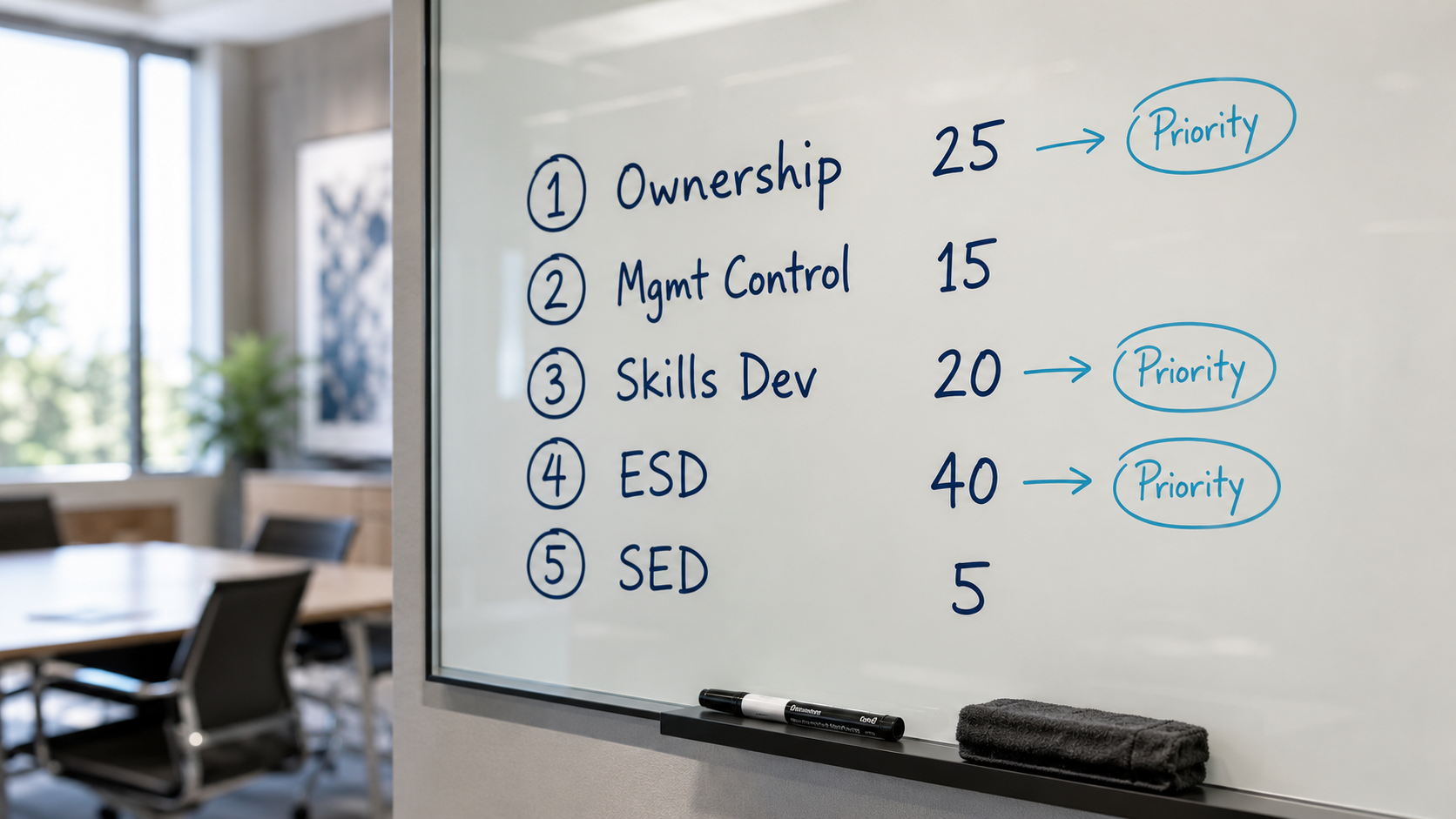
Every B-BBEE scorecard in South Africa is built from five elements: Ownership, Management Control, Skills Development, Enterprise & Supplier Development, and Socio-Economic Development. Together they total 105 points before bonuses — and three of them carry sub-minimum thresholds that, if missed, downgrade the entire certificate level regardless of what’s earned elsewhere. The wider B-BBEE framework rests entirely on how these five elements compose into a certificate.
This guide explains each element in commercial terms — what it tests, what points it carries, where the sub-minimum traps sit, and which two elements offer the highest commercial leverage for R50m+ corporates targeting Level 2 or Level 1.
Quick Answer
The five B-BBEE scorecard elements South Africa uses to measure transformation are Ownership (25 points, priority element), Management Control (15 points), Skills Development (20 points, priority element), Enterprise & Supplier Development (40 points, priority element), and Socio-Economic Development (5 points). Total available is 105 points before bonuses. Three of these — Ownership, Skills Development, and Enterprise & Supplier Development — carry sub-minimum thresholds. Missing any sub-minimum discounts the certificate by one level even if total points exceed the next-level threshold.
Want to know which elements are dragging your level down? Book an element-by-element diagnostic →
The B-BBEE Scorecard Elements South Africa Recognises at a Glance
The Generic Codes of Good Practice — applicable to corporates with turnover above R50 million — measure performance across five distinct elements. Each carries a points weighting that reflects how government and the codes drafters prioritised the underlying transformation outcome. Heavier-weighted elements aren’t necessarily more important commercially, but they are where the largest scorecard movements happen.
| Element | Points | Priority Status |
|---|---|---|
| Ownership | 25 points | Priority element — sub-minimum applies |
| Management Control | 15 points | Standard element |
| Skills Development | 20 points | Priority element — sub-minimum applies |
| Enterprise & Supplier Development | 40 points | Priority element — sub-minimum applies |
| Socio-Economic Development | 5 points | Standard element |
Two patterns matter immediately. Enterprise & Supplier Development carries 40 points — nearly 40% of the total scorecard — which is why ESD work dominates the time and budget allocations on most strategic engagements. And three of the five elements carry priority status, meaning a sub-minimum miss on any one of them triggers an automatic one-level downgrade regardless of total points achieved.
Ownership — 25 Points, Priority Element
Ownership tests the percentage of the measured entity held by Black participants, weighted by economic interest and voting rights. The core indicators are Voting Rights, Economic Interest, Net Value, and New Entrants — each with its own point allocation inside the 25-point envelope.
The sub-minimum trap on Ownership is on the Net Value sub-indicator. Even where Voting Rights and Economic Interest hit their thresholds, Net Value can sit below the sub-minimum because the calculation tests realised economic value to the Black participants — not the nominal share percentage on the share register.
The most expensive mistake at this element isn’t structural. It’s the assumption that 51% Black ownership on paper translates automatically to 51% scorecard recognition. The calculation tests substance — whether the Black participants actually receive economic benefit from the holding — and a transaction that fails the Net Value test produces zero ownership points even where 51% nominally sits with Black shareholders.
This is where the depth of the consultant matters most. A CA-qualified advisor with M.Comm Tax credentials approaches the Net Value calculation with the same testing discipline a verification agency will apply — Time Graduation Factor correctly modelled, deemed-vested portions tracked, debt-financed acquisition structures stress-tested against the realised economic value the calculation actually measures. The methodology questions here run deeper than most consultants engage with.
Management Control — 15 Points, Standard Element
Management Control tests the racial and gender diversity of the entity’s leadership: board, executive directors, senior management, middle management, and junior management. Points flow to entities whose leadership composition reflects the demographic targets laid down in the Codes.
This element has no sub-minimum, but it carries a uniquely difficult mathematical structure. Each management tier — board through to junior — has its own target percentages, and underperformance at one tier can’t be compensated by overperformance at another. A corporate with strong board diversity but a poorly diverse junior management layer leaves Management Control points on the table regardless of executive optics.
The link to Employment Equity is unavoidable here. The Employment Equity Act and its Department of Employment and Labour reporting requirements run on a parallel track to the Management Control element, and corporates that align the two reporting cycles spend less on duplicated effort. Misalignment between EE plans and Management Control element targets is the single most common point leak we see on first-engagement diagnostics.
Takeaway
Management Control rewards consistent diversity across all leadership tiers, not just the visible top. A board with strong demographic diversity but a senior management layer that hasn’t matched the trajectory produces a weaker score than the optics suggest. Score the element accurately by testing each tier independently before assuming the headline number reflects the certificate.
Skills Development — 20 Points, Priority Element
Skills Development tests training spend on Black employees as a percentage of the entity’s Leviable Amount under the Skills Development Levies Act. The element carries 20 scorecard points and an 8-point sub-minimum threshold — corporates scoring 7 points or fewer trigger the priority element downgrade regardless of total scorecard performance.
The Leviable Amount calculation is administered by SARS through the monthly EMP201 declaration. Under the SARS Skills Development Levy framework, the Leviable Amount is the total remuneration payable to employees as defined by the Fourth Schedule to the Income Tax Act. This is the figure the B-BBEE calculation uses as its denominator — not the management accounts payroll line, not the consolidated group payroll, but the specific SDL-reportable figure that lands with SARS each month.
The implication: any deviation between management accounts and SARS-reported Leviable Amount produces a methodology dispute at verification. Verification agencies test the Skills Development claim against the EMP201 trail, not management estimates. Corporates whose finance and HR teams don’t reconcile these figures monthly often discover the gap at verification — and the gap always reduces Skills Development points, never increases them.
Beyond the calculation mechanics, Skills Development is the element where bonus points are most accessible. Training for people with disabilities carries triple recognition. Bursary spend for Black students at accredited institutions carries scorecard weight beyond the core training register. Corporates already running Skills Development programmes can often capture 2-3 bonus points at marginal cost by adding a disability stream or a bursary partnership.
Skills Development sub-minimum at risk this cycle? Run a Leviable Amount reconciliation →
Enterprise & Supplier Development — 40 Points, Priority Element
ESD carries the heaviest weighting on the scorecard — 40 points across three sub-indicators: Preferential Procurement (25 points), Supplier Development (10 points), and Enterprise Development (5 points). All three sit under the same sub-minimum threshold, and the priority element rule applies if the combined ESD threshold isn’t met.
Preferential Procurement is calculated against total measured procurement spend, with recognition multipliers flowing from the B-BBEE levels of suppliers. A supplier panel weighted toward Level 1 and Level 2 suppliers generates significantly stronger PP points than one weighted toward Level 4 — even at identical Rand spend levels. This is why supplier panel composition matters as a Board-level strategic question, not just a procurement operations question.
Supplier Development tests financial contributions and non-financial support extended to qualifying Black-owned EME and QSE suppliers. The measurement focuses on outcome — did the supplier grow, become more sustainable, gain access to new markets — rather than just spend.
Enterprise Development is structurally similar to Supplier Development but applies to entities that aren’t already in the corporate’s supply chain. Contributions can be financial (grants, loans) or non-financial (training, mentorship, market access support).
The 2026 Gazette 54032 amendments tighten the outcome-based measurement across all three ESD sub-indicators. Transaction-based ESD spend will produce fewer points than partnership-based ESD spend under the amended Codes. Corporates whose ESD strategy is currently optimised for the input-based recognition under the existing Codes will need to restructure for the outcome-based recognition that the amendments introduce.
Socio-Economic Development — 5 Points, Standard Element
SED carries the smallest weighting on the scorecard but is structurally the simplest element to score. The target is 1% of Net Profit After Tax invested in Socio-Economic Development contributions to qualifying Black beneficiaries, defined broadly to include both individual recipients (bursaries, training, healthcare) and organisational recipients (NGOs, foundations, community programmes).
Corporates often score full SED points by aligning existing corporate social investment spend with the qualifying beneficiary criteria — there’s typically no need to expand the budget, just to verify that recipients meet the Black beneficiary threshold and that documentation supports each contribution.
The element doesn’t carry a sub-minimum, so the priority element downgrade rule doesn’t apply. Missing SED entirely costs 5 points off the total scorecard but doesn’t trigger an automatic level downgrade. The strategic implication: SED is the cheapest 5 points on the scorecard for most corporates, which is why scoring zero on it is almost always a documentation failure rather than a substantive failure.
How B-BBEE Scorecard Elements South Africa Penalises Sub-Minimum Misses
The most expensive scorecard outcome isn’t a points shortfall — it’s a sub-minimum miss on one of the three priority elements. A corporate scoring 96 total points (Level 2 territory) but missing the Skills Development sub-minimum produces a Level 3 certificate. The points were real. The level isn’t.
| Priority Element | Sub-Minimum Threshold | Consequence of Miss |
|---|---|---|
| Ownership | Net Value sub-indicator threshold | One-level downgrade on certificate |
| Skills Development | 8 points of 20 available | One-level downgrade on certificate |
| Enterprise & Supplier Development | 40% combined ESD threshold | One-level downgrade on certificate |
Miss two priority elements and the discount compounds: a 96-point scorecard becomes a Level 4 certificate. The points were earned in substance. The level wasn’t — because the sub-minimum mechanism overrides total point performance.
This is why competent B-BBEE engagement always tests sub-minimum risk before targeting total point uplift. There’s no commercial return on adding 4 points to Management Control if a Skills Development sub-minimum miss is about to discount the certificate by one level anyway.
Takeaway
The mathematical structure of the scorecard rewards concentration on three priority elements over uniform distribution across all five. ESD, Ownership, and Skills Development together carry 85 of 105 available points — and all three trigger automatic level downgrades when sub-minimums miss. Time and budget allocated proportionally to point weighting produces materially better outcomes than equal-effort scoring.
Who This Is NOT For
Where the Insignis Approach to Elements Differs
The mistake most consultants make on element-by-element work is optimising each scorecard line in isolation. Score the Ownership line, score the Management Control line, move to Skills Development. The result is a scorecard that works on paper but doesn’t compound across cycles — and that’s why most clients see Level 2 in year one slip to Level 4 in year three.
The Insignis approach treats the five elements as one connected scorecard, not five line items to be optimised in isolation.
Dr. Welman’s credential stack — CA(SA), M.Comm Tax, the B-BBEE Management Diploma from Wits, and SAICA membership — sits behind that integration. The audit discipline tests scorecard claims against source evidence, the tax-side modelling anchors Net Value and deductibility, and the Codes themselves are read with technical depth. The result is multi-cycle level retention, not annual reset.
Our team works with R50m+ corporates and JSE-listed clients across mining, financial services, ICT, and the broader corporate sector from our Centurion office. For the element-by-element strategy work specifically, see our B-BBEE consulting service page.
Real-World Impact of Rebalancing B-BBEE Scorecard Elements South Africa Measures
A JSE-listed financial services corporate engaged Insignis after their certificate moved from Level 2 to Level 4 across two cycles — driven entirely by deteriorating ESD performance as their supplier panel had drifted toward Level 5+ suppliers and their Supplier Development contributions had decoupled from the outcome measurement the Codes require. Twelve months of rebalanced element work later, the same corporate held a Level 1 certificate.
| Element Performance | Before Engagement | After 12 Months |
|---|---|---|
| Ownership | 18 of 25 points | 24 of 25 points |
| Management Control | 9 of 15 points | 13 of 15 points |
| Skills Development | 11 of 20 points | 18 of 20 points |
| Enterprise & Supplier Development | 22 of 40 points | 36 of 40 points |
| Socio-Economic Development | 3 of 5 points | 5 of 5 points |
| Total scorecard | 63 points (Level 7) | 96 points + bonuses (Level 1) |
The biggest gains came from ESD restructuring — moving from a panel-of-many-suppliers strategy to a focused-Black-owned-supplier strategy that lifted Preferential Procurement by 14 points alone. Skills Development gains came from aligning the Leviable Amount calculation with the SARS-reported figure and adding a disability training stream for bonus points. Ownership gains came from validating the Net Value calculation under the existing transaction structure — no new transaction was required.
Misconceptions About B-BBEE Scorecard Elements South Africa Uses
“All five elements should get equal effort”
Mathematically dominated by priority-weighted effort. ESD alone carries 40 of 105 available points. Investing equal effort across Ownership (25 points) and SED (5 points) produces a worse outcome than investing five times as much in Ownership relative to SED. Effort allocation should mirror points allocation, weighted further toward the priority elements where sub-minimum traps lurk.
“Ownership doesn’t matter if we’re at 51% Black-owned”
51% nominal ownership isn’t the same as 51% scorecard recognition. The Net Value sub-indicator tests whether Black participants receive actual economic benefit — dividends, governance rights, share-of-equity-uplift on disposal. A 51% ownership transaction that fails the Net Value test produces zero Ownership recognition. The structural test is substantive, not optical.
“Management Control points come automatically with a diverse board”
Board diversity captures only one of five sub-indicators within Management Control. Senior management, middle management, junior management, and Employment Equity targets each carry their own point weighting. A corporate with a strong board but a weak EE plan typically scores 6-9 of the 15 available Management Control points — not the 12-15 a casual reading would suggest.
“SED is too small to bother with”
5 points is the difference between Level 3 and Level 2 at the threshold. Corporates sitting at 95 points (just-clear Level 2) often have 0-2 SED points — meaning they’re 3-5 points away from a comfortable Level 2 or a marginal Level 1. SED is mathematically the cheapest 5 points on the scorecard for most R50m+ corporates already running CSI programmes. Leaving it at zero is a documentation failure, not a substantive one.
Need a full element-by-element scorecard model? Request a scoring projection for next cycle →
Frequently Asked Questions on B-BBEE Scorecard Elements South Africa Compliance
What are the five B-BBEE elements and how many points does each carry?
The five elements are Ownership (25 points), Management Control (15 points), Skills Development (20 points), Enterprise & Supplier Development (40 points), and Socio-Economic Development (5 points). Total available is 105 points before bonuses. Three of these — Ownership, Skills Development, and ESD — carry priority status with sub-minimum thresholds. Bonus points across elements can push the total scorecard above 105.
Which element is the most important commercially?
Enterprise & Supplier Development carries the heaviest weighting at 40 points and is where most strategic engagement time is spent. But the priority element rule means that Ownership and Skills Development punch above their nominal weights — missing the sub-minimum on either triggers an automatic level downgrade regardless of total scorecard performance. The strategic answer is “all three priority elements simultaneously,” not any one in isolation.
How does the priority element sub-minimum rule work?
Three elements carry sub-minimum thresholds: Ownership (on the Net Value sub-indicator), Skills Development (8 points of 20), and ESD (40% combined threshold). Missing any one of these triggers a one-level downgrade regardless of total points scored. Missing two compounds the discount to two levels. The rule exists to prevent corporates from “buying” a Level 2 by overperforming on lower-weighted elements while ignoring core transformation indicators.
Can we skip an element and still get a usable certificate?
Technically yes — a Level 4 certificate is achievable while scoring zero on SED, for example. But “skipping” Skills Development, ESD, or Ownership invariably triggers the priority element sub-minimum and discounts the certificate by at least one level. The only element a corporate can score zero on without level downgrade is Management Control or SED, and even then the absence of those points typically prevents reaching the higher levels.
How do the 2026 amendments change the element weightings?
The amendments don’t change the headline point allocations for the five elements. What they do change is the methodology inside elements — particularly ESD, where outcome-based measurement tightens, and Preferential Procurement, where recognition shifts toward 100% Black-owned and Black women-owned suppliers. The Transformation Fund proposal adds a contribution pathway worth up to 20 additional scorecard points outside the five-element framework.
Do sector codes use the same five elements?
Most do, but with adjustments. The Financial Sector Code adds Access to Financial Services and Empowerment Financing as additional elements. The Mining Charter adds Beneficiation. The ICT Sector Code uses the same five but with adjusted weightings reflecting industry economics. The headline structure is consistent — five core elements plus sector-specific additions — but the actual point allocations and sub-minimum thresholds need to be checked against the relevant gazetted sector code.
Model Your Scorecard Across All Five Elements
The diagnostic conversation that delivers value isn’t a generic compliance overview — it’s a Rand-and-points model that shows where your current scorecard composition sits and where the high-leverage moves are. Most engagements that begin with a one-element focus end up rebalancing across all five within the first three months.
Get a Free Five-Element Diagnostic
Get a free initial review from Dr. Este Welman, CA(SA), and the Insignis team. We model your current points across all five elements, flag priority element sub-minimum risk, and identify the high-leverage moves for your next certificate cycle. National delivery from our Centurion office.
No obligation. We will get back to you within 24 hours.
Request Your Five-Element Diagnostic
About the Author
Dr. Este Welman, CA(SA) — Founding Director, Insignis Solutions
A Chartered Accountant (SA) with a PhD in Economic Transformation from the Da Vinci Institute, Dr. Welman holds an M.Comm in Taxation, a B-BBEE Management Diploma from Wits, and is a registered SAICA member.
Her work brings the credential stack together as a single operating discipline across all five scorecard elements — testing Ownership Net Value against the standard the rating agency will apply, modelling Skills Development against Section 12H, structuring ESD and SED inside the deductibility rules, and holding the scorecard, the evidence file, and the tax position together as one connected problem.