
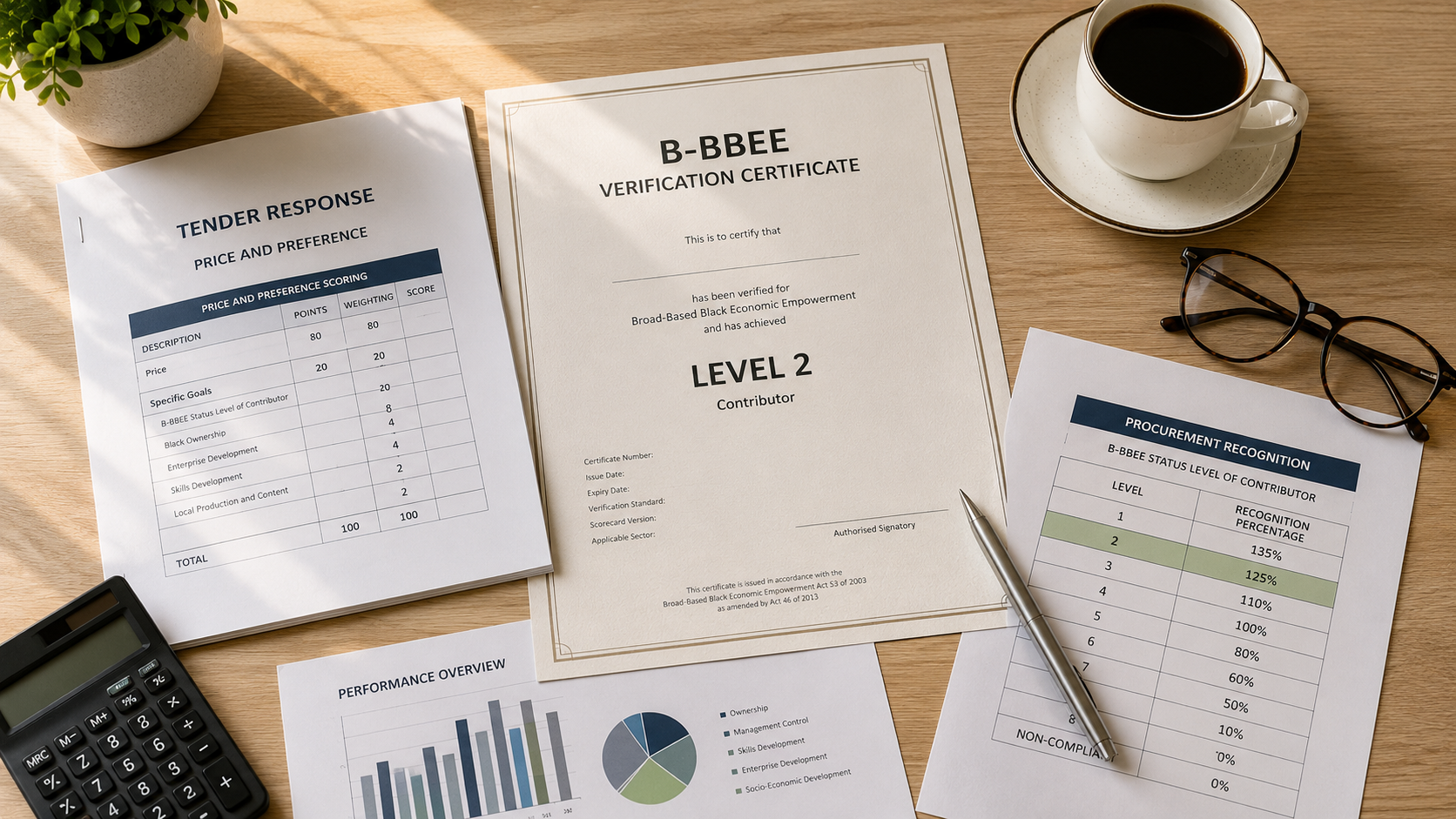
B-BBEE recognition levels are the single clearest line connecting a transformation programme to revenue — yet most corporates treat them as a compliance output rather than a commercial asset. It isn’t just a certificate grade. It’s the multiplier a customer applies to every rand they spend with you, and the score that decides whether you win or lose a tender.
Move up one level and you can become materially more valuable to every empowerment-conscious buyer in your market overnight. That is the commercial reality this guide unpacks.
This guide explains exactly how each level translates into procurement value, where the private-sector and public-sector mechanics differ, and why a level change moves revenue. The broader scorecard improvement framework covers how to move up; this article covers what the move is worth.
Quick Answer
B-BBEE recognition levels determine two distinct commercial outcomes. In private-sector procurement, your level sets the procurement recognition a customer can claim on their spend with you — from 135% at Level 1 down to 0% for non-compliant suppliers. In public-sector tenders, your level commonly feeds the preference-point score under the 80/20 or 90/10 system, though the 2022 PPPFA Regulations now let each organ of state set its own “specific goals.” Either way, a stronger rating makes you a more valuable supplier.
Want to know what your current level is worth to your biggest customers? Request a procurement-value review →
How B-BBEE Recognition Levels Translate Into Procurement Value
The mechanism that makes a level commercially valuable is the procurement recognition. When a customer spends money with a supplier, the customer can count a portion of that spend toward its own Preferential Procurement score — and the portion it can count is set by the supplier’s level.
A Level 1 supplier carries a 135% rate. That means a customer spending R1 million with that supplier can claim R1.35 million of recognised procurement on its own scorecard. The same R1 million spent with a Level 4 supplier yields R1 million of recognition (100%), and with a Level 6 supplier just R600,000 (60%). The supplier’s level directly changes how much scorecard value the customer extracts from the relationship.
This is why large corporates with their own targets actively prefer high-level suppliers. A procurement manager under pressure to lift the company’s Preferential Procurement score will route spend toward Level 1 and Level 2 suppliers because every rand goes further on their own scorecard. The supplier’s level is, in commercial terms, a discount on the customer’s compliance cost — and that makes the high-level supplier the easier one to choose.
| Recognition Level | Scorecard Points Range | Procurement Recognition | What R1m of Spend Is Worth to a Customer |
|---|---|---|---|
| Level 1 | 100+ points | 135% | R1,350,000 recognised |
| Level 2 | 95–99.99 | 125% | R1,250,000 recognised |
| Level 3 | 90–94.99 | 110% | R1,100,000 recognised |
| Level 4 | 80–89.99 | 100% | R1,000,000 recognised |
| Level 5 | 75–79.99 | 80% | R800,000 recognised |
| Level 6 | 70–74.99 | 60% | R600,000 recognised |
| Level 7 | 55–69.99 | 50% | R500,000 recognised |
| Level 8 | 40–54.99 | 10% | R100,000 recognised |
| Non-compliant | Below 40 | 0% | R0 recognised |
Takeaway
The jump from Level 4 (100%) to Level 1 (135%) makes the same supplier 35% more valuable to a buyer’s scorecard without the buyer spending a cent more. For a supplier competing for a large corporate’s procurement budget, that 35-point recognition gap is often the deciding factor between winning the spend and losing it to a higher-rated competitor.
Where the Level Stops Being a Smooth Slope
Look again at the table and a strategic insight jumps out: the value drop between levels isn’t even. The fall from Level 4 (100%) to Level 5 (80%) is a 20-point cliff — the single steepest drop on the scale.
The fall from Level 1 to Level 2 is only 10 points. The structure of the scale rewards staying at Level 4 or above far more than it rewards incremental movement at the bottom.
This changes where defensive effort should go. A corporate at Level 4 sitting on 80 points is one bad cycle away from the 20-point recognition cliff — a slip to 79 points drops it to Level 5 and strips a fifth of its procurement value to every customer. That marginal Level 4 position is the most commercially fragile place on the scale, and it deserves more protective attention than a comfortable Level 2 position does.
The same logic runs in reverse for upgrade planning. A corporate at Level 5 climbing to Level 4 gains 20 recognition points — the largest single-level gain available. A corporate at Level 2 climbing to Level 1 gains only 10. The scale means the commercial return on a one-level climb is largest at exactly the point where most corporates have given up trying.
Sitting at a marginal Level 4 or 5? Get a free recognition-cliff risk assessment →
Public Tenders: Where the Rules Changed in 2022
Public-sector procurement works differently from the private-sector recognition percentages above — and the rules shifted materially in 2022. Historically, a tenderer’s B-BBEE level fed directly into the preference-point score: under the 80/20 system (for tenders up to R50 million), 80 points went to price and 20 to the bidder’s B-BBEE level; under the 90/10 system (above R50 million), the split was 90 to price and 10 to the level.
The 2022 Preferential Procurement Regulations changed the architecture. Following a Constitutional Court judgment, each organ of state now sets its own “specific goals” for which preference points are awarded, rather than the points being locked to B-BBEE level alone. The National Treasury’s Preferential Procurement Policy Framework Act regulations set out the current framework.
In practice, B-BBEE level remains the most common basis most organs of state use for their specific goals — but it is no longer automatic, and a corporate bidding on public tenders should check each tender’s specific preference criteria rather than assuming the old fixed level-to-points mapping. The 80/20 and 90/10 price-versus-goals split survives; what changed is how the “goals” portion is defined tender by tender.
Takeaway
Private-sector procurement recognition is fixed by level and uniform across the market. Public-sector tender scoring, after the 2022 Regulations, varies by organ of state — most still use B-BBEE level for the preference-goals points, but each tender’s criteria must be read individually. Assuming the old fixed mapping on a 2026 public tender is a common and costly error.
Why B-BBEE Recognition Levels Move Revenue, Not Just Compliance
The reason levels deserve board-level attention is that the level sits upstream of revenue, not downstream of compliance. A supplier that moves from Level 4 to Level 2 becomes more attractive to every empowerment-conscious customer simultaneously — existing customers have more reason to grow the relationship, and new customers have a sharper reason to choose it over a lower-rated competitor.
The effect compounds in concentrated B2B markets. A corporate supplying a handful of large customers, each running its own Preferential Procurement target, can find that a single upgrade shifts its standing with all of them at once. The procurement-value uplift isn’t spread thinly across a long tail; it lands hard with the specific large buyers whose scorecards the supplier feeds.
This is the commercial case for treating a level upgrade as an investment with a return, not a compliance cost to minimise. The spend required to move from Level 4 to Level 2 should be weighed against the procurement value the move unlocks across the customer base — and in concentrated markets, that return frequently dwarfs the cost of the transformation programme that produces it.
Who This Is NOT For
How Insignis Connects Recognition Levels to the Customer Base
The Insignis approach to level strategy starts where most consultants finish: with the commercial map. Before recommending a target, the team works through which of the corporate’s customers run Preferential Procurement targets, how much each spends, and what an uplift is worth to each relationship. The level target follows from the revenue map, not the other way round.
Dr. Este Welman’s CA(SA) and M.Comm in Taxation background shapes the return-on-investment analysis that anchors this work — modelling the procurement-value uplift of a move up against the cost of the transformation programme required to achieve it, so the board sees the decision as a capital allocation question with a quantified return rather than a compliance expense.
The engagement model for this work is set out on the Insignis B-BBEE compliance strategy development service page, where level strategy is scoped against the verification cycle and the customer revenue map together.
A Level Move That Paid for Itself: Engagement Snapshot
An Insignis client — a Western Cape logistics supplier to three large retail groups — sat at Level 4 and treated its B-BBEE programme as a pure compliance cost. The commercial map told a different story: all three of its major customers ran Preferential Procurement targets, and a move to Level 2 would lift the supplier’s rate from 100% to 125% for every rand those customers spent.
The level upgrade took 14 months and cost roughly R900,000 in transformation programme investment. The procurement-value impact across the three customer relationships, once the Level 2 certificate landed, justified the spend inside the first year — and two of the three customers increased their allocation to the supplier once the higher rate made the relationship more valuable to their own scorecards.
| Commercial Metric | Before (Level 4) | After (Level 2) |
|---|---|---|
| Procurement rate to customers | 100% | 125% |
| Recognition value on R10m customer spend | R10m recognised | R12.5m recognised |
| Customers actively growing the relationship | 0 of 3 | 2 of 3 |
| Transformation programme cost | R900,000 (treated as cost) | R900,000 (treated as investment) |
| Programme framing at board level | Compliance expense | Revenue-linked capital allocation |
The framing line at the bottom is the real lesson. Nothing about the transformation work changed — the same R900,000 produced the same Level 2 certificate. What changed was the board’s understanding that the spend bought a recognition uplift that made the supplier measurably more valuable to its three biggest customers.
Three Questions Before Setting a Level Target
Corporates planning a level strategy should answer three commercial questions before fixing a target. The answers convert a vague “we should be Level 1” ambition into a quantified investment decision.
Which of your customers actually run Preferential Procurement targets? The recognition multiplier only pulls revenue when customers have scorecards to feed. Map the customer base into those who reward a stronger rating and those indifferent to it — the size of the first group sets the commercial value of any level move.
Where on the scale does a move generate the most value? The 20-point cliff between Level 4 and Level 5 means a Level 5 corporate climbing to Level 4 captures the largest single-level recognition gain available. Identify which climb produces the biggest recognition jump for the cost, rather than defaulting to a Level 1 target.
What is the recognition uplift worth in rand across the customer base? Multiply each rewarding customer’s annual spend by the recognition-rate change a level move delivers. That figure — the procurement-value uplift — is what the transformation programme cost should be weighed against to decide whether the climb pays for itself.
Want these three questions modelled against your actual customer base? Book a level-strategy mapping session →
Frequently Asked Questions on B-BBEE Recognition Levels
What is the procurement recognition for each B-BBEE level?
The procurement recognitions are: Level 1 at 135%, Level 2 at 125%, Level 3 at 110%, Level 4 at 100%, Level 5 at 80%, Level 6 at 60%, Level 7 at 50%, Level 8 at 10%, and non-compliant at 0%. This is the percentage of spend a customer can claim toward its own Preferential Procurement score when it buys from a supplier at that level.
Do public tenders still use B-BBEE level for scoring?
Most public tenders still use B-BBEE level as the basis for the preference-goals points, but it is no longer automatic. The 2022 Preferential Procurement Regulations require each organ of state to set its own “specific goals” for which preference points are awarded. The 80/20 split (tenders up to R50m) and 90/10 split (above R50m) between price and goals survives, but each tender’s specific criteria must be read individually rather than assuming a fixed level-to-points mapping.
Why is the drop from Level 4 to Level 5 so significant?
The rate falls from 100% at Level 4 to 80% at Level 5 — a 20-point cliff, the steepest single-level drop on the scale. A corporate slipping from Level 4 to Level 5 strips a fifth of its procurement value to every customer at once. This makes a marginal Level 4 position (sitting near 80 points) the most commercially fragile place on the scale and the position most worth defending.
How much more valuable is a Level 1 supplier than a Level 4 supplier?
A Level 1 supplier carries a 135% rate versus 100% for Level 4 — making the same supplier 35% more valuable to a customer’s Preferential Procurement score for the identical spend. On R1 million of spend, a customer recognises R1.35 million with a Level 1 supplier versus R1 million with a Level 4 supplier, with no additional cost to the buyer.
Does a higher B-BBEE level guarantee winning more business?
No — a stronger rating makes a corporate a more attractive supplier to B-BBEE-conscious buyers, but it doesn’t guarantee wins. The level creates commercial pull only with customers who run Preferential Procurement targets or score B-BBEE in tenders. For customers indifferent to B-BBEE, the level has no procurement effect. The commercial value of a level move depends entirely on how much of the customer base rewards it.
Should we always target Level 1?
Not necessarily. The scale’s 20-point cliff between Level 4 and Level 5 means the largest single-level recognition gain comes from climbing to Level 4, not to Level 1.
The right target depends on the customer base — which buyers reward a stronger rating and by how much — weighed against the cost of each climb. A Level 4 target may deliver a better return than a Level 1 target for a corporate whose customers don’t differentiate above Level 3.
Map Your B-BBEE Recognition Levels to Real Procurement Value
The most valuable exercise a corporate can run on its B-BBEE programme is connecting its level to the procurement value it unlocks across the customer base. That map turns an abstract compliance grade into a quantified revenue lever — and it usually reveals that the decision is a bigger commercial question than the board realised.
Request a Recognition-to-Revenue Mapping
Schedule a no-cost initial conversation with Dr. Este Welman, CA(SA), and the Insignis team. We map your current level against your customer base, quantify the procurement-value uplift of a move up, and quote a phase-priced engagement that treats the climb as a capital allocation decision with a measurable return.
No obligation. We will get back to you within 24 hours.
Request Your Recognition Mapping
About the Author
Dr. Este Welman, CA(SA) — Founding Director, Insignis Solutions
A Chartered Accountant (SA) holding a PhD in Economic Transformation from the Da Vinci Institute, an M.Comm in Taxation, a B-BBEE Management Diploma from Wits, and registered SAICA membership.
Her work on level strategy centres on the return-on-investment modelling that connects a recognition uplift to procurement value across a corporate’s customer base — turning the level decision from a compliance line item into a quantified capital allocation question.