
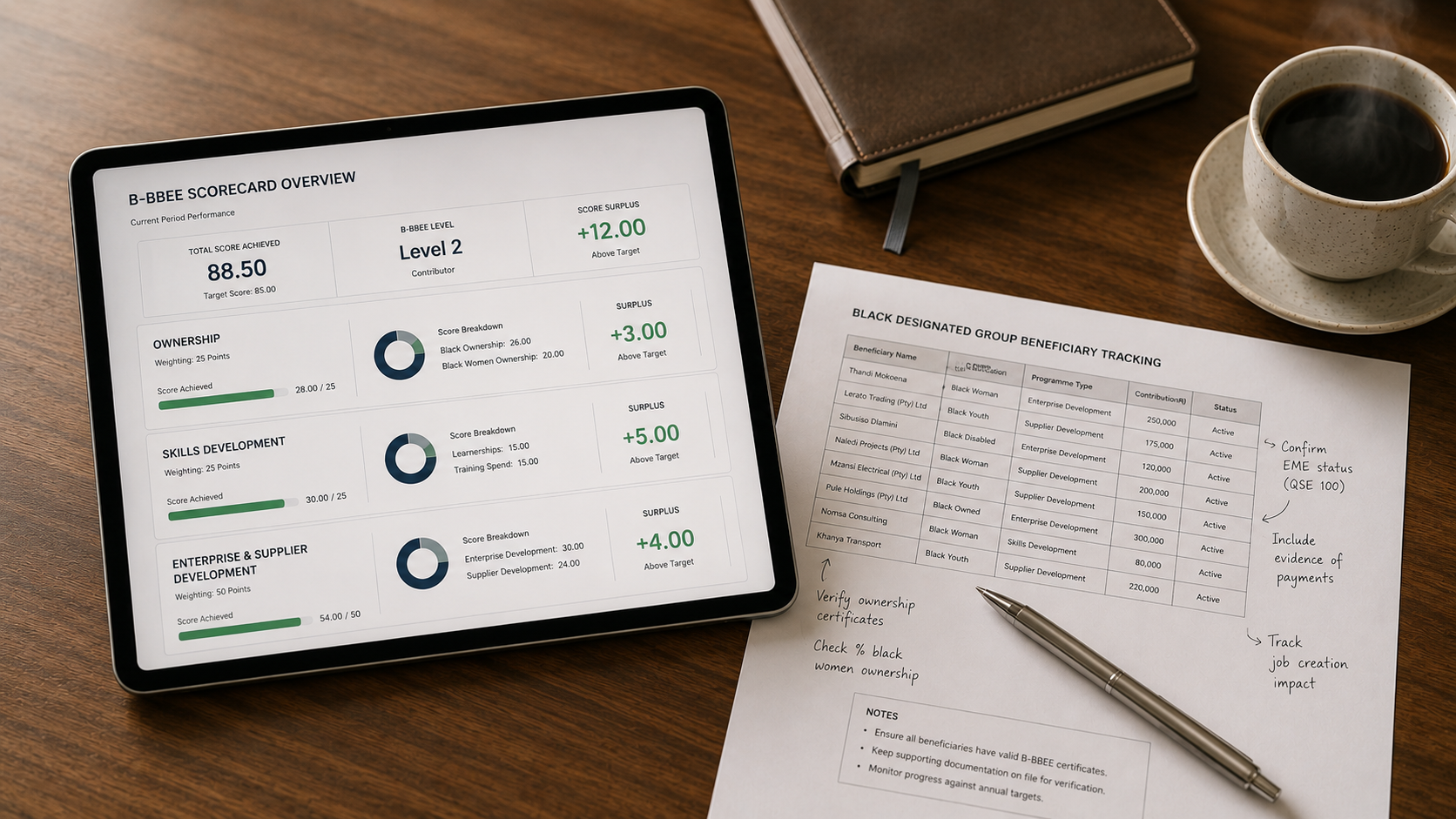
B-BBEE bonus points sit on top of the base scorecard and are the most under-captured score on the certificate. Up to 12 extra credits are available across three elements, and most corporates leave half of them on the table — not because the underlying activity isn’t happening, but because the evidence isn’t documented in a way that lets verification recognise the surplus.
This guide walks through every available bonus category, what triggers each one, what evidence the verification body needs, and where the common claim failures happen. The broader scorecard improvement framework covers the base scoring; this article covers the surplus that sits above it.
Quick Answer
B-BBEE bonus points are additional scorecard credits (up to 12 in total under the Generic Codes) awarded for transformation activity that exceeds base element targets. The credit is distributed across Ownership (+3), Skills Development (+5), and Enterprise & Supplier Development (+4). Most corporates capture only 30-50% of the available surplus because verification-grade evidence isn’t structured at source — not because the activity isn’t happening.
Want to know how much extra credit your current scorecard could be capturing? Request a scorecard surplus review →
How B-BBEE Bonus Points Sit Inside the Scorecard
The Generic Codes scorecard awards a base score across five elements: Ownership (25 base credits), Management Control (15), Skills Development (20), Enterprise & Supplier Development (40), and Socio-Economic Development (5). That’s 105 in the base layer.
The certificate level is determined by where the total score lands against the level thresholds — Level 1 requires 100+, Level 2 sits at 95-99, and the bands run downward to Level 8. The surplus credits sit on top of that base, capped element-by-element, and each one is tied to a specific evidence requirement defined in the Codes.
The total surplus available across the scorecard is 12 — enough to move a borderline corporate up a full level when captured well, and often the deciding factor in close certifications. The key reframing: this surplus isn’t a separate workstream. Every claim is awarded for a stronger version of activity that’s already happening in the base element. The activity stays the same; the documentation discipline determines whether the surplus gets recognised.
Ownership: Three Credits for Going Beyond the Base Targets
The Ownership element offers three credits across two factors. The first is awarded for additional black ownership above the 25% target — corporates with verified black shareholding above the threshold claim incremental recognition on the surplus, up to two credits. The second is awarded for black women ownership above target: corporates that exceed the BWO sub-target by at least 5 percentage points claim an additional credit.
The evidence requirement matches the base Ownership scoring: registered shareholding (Companies and Intellectual Property Commission verified), confirmed black status (with affidavits or B-BBEE Commission verification where applicable), and confirmed economic interest under the modified net value test.
The most common claim failure is corporates with strong ownership positions whose shareholder registers don’t capture the granular black-status and BWO breakdown verification needs. The ownership is there; the recognition isn’t claimed because the shareholding documentation stops at “X% black ownership” rather than showing the BWO and black designated group splits the surplus claim requires.
Takeaway
Ownership surplus credits usually don’t need new transactions — they need better documentation of existing shareholding. The split between black ownership, black women ownership, and black designated group ownership must be verifiable at the share register level for the surplus to be claimed at certification.
Skills Development: Five Credits That Most Corporates Leave Untouched
Skills Development carries the largest surplus allocation on the scorecard — five credits across three factors. The largest comes from accelerated progression of learnership beneficiaries through SETA-recognised qualifications during the programme cycle (up to three credits).
One additional credit is awarded for spend on Black Designated Group beneficiaries (black women, black youth, black people with disabilities, and black unemployed people) above the base target. A final credit is awarded for absorption of learnership and internship beneficiaries into permanent employment at the end of the programme.
The Skills Development surplus ties back to the SARS Leviable Amount. The base scoring is calculated against 6% of the Leviable Amount for Skills Development spend — a figure derived from the SARS Skills Development Levy framework. The surplus builds on top of that base.
Corporates whose Leviable Amount baseline is outdated underclaim both the base scoring and the surplus simultaneously. The entire Skills Development element operates against an understated denominator — and that compounds into both layers of the score.
The Black Designated Group spend is where most corporates leak the largest portion. Programmes default to “Black beneficiary” tracking without the disability, gender, and unemployment-status splits the BDG surplus claim requires. The training spend is happening; the granular beneficiary classification isn’t. By the time verification reviews the file, the credit can’t be backed out from invoice-level data alone.
Running Skills Development spend but not tracking Black Designated Group splits? Get a free Skills Development assessment →
Enterprise & Supplier Development: Four Credits Tied to Outcomes
The ESD element offers four credits distributed across Preferential Procurement, Supplier Development, and Enterprise Development sub-elements. The defining feature: these aren’t awarded for spend levels — they’re awarded for outcomes that ESD programmes are supposed to produce but often don’t.
The first ESD credit is awarded for graduation of beneficiaries — when a supplier development partner graduates to become a regular supplier on the corporate’s panel, or an enterprise development partner crosses the threshold to become a supplier development beneficiary.
The second is awarded for verified permanent job creation attributable to ESD partnership activity (up to two credits). The third is awarded for new market entry: ESD beneficiaries entering supplier panels outside the originating corporate’s procurement footprint.
The evidence trail for ESD surplus is the hardest part of the scorecard to retrofit. Graduation events need to be documented at the moment they happen — supplier agreement amendments, ESD partnership termination documents acknowledging the graduation, supplier-panel registration paperwork. Job creation outcomes need beneficiary HR records and PAYE confirmations.
By the time verification arrives, these events are often two to three years in the past, and the documentation is fragmented across multiple business systems. The single biggest predictor of whether an ESD surplus claim succeeds is whether evidence collection was embedded in the partnership agreement at the start — not retrofitted at audit.
| Element | Credits Available | Trigger | Most Common Claim Failure |
|---|---|---|---|
| Ownership | +3 | Black ownership above target; BWO above sub-target | Share register doesn’t show BWO and BDG splits granularly enough |
| Skills Development — BDG spend | +1 | Black Designated Group beneficiary spend above target | Beneficiary tracking missing disability/gender/youth splits |
| Skills Development — Absorption | +1 | Learnership beneficiaries absorbed into permanent roles | Absorption events not documented at the time they happened |
| Skills Development — Accelerated progression | +3 | Beneficiaries progressing through SETA qualifications | SETA progression evidence held by training provider, not by corporate |
| ESD — Graduation | +1 | ESD beneficiary graduates to supplier panel | Graduation event not formally documented at the moment it happens |
| ESD — Job creation | +2 | Permanent jobs created via ESD partnerships | Beneficiary HR records not linked to ESD attribution |
| ESD — New market entry | +1 | ESD beneficiary enters external supplier panels | External supplier registration not tracked back to originating ESD work |
Why Most Corporates Capture Only Half the Available B-BBEE Bonus Points
Across the Insignis client base, the pattern is consistent: corporates with mature transformation programmes routinely capture 4-6 surplus credits out of the 12 available. The work that would have justified the other 6-8 is happening — the documentation infrastructure isn’t there to claim it at verification.
Three structural reasons drive this. Programme reporting captures activity (“we ran a learnership cohort of 40”) but not the verification-grade granularity (“of those 40, 18 were Black Designated Group beneficiaries, 12 were absorbed into permanent roles, and 7 progressed to a higher SETA qualification level during the programme”).
Verification preparation runs in the final 60 days before the audit, by which point the granular evidence for events 18 months earlier can’t be reconstructed. And the surplus categories aren’t named in the strategy document, so the team running the programme doesn’t know which specific outcomes to evidence in real time.
Corporates that fix this redesign their programme reporting at source. Every monthly update captures the surplus-relevant fields. Every learnership cohort has BDG splits tracked from enrolment. Every ESD partnership has a graduation evidence template ready for the moment graduation happens. The annual verification preparation becomes an evidence-assembly exercise from data that’s already been captured in the correct structure — not an evidence-reconstruction exercise.
Takeaway
The gap between corporates capturing 4 credits and corporates capturing 9 credits isn’t programme spend or consultant quality — it’s whether the monthly reporting cadence captures verification-grade granularity in real time. The redesign work is one-off; the recurring uplift compounds across every subsequent certification cycle.
Who This Is NOT For
How the Insignis Methodology Maps B-BBEE Bonus Points at Programme Design
The Insignis approach to scorecard work runs the surplus map alongside the base programme design from day one. When a corporate scopes a new transformation cycle with Dr. Este Welman’s team, every programme line is tagged against both its base scoring contribution and the surplus pathway it enables.
The CA(SA) and M.Comm in Taxation lens shapes the financial reconciliation work that anchors the Leviable Amount baseline — and a correct baseline is what makes Skills Development surplus claims durable at verification.
The methodology produces a scorecard where the base and surplus are designed together, not retrofitted at verification. Programme reporting templates are pre-built to capture the BDG splits, the absorption events, the SETA progression milestones, and the ESD graduation evidence as those events happen — not 14 months later when audit preparation begins.
For corporates considering a structural redesign of their scorecard approach, the engagement model is set out on the Insignis B-BBEE compliance strategy development service page. Engagements are scoped against the verification cycle with quarterly checkpoint reviews on evidence collection discipline.
The Difference at a Real Corporate: A Recent Engagement Snapshot
An Insignis client running an established R5m annual transformation programme had captured an average of 4.2 surplus credits across three consecutive verification cycles. The certificate had been stable at Level 3 across the same period. The diagnostic surfaced the structural gap: programme activity was strong, but evidence was being reconstructed at verification rather than captured at source.
The 12-month redesign focused on three tracks. Skills Development reporting was rebuilt to capture BDG splits, absorption events, and SETA progression milestones in real time. ESD partnership templates were rewritten to include a graduation event protocol — partnership agreements now include a graduation-criteria appendix and a documented sign-off at the moment graduation triggers. Ownership documentation was tightened to show BWO and BDG splits at share register level.
| Scorecard Metric | Before Redesign (3-cycle avg) | After 12 Months |
|---|---|---|
| Base element score captured | 89.4 / 105 | 92.1 / 105 |
| Surplus credits captured | 4.2 / 12 | 9.1 / 12 |
| Total scorecard score | 93.6 | 101.2 |
| Certificate level | Level 3 | Level 1 |
| Programme spend | R5m annual | R5m annual (unchanged) |
| Reporting infrastructure cost | — | R140,000 first year, R45,000 ongoing |
The most useful figure in the table is the programme spend line. The level movement came from claiming surplus credits already earned through existing programme activity — not from new spend. The reporting infrastructure investment was a fraction of the procurement uplift the level change unlocked in the same year.
Three Diagnostic Questions Before Starting Surplus Capture Work
Corporates considering a focused surplus capture exercise should test three diagnostic questions before scoping the work. The answers separate cases where this work will produce a real level movement from cases where the binding constraint sits elsewhere.
Is the base scoring strong enough for surplus capture to matter at the level threshold? A corporate scoring 75 base credits moves from Level 5 to Level 4 with strong surplus capture — a useful but modest movement. A corporate scoring 92 base credits moves from Level 3 to Level 1 with the same work — a transformative outcome. Surplus capture compounds on a sound base; it doesn’t substitute for one.
Is the Leviable Amount baseline current? Skills Development credits (5 out of the 12 available) are calculated against the SARS Leviable Amount. An outdated baseline understates both base and surplus claims simultaneously. The Leviable Amount reconciliation is the first task in any surplus project, ahead of programme redesign work.
Does the corporate have the monthly programme reporting cadence to capture verification-grade data at source? If transformation data is produced only annually, the reporting redesign work is the prerequisite. Without monthly granular data, surplus evidence has to be reconstructed at verification — and that reconstruction loses credits consistently.
Want to run these diagnostic questions against your current programme with structured advisory support? Book a surplus capture diagnostic conversation →
Frequently Asked Questions on B-BBEE Bonus Points
How many bonus credits are available under the amended 2025 Codes?
The Generic Codes scorecard makes 12 surplus credits available across three elements: Ownership (+3), Skills Development (+5), and Enterprise & Supplier Development (+4). Management Control and Socio-Economic Development don’t carry surplus allocations. The 2025 amendments tightened the qualifying criteria for several categories — particularly Skills Development absorption and SETA progression — but didn’t change the total available allocation.
Can a corporate move up a full level on surplus capture alone?
Yes, for corporates sitting on the threshold between levels. The level bands are 5-point intervals on the total scorecard, so a corporate scoring 96 base credits capturing 5 surplus credits crosses from Level 2 to Level 1.
A corporate scoring 89 base capturing 7 surplus moves from Level 4 to Level 2. The capture is most leveraged at the threshold; the strategic conversation starts with where the corporate’s base score lands against the nearest level band.
How long does it take to build the evidence infrastructure?
The reporting redesign typically takes 8-12 weeks to scope and implement. The downstream evidence then needs to accumulate over the next verification cycle — surplus claims at the next certification require 12 months of correctly-captured data. Corporates starting in Month 1 of a new cycle will see the full uplift at the verification 12 months later, not at any earlier point.
Is this work worth pursuing if our certificate is stable at Level 2?
The arithmetic depends on the gap to Level 1. A Level 2 corporate scoring 96-99 total credits may need only 2-4 surplus to reach Level 1. A Level 2 corporate scoring 95 needs 5+ to cross the threshold. Run the diagnostic before committing budget — for corporates at the upper end of Level 2, the work pays back fast. For corporates at the lower end, the priority sequence is base scoring first.
Do surplus claims carry the same evidence standard as the base score?
Yes — and often more granular. Surplus claims require evidence at a finer level of detail than the base claim they sit on. Skills Development BDG credits require beneficiary-level disability, gender, youth, and unemployment-status data. ESD graduation credits require the graduation event to be formally documented at the moment it happened. Verification bodies apply a slightly higher evidence threshold to surplus claims because the credits are awarded for stronger versions of the base activity.
Which element offers the easiest surplus credits to capture?
Ownership, for corporates with strong existing black ownership positions — the credits usually need no new activity, only better documentation of the shareholding splits already in place. Skills Development BDG spend is the second-easiest for corporates that already track beneficiary demographics granularly. ESD credits are the most operationally demanding because they require event-by-event documentation across multi-year partnerships, with evidence collection embedded in the supplier and ESD agreements themselves.
Get a Surplus Capture Diagnostic
The fastest way to know whether surplus capture work is the right priority for the next verification cycle is to run a structured diagnostic. The exercise identifies how many credits the corporate is already entitled to under existing programme activity, how many more could be captured with reporting redesign, and where the level threshold actually sits.
Request a Scorecard Surplus Diagnostic
Schedule a no-cost initial conversation with Dr. Este Welman, CA(SA), and the Insignis team. We test how many surplus credits your current programme should be capturing, identify where evidence infrastructure is missing, and quote a phase-priced engagement aligned to your next verification cycle.
No obligation. We will get back to you within 24 hours.
Request Your Surplus Diagnostic
About the Author
Dr. Este Welman, CA(SA) — Founding Director, Insignis Solutions
A Chartered Accountant (SA) holding a PhD in Economic Transformation from the Da Vinci Institute, an M.Comm in Taxation, a B-BBEE Management Diploma from Wits, and registered SAICA membership.
Her scorecard work concentrates on the structural reporting infrastructure that determines whether transformation programmes claim the credits they’ve earned — particularly the Leviable Amount reconciliation and the Black Designated Group beneficiary tracking that underpin Skills Development surplus claims.