
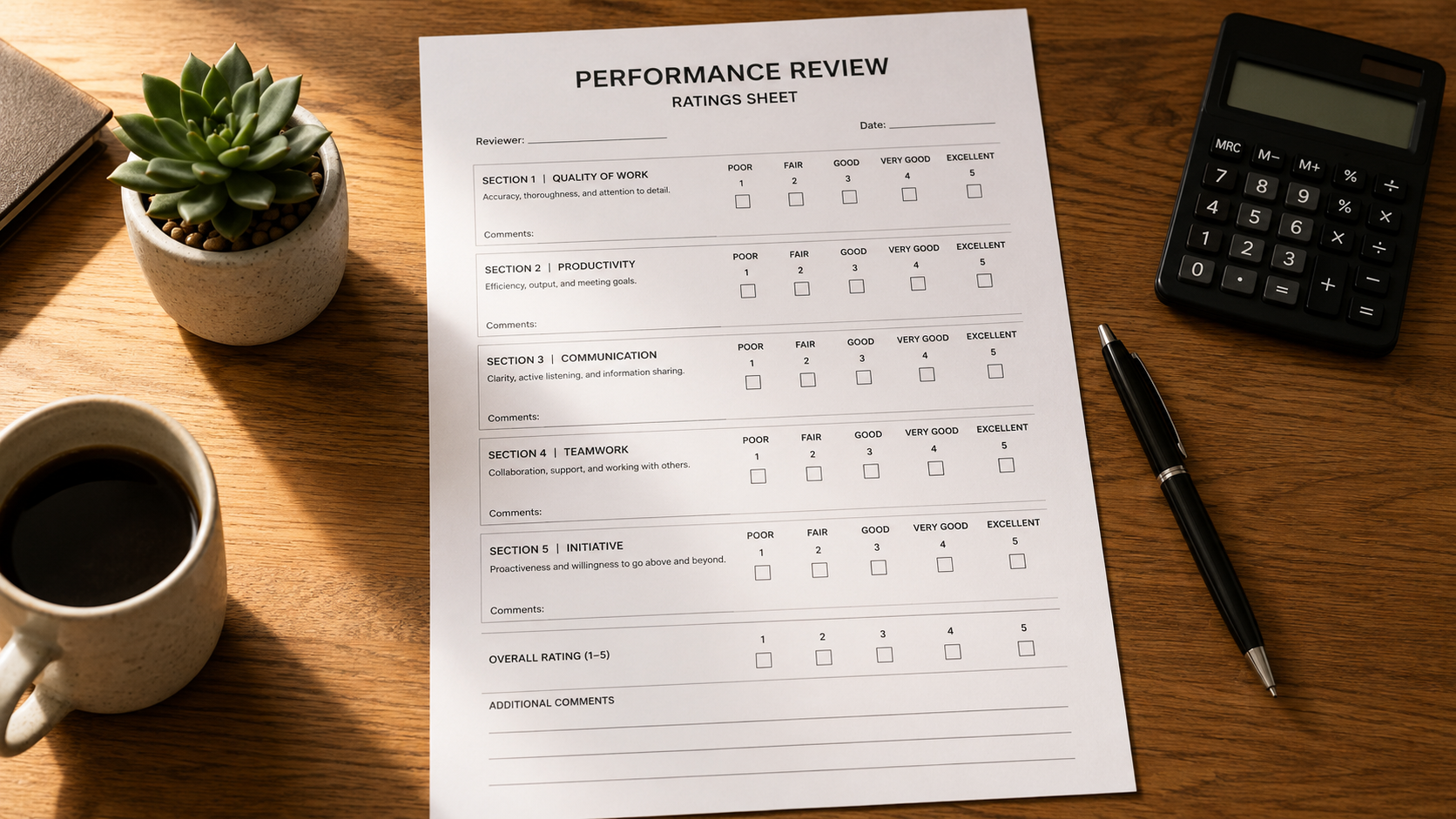
A B-BBEE scorecard is the single sheet that turns everything your business does for transformation into one number — a contributor level from 1 to 8 that buyers use to decide whether to work with you. If you have ever been asked for your B-BBEE level and had no idea where the figure comes from, this is the page that explains it in plain language.
No jargon, no consultant-speak. Just what the rating measures, how the points add up, and why the result quietly decides which contracts your business can win.
Quick Answer
A B-BBEE scorecard is a standardised measurement that rates a South African business on five areas of economic transformation and converts the result into a level from 1 (best) to 8. Level 1 gives buyers the most procurement recognition; non-compliant businesses give none. The rules are set by the Codes of Good Practice, and the version you use depends on your annual revenue.
What a B-BBEE Scorecard Actually Is
Think of it as a report card for transformation. Rather than grading maths and history, it grades a business on how meaningfully black South Africans participate in its ownership, its leadership, its training and its supply chain. Each area earns points, the points add up, and the total lands the business on a level.
The rules behind it come from the Codes of Good Practice, issued under the B-BBEE Act. The framework is national, but it is not one-size-fits-all: a corner café and a listed corporate are measured very differently, which is where business size comes in.
Every measured business fits one of three size bands, and the band decides which version of the assessment applies.
| Business size | Annual revenue | What applies |
|---|---|---|
| Exempt Micro Enterprise | Under R10 million | No full assessment; a free sworn affidavit sets the level |
| Qualifying Small Enterprise | R10 million to R50 million | A shorter QSE version (affidavit if majority black-owned) |
| Generic enterprise | Above R50 million | The full generic card, verified by an agency |
So the smallest businesses barely touch a measurement at all — a signed affidavit does the job. The moment revenue climbs past R10 million, though, the points start to matter, and past R50 million the full assessment kicks in.
The one-line version
The framework measures five things, scores them out of roughly 100 points, and turns the total into a level from 1 to 8. Your revenue decides which version you use; your level decides how attractive you are to buyers.
The Five Things Every Business Is Rated On
Every generic rating covers the same five elements. Knowing what each one rewards is most of the battle, because it tells you where the easy points and the hard points sit for your particular business.
| Element | Points | What it rewards |
|---|---|---|
| Ownership | 25 points | Black shareholding, voting rights and real economic interest |
| Management Control | 19 points | Black representation among directors and managers |
| Skills Development | 20 points (plus bonus) | Training, learnerships and bursaries for black employees |
| Enterprise & Supplier Development | 40 points (plus bonus) | Buying from and investing in black-owned businesses |
| Socio-Economic Development | 5 points | Community contributions that benefit black South Africans |
Enterprise and supplier development carries the most weight by far. At 40 points before bonuses, how and from whom a business buys matters more to its rating than anything else — which is exactly why large corporates chase compliant suppliers so hard.
Ownership and skills development sit in the middle but carry a sting. Alongside enterprise and supplier development, they are the three priority elements. Miss the 40% sub-minimum on any one of them and the whole result drops a level, no matter how strong the rest of the card looks.
Socio-economic development is the lightest at 5 points, usually funded through community contributions of about 1% of after-tax profit. It is the element most businesses find easiest to satisfy.
Management control and ownership are where transformation gets structural. Ownership looks past the share register to whether black shareholders receive real dividends and hold genuine voting rights, while management control looks at who actually runs the business day to day. Both reward substance over paperwork, which is deliberate.
It helps to remember why the framework exists at all. It is the State’s chosen mechanism for widening economic participation after decades of exclusion, which is why the heaviest weightings sit on ownership, skills and supply-chain spend rather than on gestures. Reading the elements as policy priorities, not box-ticking, makes the point allocations far easier to understand.
How a B-BBEE Scorecard Produces Your Level
Once each element is scored, the points are added into a single total, and that total maps onto a level. The bands are fixed: the more points, the better the level, with Level 1 at the top and Level 8 as the lowest compliant rung. A business that scores too low, or submits nothing, is rated non-compliant.
A quick worked example makes it concrete. Cross 100 points and you reach Level 1. Land around 80 points and you sit at Level 4 — the middle of the pack. Slip under 40 points and you are non-compliant, which for procurement purposes is the same as having no rating at all. Small movements in points can therefore mean a whole level either way.
Here is the part that catches people out. The level is not just a badge — it carries a procurement recognition percentage that flows straight to your customers. A Level 1 business hands its buyer 135% recognition on what they spend with you; a Level 4 business hands over 100%; a non-compliant one hands over nothing.
That percentage is why a buyer will choose a Level 2 supplier over an identical Level 5 one. The higher your level, the more your customer earns on their own rating simply for working with you.
The priority-element rule is the other thing worth remembering. Because ownership, skills development, and enterprise and supplier development each carry that 40% floor, a business can rack up points everywhere else and still be knocked down a level for neglecting one of the three. The framework rewards balance, not just a high total.
How the Rating Gets Checked
A number on a page means little until someone independent confirms it. How that confirmation happens depends, again, on size and ownership.
The smallest businesses — those under R10 million, and majority black-owned businesses up to R50 million — confirm their status with a free sworn affidavit signed before a Commissioner of Oaths. There is no audit and no fee. Larger businesses, and small ones that are not majority black-owned above the R10 million mark, are verified by an agency accredited by the South African National Accreditation System, which examines the evidence behind every claimed point.
Either way the result is a certificate valid for 12 months. Let it lapse and a single expired day can be enough for a government buyer to reject a bid, so the renewal date matters as much as the rating itself.
Between certificates, the smart habit is keeping the evidence current rather than scrambling once a year. Payroll records for training, proof of community contributions, supplier certificates and shareholding documents all feed the next assessment, and businesses that file them as they go tend to land closer to their true position than those reconstructing a year from memory. The annual cycle rewards good record-keeping almost as much as good intentions.
Why the number is worth knowing
Your level is not a compliance formality — it is a commercial signal. Buyers read it before they read your proposal, and a rating you have never measured is a rating that is almost certainly costing you work you never knew you lost.
Why Your B-BBEE Scorecard Decides Who You Can Sell To
For most businesses the result matters for one blunt reason: revenue. Government buyers convert your level into preference points under the 80/20 and 90/10 tender formulas, and many large private buyers set a minimum level before they will even add you to a supplier panel. A weak rating can shut you out before price is ever discussed.
The difference between managing your standing and ignoring it shows up quickly in the kind of work you can pursue.
A concrete example helps. A municipality inviting bids for a R30 million contract runs the 80/20 formula: 80 points for price, 20 for preference. Two bidders match on price, but the Level 2 firm claims close to full preference points while the Level 6 firm claims only a fraction. The gap on those 20 points routinely decides the award — which is how a rating quietly outweighs a sharper quote.
| Situation | Before (rating ignored) | After (rating managed) |
|---|---|---|
| Knowledge of your own level | Assumed or unknown | Measured and confirmed |
| Recognition passed to buyers | 0% if non-compliant | 100% or higher |
| Government tender eligibility | Often pre-disqualified | Earns 80/20 preference points |
| Standing on corporate panels | Dropped at review | Retained and preferred |
| Priority-element risk | Unmanaged | Sub-minimums tracked |
None of this requires a business to transform overnight. It requires knowing the number, knowing which elements are dragging it down, and fixing those in order of impact.
Who This Guide Is NOT For
Being honest about who should skip this explainer is as useful as the explainer itself.
The Insignis Approach to Your First Rating
Most first-time clients arrive having been handed a level by an agency without ever being shown how it was built. Insignis works the other way around, starting by making the number legible.
Led by Dr. Este Welman — a CA(SA) holding a PhD in Economic Transformation from the Da Vinci Institute — the team walks through which of the five elements you are winning, which are dragging you down, and what a realistic level looks like once the gaps are closed.
Through our B-BBEE consulting service, we translate the Codes into a plan a business owner can act on, then sequence the fixes by commercial impact rather than by whichever element is easiest to talk about. Understanding the number is the first step to improving it.
If you want to see how the five elements interact in more depth, our guide to the five scorecard elements breaks each one down, and the EME, QSE and Generic comparison shows exactly which version applies to a business your size.
Turning Understanding Into a Number
The useful test at this stage is simple: can you name your current level and the one element most likely to be holding it back? If you can, you are already ahead of most businesses your size. If you cannot, that gap is precisely where a short diagnostic earns its keep.
A brief orientation walks through your five elements, estimates where your level sits today, and flags the fastest route to a stronger one — before you spend a cent on formal verification. It is the difference between guessing at your standing and knowing it.
Get your rating explained — and estimated
We will walk you through each of the five elements, estimate your current level, and show you the single change most likely to lift it. No obligation, and we will get back to you within 24 hours.
Book your plain-English orientationFrequently Asked Questions
What is a B-BBEE scorecard in simple terms?
It is a standardised rating that measures how meaningfully black South Africans participate in a business across five areas, then converts the result into a level from 1 to 8. Level 1 is the strongest and gives buyers the most procurement recognition. The measure is defined by the Codes of Good Practice.
What are the five elements measured?
Ownership, management control, skills development, enterprise and supplier development, and socio-economic development. Enterprise and supplier development carries the most points, while ownership, skills development and enterprise and supplier development are the three priority elements that can drop your level if neglected.
How many points make up the rating?
The generic version totals roughly 100 points across the five elements, with additional bonus points available. The points are added into one total, and that total maps onto a contributor level from 1 to 8, subject to the priority-element rules.
Does every business use the same measurement?
No. Businesses under R10 million in revenue use a free sworn affidavit rather than a full assessment. Those between R10 million and R50 million use a shorter QSE version, and businesses above R50 million use the full generic version verified by a SANAS-accredited agency.
What is a priority element?
Ownership, skills development, and enterprise and supplier development are priority elements. Each carries a 40% sub-minimum, and missing that floor on any one of them discounts your overall level by one, regardless of your total points. It is why balance across the card matters.
Why does my level matter to my customers?
Because your level carries a procurement recognition percentage that flows to whoever buys from you. A Level 1 supplier delivers 135% recognition, a Level 4 supplier delivers 100%, and a non-compliant supplier delivers none. A stronger level makes your business more valuable to compliance-conscious buyers.

Dr. Este Welman, CA(SA) — Founding Partner, Insignis Solutions. A Chartered Accountant (SA) holding a PhD in Economic Transformation from the Da Vinci Institute, with an M.Comm in Taxation and a B-BBEE Management Diploma from Wits. Her focus on making the Codes legible to non-specialists shapes how Insignis explains the numbers to first-time clients.