
B-BBEE government tenders live and die on twenty preference points. For any bid under R50 million, those twenty points determine the award outcome between two suppliers whose pricing is within five percent of each other — which is most of the time. Understanding exactly how the rating translates into the preference points your bid will be scored on is the difference between winning and watching the contract go to the supplier next door.
This guide walks through the preference point mechanics under PPR 2022, what rating each tier of state contract realistically demands, and how a mid-market supplier sequences the work to be competitive on state bids. The pillar reference for B-BBEE levels in South Africa sits alongside this for the broader scorecard band context.
Quick Answer
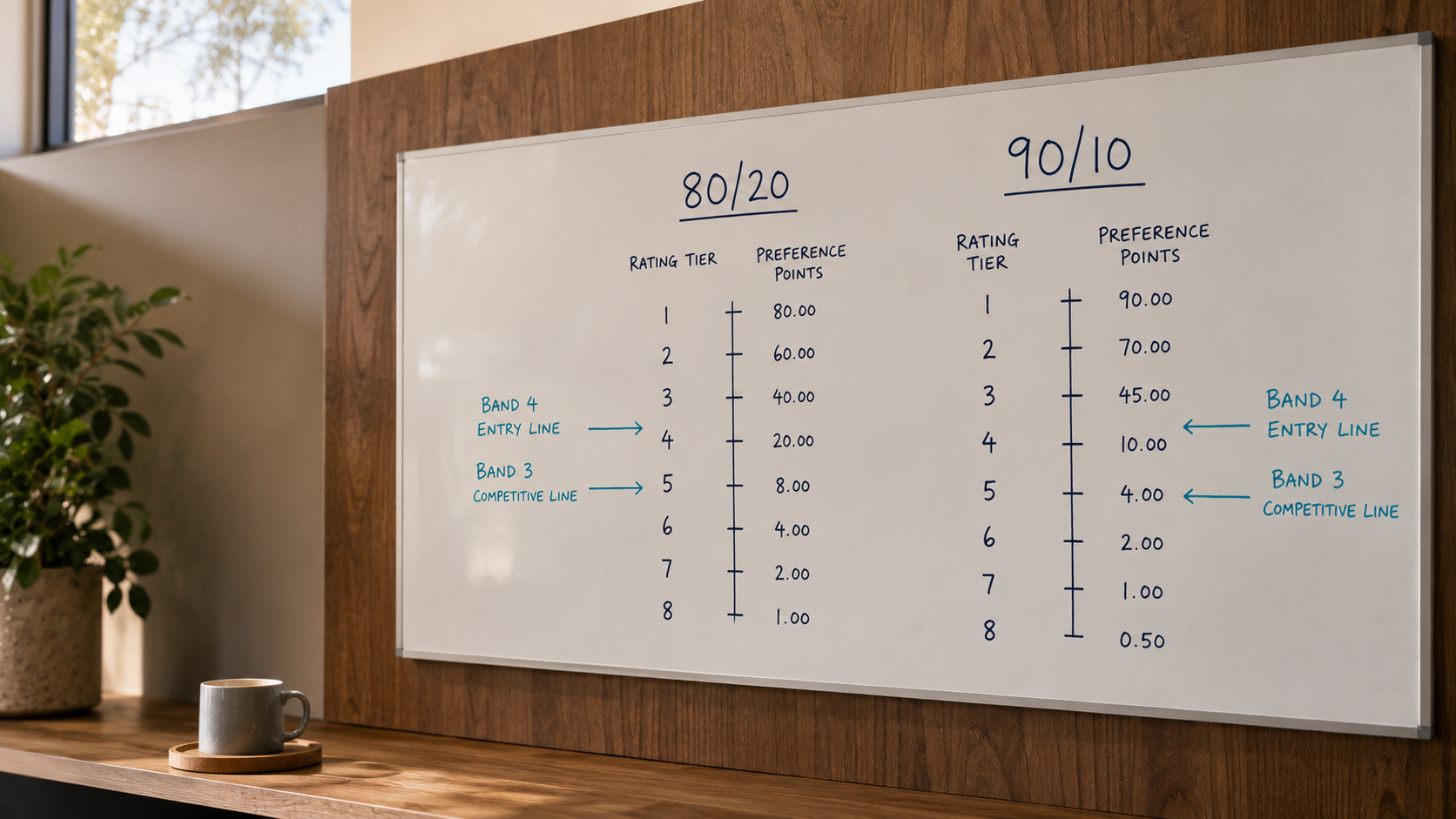
B-BBEE government tenders are scored under the Preferential Procurement Regulations 2022, which apply an 80/20 point split for state contracts up to R50 million and a 90/10 split above that threshold. A Level 1 supplier earns the full 20 (or 10) preference points; a Level 4 supplier earns 12 (or 5); below Level 8 the supplier earns zero. For competitive bids where pricing is within 5% across submissions, the rating-derived preference points usually decide the award. Most state contracts realistically require Level 4 minimum to be commercially competitive.
Preparing to bid on a state contract and wondering whether your current rating is competitive? Request a tender-readiness diagnostic →
How the Preferential Procurement Regulations Score Suppliers
The Preferential Procurement Regulations 2022 are the operational rulebook every organ of state uses to evaluate bids. The regulations came into effect in January 2023 after a Constitutional Court judgment invalidated the 2017 framework, and they apply across national departments, provincial governments, municipalities, and public entities listed under the Public Finance Management Act.
The mechanics work in two stages. The price component scores either 80 points (for bids up to R50 million) or 90 points (for bids above R50 million), calculated against the lowest acceptable price submitted. The remaining 20 or 10 points are allocated for specific goals — and the B-BBEE rating is the dominant input here.
An organ of state can use the 20 or 10 specific-goal points to recognise multiple goals beyond the rating itself: contracting with historically disadvantaged individuals, regional development goals, support for SMMEs, and so on. But the empowerment rating is the universal anchor.
For the full text of the implementation guide that organs of state work from when evaluating bids, see the National Treasury OCPO Implementation Guide for PPR 2022.
B-BBEE Government Tenders Under the 80/20 and 90/10 Systems
The split between the two preference point systems matters because the marginal value of each rating tier changes between them. Under 80/20, a single rating level shift is worth two preference points; under 90/10, the same level shift is worth one point. On a competitive R30 million bid where pricing is tight across submitters, two points often decide the award. On a R200 million bid, one point sometimes decides it.
| Rating Tier | 80/20 Preference Points (bids ≤R50m) | 90/10 Preference Points (bids >R50m) |
|---|---|---|
| Top tier (Level 1) | 20 points | 10 points |
| Second band (Level 2) | 18 points | 9 points |
| Third band (Level 3) | 14 points | 6 points |
| Band 4 (Level 4) | 12 points | 5 points |
| Band 5 (Level 5) | 8 points | 4 points |
| Band 6 (Level 6) | 6 points | 3 points |
| Band 7 (Level 7) | 4 points | 2 points |
| Band 8 (Level 8) | 2 points | 1 point |
| Below the scoring floor | 0 points | 0 points |
Notice that the step from Band 5 to Band 4 is worth four preference points under 80/20 — the largest single-tier jump anywhere on the table. This is why corporates carrying a Band 5 rating into state contracting markets feel the most acute commercial pressure to climb one band: the marginal procurement return on that single climb is materially higher than at any other tier transition.
What Rating Do You Actually Need to Win State Bids?
The honest answer is that it depends on the price competitiveness of your offer and the typical rating profile of competing bidders in your category. A few practical patterns hold across most public-sector contracting environments.
For specialised technical services where your pricing is competitive but not the lowest: Band 4 is the realistic minimum. Below Band 4, the preference point gap to the leading bidder is too large to overcome on price alone unless you are materially cheaper.
For commoditised goods and services where price is the dominant differentiator: Band 4 or the third band is often sufficient, because suppliers compete primarily on the 80 or 90 price points. The rating-driven preference points become the tie-breaker, not the primary decision driver.
For high-value strategic contracts where multiple suppliers can price competitively: The second band or top tier is often necessary. State buyers running large transversal contracts see a cluster of bids from second-band and top-tier suppliers, and a Band 4 supplier rarely wins these even with sharp pricing.
For provincial or municipal contracts under R10 million: Local specific-goal points (regional development, local SMME promotion) can offset the rating component. A Band 5 supplier with strong local presence and demonstrable township economy contracting credentials sometimes wins where a Band 3 supplier from outside the region cannot.
The Procurement Reality at Mid-Market Turnover
For generic-tier corporates with R50 million to R500 million annual turnover targeting national public-sector contracts, Band 4 is the entry threshold and the third band is where bidding becomes consistently competitive across categories. The strategic question is whether to defend Band 4 against slippage or invest in the climb to the third band — and the answer depends on how much of the business revenue comes from state contracting versus private-sector customers.
Quantifying the state-contracting return on rating-improvement investment? Book a strategy conversation with a senior Insignis advisor →
How a Mid-Market Supplier Wins State Contracts
Concrete example: a Pretoria-based information-and-communications-technology services firm with R190 million annual turnover ran two consecutive bid cycles before and after a structured rating climb from Band 5 to the third band.
| Bid Outcome Metric | Before — Band 5 rating | After — Third-band rating |
|---|---|---|
| Preference points earned (80/20 average) | 8 of 20 | 14 of 20 |
| Bids submitted (12-month window) | 17 | 21 |
| Bids advanced past first cut | 7 | 15 |
| Bids won | 2 | 8 |
| Win-rate on submitted bids | 12% | 38% |
| Total contract value won | R18 million | R94 million |
| Rating-improvement programme cost | baseline | R760,000 over 13 months |
| Net incremental revenue from state contracting | baseline | R76 million in year one |
The win-rate jump from 12% to 38% reflects two compounding effects. The preference points gap to the leading competitor closed by six points, which converted several near-miss bids into winners. The bid pipeline itself also opened up — submissions that the team would not have prepared at Band 5 became worth the effort at the third band.
Common Submission Mistakes That Lose State Bids
Submitting an expired empowerment certificate. Public-sector bid evaluators are required to score zero preference points where the certificate is invalid at the submission deadline. Many corporates run renewal cycles that drift two or three weeks past expiry; submitting during the gap window is a guaranteed zero on the rating component.
Using affidavit proof for QSE submissions where the contract value triggers measured-scorecard requirements. The affidavit route works for QSEs up to R50m turnover, but some state procurement units require verified scorecard certificates for contracts above specific thresholds. Submitting an affidavit where a certificate is required disqualifies the bid.
Missing specific-goal documentation. Beyond the rating itself, organs of state often allocate a portion of the preference points to specific goals (regional development, HDI ownership, youth employment, local SMME usage). Failing to submit the supporting documentation forfeits those points even where the supplier qualifies substantively.
Treating the SBD 6.1 form as administrative. The SBD 6.1 form is where the supplier formally claims its preference points. Errors on this form — wrong rating tier claimed, missing signature, mismatched certificate reference — directly invalidate the claim. Generic-tier corporates lose more bids to SBD 6.1 errors than to rating gaps.
The Compounding Pipeline Effect
Suppliers operating consistently at the third band or higher often find that state-contracting revenue grows faster than overall turnover. The improving rating widens the bid pipeline, the wider pipeline produces more wins, and the higher state-contract revenue base compounds across budget cycles. A board treating rating climb as cost-only often misses the revenue-acceleration side of the calculation.
Who This Article Is NOT For
Businesses with zero state-sector revenue ambitions. Pure B2B and B2C corporates with no public-sector contracting exposure feel the rating effects through customer supplier scorecards rather than direct preference-point scoring. The mechanics in this guide do not apply directly — the relevant framing is corporate procurement recognition, not preference point arithmetic.
Pure-play public-sector incumbents with locked transversal contracts. Where the business already holds an active multi-year state contract that does not come up for re-tender soon, the rating affects renewal-cycle positioning rather than imminent bid outcomes. The recovery framework is the wrong lens; the maintenance framework applies.
EMEs below R10 million turnover that automatically rate at Band 4. The default rating delivers 12 of 20 preference points (or 5 of 10 under 90/10) without any operational programme work. EMEs that want to compete at the third band or higher need to look at the affidavit-elevation rules for 51%-and-above black ownership, not at a measured-scorecard climb.
Suppliers whose pricing is consistently the lowest by 8% or more. Where the price competitiveness gap exceeds the rating-driven preference point gap, the rating becomes secondary to maintaining price leadership. A rating climb at the expense of price competitiveness often loses more bids than it wins.
How Insignis Sequences Tender Readiness Work
Insignis runs B-BBEE compliance strategy development for mid-market generic corporates with material state-contracting revenue. The engagement model differs from a routine rating-improvement programme because the timing pressure aligns to state budget cycles and tender-publication windows rather than to the supplier’s own measurement year alone.
Dr. Este Welman leads tender-readiness engagements with a Chartered Accountant (SA) background, a PhD in Economic Transformation from the Da Vinci Institute, an M.Comm in Taxation from North-West University, a B-BBEE Management Diploma from Wits, and SAICA membership. Her tender-readiness work focuses on the gap between the certificate renewal cycle and the typical state-contract bid windows — a mismatch that quietly costs corporates winnable bids each cycle.
The Insignis approach for tender-focused clients runs an annual rating-renewal calendar mapped against the major state tender publication windows, supports SBD 6.1 form preparation for each significant bid, and embeds bid-team rating literacy through quarterly briefings. Engagement scope is typically 9-12% of total programme value plus a small per-bid advisory component.
Bidding into state contracts and want a strategist who knows the SBD 6.1 trap inside out? Speak to a senior Insignis advisor on your tender pipeline →
Frequently Asked Questions
What is the difference between the 80/20 and 90/10 preference point systems?
The 80/20 system applies to state contracts with a Rand value up to R50 million inclusive of taxes — price scores 80 points and specific goals (including the rating) score 20 points. The 90/10 system applies above R50 million, with 90 points for price and 10 for specific goals.
The marginal value of each rating tier is therefore higher under 80/20, which is why mid-market suppliers feel the rating effect most acutely on bids below R50 million.
How many preference points does a Band 4 rating earn on an R20 million state bid?
Twelve points out of twenty under the 80/20 system, which applies at that bid value. The leading top-tier supplier earns the full twenty points on the same bid, leaving a Band 4 supplier with an eight-point gap to close on the price component. Closing eight points on an R20 million bid typically requires the supplier to price 5% to 7% lower than the leader.
Is an affidavit acceptable for state-contract bid submissions?
For EMEs and qualifying QSEs with 51%-or-above black ownership, sworn affidavits are acceptable proof of rating tier and substitute for a verified certificate. Some state procurement units have additional documentation requirements for contracts above specific thresholds, so checking the tender document carefully matters. The affidavit must be properly notarised and current to the bid submission date.
What happens if the certificate expires between bid submission and contract award?
State procurement units typically require the certificate to be valid at the submission deadline. Subsequent expiry during the evaluation window does not invalidate the bid, but contract award is sometimes contingent on a renewed certificate being available by the award date. Suppliers running renewal cycles that overlap with active bid windows should communicate the timing to the procurement unit proactively.
Can specific-goal points compensate for a low rating?
Partially, depending on how the tender allocates the twenty or ten specific-goal points. Where a tender allocates ten of the twenty points to the rating and ten to other specific goals (regional development, HDI ownership, youth employment), a supplier with strong specific-goal credentials can offset a lower rating. Where the tender allocates all twenty points to the rating itself, no compensation is possible.
How long does a rating-climb programme take to pay back through state contracting?
Typically twelve to twenty-four months from programme start, depending on tender pipeline density and average contract size. Suppliers with an active pipeline of three-to-five state bids per quarter see the win-rate improvement within the first renewal cycle after the new rating is issued. Suppliers with sporadic bid activity see the payback over a longer horizon as bid frequency matters more than any single bid outcome.
Align Your Rating Cycle to Your State-Contract Bid Pipeline
The rating renewal cycle and the state tender publication windows rarely line up by accident. The diagnostic conversation maps your rating renewal dates against your typical bid cadence and identifies whether the timing mismatch is quietly costing you winnable contracts each cycle.
Dr. Este Welman or a senior Insignis advisor will run the initial tender-readiness diagnostic. No obligation. We will get back to you within 24 hours of your enquiry.
Book a Tender-Readiness Diagnostic
About the Author — Dr. Este Welman, CA(SA)
Founding Partner, Insignis Solutions. Chartered Accountant (SA), PhD in Economic Transformation (Da Vinci Institute), M.Comm in Taxation (North-West University), B-BBEE Management Diploma (Wits), SAICA member.
Dr. Welman advises mid-market generic corporates with material public-sector contracting exposure, focusing on the rating-cycle and bid-window timing alignment that separates suppliers who win consistently from suppliers who win occasionally despite carrying the same rating tier.