
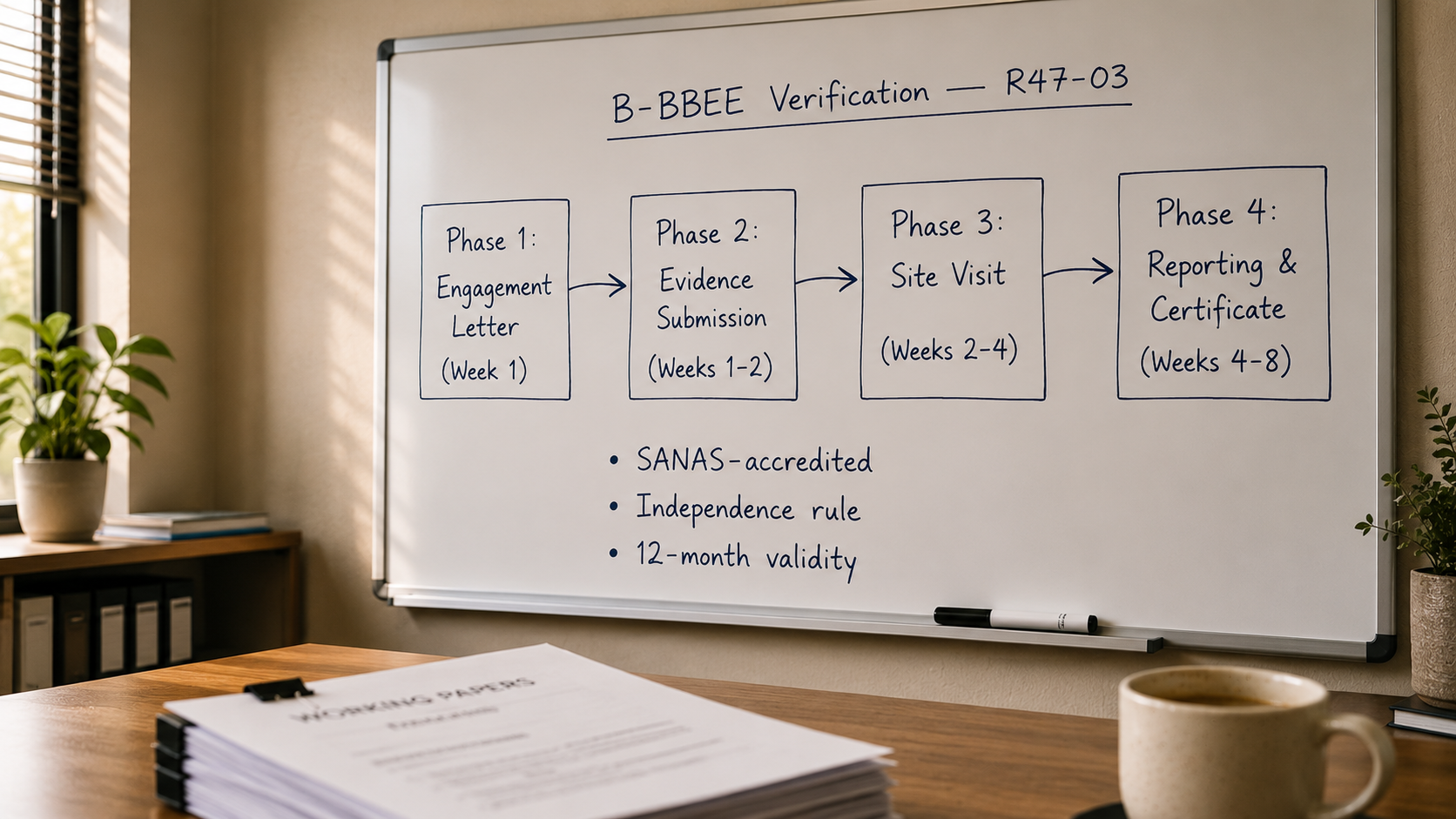
The B-BBEE verification process is the SANAS-accredited rating engagement that produces the certificate carrying the corporate’s empowerment status — and it is structured very differently from the advisory work that prepares the corporate to face it. Most CFOs first encounter the difference at the site visit, when the rating agency declines to discuss interpretation of the Codes and instead asks for the next batch of evidence.
This guide explains what actually happens during the verification — the R47-03 framework that governs it, the four-phase engagement timeline, what the agency tests at site visit, and where the boundary sits between what a verifier can and cannot do. For the wider context on the B-BBEE certificate process in South Africa, that pillar covers the full certificate lifecycle; this article focuses on the verification itself.
Quick Answer
The B-BBEE verification process is a SANAS-accredited rating engagement conducted under R47-03, in which an independent verification agency tests the corporate’s submitted evidence against the Codes of Good Practice and issues a certificate confirming the resulting scorecard level. The engagement typically runs four to eight weeks across four phases — engagement letter, planning, site visit, and reporting — and produces a certificate valid for 12 months from the date of issue. The verification agency is an independent rater, not an advisor; under R47-03 it cannot provide gap analysis, scenario planning, or interpretation of the Codes during the engagement.
Verification window approaching and want to understand what to expect? Request a verification-readiness conversation →
What the B-BBEE Verification Process Means Under R47-03
R47-03 — the SANAS Accreditation Programme for B-BBEE Verification Agencies — defines a verification as the independent assessment of a measured entity’s compliance with the Codes of Good Practice, performed by a SANAS-accredited rating agency, leading to the issuance of a B-BBEE verification certificate. The framework borrows its conceptual model from financial audit: an independent professional examines evidence against a defined standard and issues an attestation. The certificate is the attestation document.
Three structural features matter. The verification agency must be SANAS-accredited under R47-03, which means it has been formally evaluated against international ISO/IEC 17029 standards for conformity assessment bodies. The technical signatory who signs the certificate must be a registered verification professional, separately credentialed and bound by ethical standards.
And the agency must maintain independence from the corporate it rates — under R47-03 it cannot provide advisory services to the same client during or around the verification cycle.
According to the B-BBEE Commission’s Practice Guide on the verification process, the role of a verification professional is not to express an opinion on the interpretation of any B-BBEE matter — that role is assigned to the B-BBEE Commission by the Act. The verifier’s role is narrower: assess the evidence against the Codes as written, and rate accordingly.
That narrowness is what makes the certificate worth something commercially. A rating from an entity that could also have advised the corporate would carry no more weight than the corporate’s own self-assessment.
The B-BBEE Verification Process Timeline: Four Phases
A typical engagement runs four to eight weeks from engagement letter to certificate issuance, sequenced through four phases. The agency’s work compresses into the middle two phases; the corporate’s evidence-readiness work has to be complete before phase one begins.
Phase 1 — Engagement letter and scoping (week 1). The corporate selects a SANAS-accredited verification agency, the agency issues an engagement letter scoping the work against the corporate’s industry sector code (Generic Codes, Financial Sector Code, Mining Charter, ICT Sector Code, etc.), and a verification fee is agreed.
Fee structure is typically based on the corporate’s turnover band and the complexity of the scorecard. R47-03 prohibits the agency from offering fee discounts contingent on a particular level outcome.
Phase 2 — Planning and evidence submission (weeks 1–2). The agency sends the corporate an evidence request list, structured by scorecard element, against which the corporate uploads the assembled evidence file. This is the phase where a poorly prepared corporate scrambles, because the agency’s evidence list is exhaustive.
The list typically covers the share register, trust deeds, EMP201 trail, training register, SETA learnership agreements, supplier B-BBEE certificates, ESD contribution agreements, Section 18A receipts, and board minutes confirming EE plans. A corporate that has run a compliance audit through the cycle delivers the evidence file at phase 2 ready; one that hasn’t, starts assembling under deadline pressure.
Phase 3 — Site visit and substantive testing (weeks 2–4). The agency’s verification team conducts an on-site visit, supplemented by online evidence review, during which they test the submitted evidence against R47-03 sampling methodology. The site visit typically runs three to five days for a Generic-Codes corporate and can extend longer for multi-entity groups or sector-code corporates. The technical signatory may attend portions of the visit personally or review the team’s working papers remotely.
Phase 4 — Reporting and certificate issuance (weeks 4–8). The agency drafts a verification report, the technical signatory reviews and signs, and the certificate is issued. The certificate carries the SANAS accreditation symbol and number, the technical signatory’s name and registration number, the corporate’s scorecard breakdown by element, and the resulting B-BBEE level. The certificate is valid for 12 months from the date of issue.
What the Verification Agency Tests at Site Visit
The site visit phase is where most of the testing intensity sits. The agency works through the evidence file element by element, sampling transactions and documents to substantive-test the scorecard claims the corporate has submitted. The depth of testing scales with materiality — a R50,000 SED contribution gets less scrutiny than a R5 million Ownership transaction, but neither is taken on faith.
On Ownership, the agency tests the share register against the actual share certificates and trust deeds, traces dividend payments to bank statements, calculates Net Value independently using the Time Graduation Factor, and confirms voting-rights provisions in the company’s MOI. If the structure includes an Employee Share Ownership Plan or a Broad-Based Ownership Scheme, the trust deed itself is read end-to-end and the trustees’ minutes are sampled.
On Skills Development, the agency reconciles the training register to the EMP201 trail, samples training events to attendance registers and proof of payment, and tests Section 12H learnership claims against the underlying SETA registration documents. Triple-recognition claims for training of people with disabilities are tested against medical certification.
On Enterprise & Supplier Development, the agency samples supplier B-BBEE certificates, tests that each is valid at the measurement period, and reconciles the Preferential Procurement spend total to the corporate’s general ledger. Supplier Development and Enterprise Development contributions are tested for both Rand value and outcome — did the supplier actually grow, was the training actually delivered.
On Management Control, the agency reconciles the EE report submitted to the Department of Employment and Labour to the management-tier diversity numbers claimed on the scorecard. Misalignment between EE-Act reporting and B-BBEE Management Control scorecard claims is one of the most common findings at this phase.
Takeaway
The verification is substantive testing, not a paperwork tick. Every scorecard claim is traced back to a source document — a share certificate, a bank statement, a trust deed, an EMP201 return, a SETA contract — and tested against R47-03 sampling rules. Corporates whose evidence file genuinely supports the claims sail through; corporates whose evidence has gaps discover them at this stage, when there is no longer time to fix them inside the financial year.
The Verification Report and the Certificate Issuance
A verification report is the working paper file that supports the certificate. It runs to thirty or forty pages for a Generic-Codes corporate and contains an executive summary, the element-by-element scorecard with point allocations, the evidence sample tested per element, the technical signatory’s conclusion, and any findings or qualifications.
The certificate itself is a one-page document carrying the SANAS accreditation symbol, the verification agency’s SANAS accreditation number, the technical signatory’s name and registration number, the corporate’s legal name and registration number, the measurement period, the B-BBEE level achieved, the scorecard summary by element, and the certificate’s expiry date. That expiry date sits 12 months after the date of issue, and the next verification cycle begins planning six months before that expiry.
Customers and procurement counterparties will request the certificate — typically in tender submissions, supplier on-boarding processes, or public-sector contract awards. Authenticity can be confirmed directly with SANAS or with the issuing agency, which means fabricated certificates collapse on first counterparty scrutiny.
Need help structuring evidence so the verification report contains zero findings? Request an evidence file review →
What the Verification Agency Cannot Do Under R47-03
The R47-03 independence rule defines the boundary clearly. The agency is permitted to test evidence, apply the Codes, and issue a rating opinion. The agency is not permitted to advise on Code interpretation, structure scorecard scenarios, draft trust deeds, recommend ESD beneficiaries, or do any other work that resembles consultancy for the client it is rating.
| Activity | Verification Agency Can? | Verification Consultant Can? |
|---|---|---|
| Test submitted evidence against the Codes | Yes — this is the verification | Yes — at pre-verification compliance audit stage |
| Issue the B-BBEE certificate | Yes — the SANAS-accredited certificate | No — only SANAS-accredited agencies can |
| Advise on Code interpretation | No — the framework prohibits this | Yes — within the advisory engagement |
| Structure a B-BBEE ownership transaction | No — independence violation | Yes — central consultant work |
| Recommend ESD beneficiaries | No — independence violation | Yes — within the advisory engagement |
| Calculate the Net Value sub-indicator | Yes — at verification | Yes — at compliance audit |
| Negotiate the scorecard outcome | No — the rating is an opinion, not a deal | No — consultant work shapes substance, not opinion |
The implication for corporates: any request to the verification agency that resembles advice receives a polite redirection. The agency will not tell the corporate how to fix a gap mid-verification, will not interpret an ambiguous Code provision in the corporate’s favour, and will not help structure a deferred Ownership transaction to qualify under the measurement period. Those questions belong to the consultant, who should already have answered them six months earlier.
Takeaway
The structural separation between consultant and rating agency is what gives the certificate commercial weight. A rating that could be negotiated with the rater would carry no more authority than the corporate’s self-assessment. The boundary is not bureaucratic — it is the mechanism that makes the SANAS accreditation symbol on the certificate worth something to the customers and procurement counterparties who will rely on it.
Common Verification Surprises and What Causes Them
Most verification surprises are not the agency catching something the corporate had hidden. They are the agency applying the Codes more strictly than the corporate’s internal team had assumed. Five patterns recur.
The Leviable Amount mismatch. The Skills Development calculation uses the corporate’s SARS-reported Leviable Amount as the denominator. Corporates whose finance team had used management-accounts payroll instead discover the variance at verification, and the variance always reduces Skills Development points — never increases them. The R-value gap is sometimes large enough to trigger the priority element sub-minimum.
The Ownership Net Value calculation gap. Many corporates submit Ownership scores based on the nominal Black-shareholder percentage on the share register. The agency calculates Net Value using the Time Graduation Factor, the realised economic value to Black participants, and the deemed-vested portion of any deferred ownership structures. The recalculated Net Value frequently sits below the sub-minimum even where the nominal percentage exceeds 51%.
The ESD beneficiary certificate lapse. Preferential Procurement and Supplier Development claims depend on the suppliers’ own B-BBEE certificates being valid at the measurement period. Corporates often discover at verification that one or more ESD beneficiaries’ certificates had lapsed mid-cycle, which means the claimed spend is recalculated against the lapsed-status discount.
The EE-Act-Management Control divergence. The corporate’s annual EE-Act submission to the Department of Employment and Labour is a public-record document the agency obtains and reconciles to the Management Control scorecard claim. Where the two diverge — and they often do because the EE submission is HR-led and the Management Control scorecard is finance-led — the agency uses the EE submission as the authoritative figure.
The SED Section 18A-receipt absence. SED contributions are creditable when paid to qualifying Black beneficiaries — and to a Section 18A-registered beneficiary the contribution also qualifies for direct tax deduction. Corporates whose SED beneficiary lacks Section 18A registration get the scorecard credit but lose the deduction, and the agency notes this in the report as a structural inefficiency.
| Verification Outcome | Before Compliance-Audit Engagement | After Compliance-Audit Engagement |
|---|---|---|
| Leviable Amount reconciliation | Management-accounts figure used | EMP201 figure used, claim defensible |
| Ownership Net Value calculation | Nominal percentage submitted | Time Graduation Factor modelled, sub-minimum cleared |
| ESD beneficiary certificate tracking | Annual check only | Quarterly check, mid-cycle lapses replaced |
| EE-Act-Management Control alignment | HR and finance reporting separately | Joint reconciliation pre-submission |
| Verification findings count | Three to five material findings | Zero material findings |
| Certificate level outcome | Level 4 (target Level 2) | Level 2 (target achieved) |
Who This Is NOT For
How the Insignis Approach Anchors the B-BBEE Verification Process Outcome
The Insignis approach treats the verification as a confirmation event, not a discovery event. The compliance audit work runs six months before the verification window opens — testing every scorecard claim against the same R47-03 standard the rating agency will apply, identifying gaps inside the financial year while there is still time to close them, and consolidating the evidence file to the structure the agency will request.
Dr. Welman’s CA(SA) and M.Comm Tax credentials anchor that work in the same evidence-testing discipline the audit profession applies. The result is a verification engagement where the corporate already knows what the rating outcome will be — because the same calculations have already been done, the same evidence has already been reconciled, and the same priority element sub-minimums have already been tested.
The four-phase consultant engagement that sets up this kind of verification outcome is scoped on the Insignis B-BBEE verification compliance service page, where the work is sequenced against the corporate’s verification window.
A B-BBEE Verification Process Done Right: Engagement Snapshot
A Pretoria-based industrial group with turnover of R220 million engaged Insignis nine months ahead of their verification window, after a prior cycle had landed them a Level 4 certificate despite scorecard arithmetic that should have produced Level 2.
The Level 4 outcome had been driven by three findings at the prior verification — an Ownership Net Value calculation that didn’t survive the Time Graduation Factor recalculation, a Skills Development claim that didn’t reconcile to the EMP201 trail, and an ESD beneficiary whose B-BBEE certificate had lapsed two months before the measurement period closed.
The nine-month consultant engagement closed all three gaps inside the financial year before the next verification opened. The Ownership calculation was redone with the Time Graduation Factor correctly applied and the supporting deemed-vested workings documented. The Skills Development claim was rebuilt against the SARS-reported Leviable Amount with quarterly reconciliations. The lapsed ESD beneficiary was replaced six months before year-end, with the new beneficiary’s certificate confirmed valid through the measurement period.
The subsequent verification ran four weeks from engagement letter to certificate issuance, with zero material findings in the verification report. The corporate held a Level 2 certificate at the end of the cycle and the cost saving on the next-cycle tender pipeline materially exceeded the consultant fee that had produced the outcome.
Want a verification window timeline structured against your year-end? Request a phased engagement scope →
Frequently Asked Questions
How long does the B-BBEE verification process take?
A typical engagement runs four to eight weeks from engagement letter to certificate issuance, with the site visit phase taking three to five days for a Generic-Codes corporate. Multi-entity groups, sector-code corporates, and corporates with complex Ownership structures can extend the timeline. The corporate’s own pre-verification compliance audit work runs six months ahead of the engagement and is not part of the verification timeline itself.
What does a SANAS-accredited verification agency actually do?
The agency tests the corporate’s submitted evidence against the Codes of Good Practice using R47-03 sampling methodology, applies the scorecard calculations to the verified evidence, and issues a certificate confirming the resulting B-BBEE level. The technical signatory is a registered verification professional who personally signs the certificate. Under R47-03 the agency cannot provide advisory services, gap analysis, or Code interpretation to the same client during the engagement.
How long is a B-BBEE certificate valid?
The certificate is valid for 12 months from the date of issue. Planning for the next cycle begins approximately six months before the expiry date, which is when the compliance audit work should start. Corporates whose certificate expires without a new verification in place face a gap during which they cannot demonstrate B-BBEE status to customers or procurement counterparties — a commercially expensive position to be in.
Can we change verification agencies between cycles?
Yes, and many corporates do so to maintain a fresh perspective on the evidence. Changing agencies does not affect the scorecard outcome materially because all SANAS-accredited agencies apply the same R47-03 framework to the same Codes.
What can change between agencies is the depth of testing on edge cases — agencies vary in how strictly they apply marginal interpretations. The selection criterion is the agency’s technical signatory experience and its track record on the corporate’s industry sector code, not fee level.
What happens if the verification report contains findings?
Findings are recorded in the verification report and reduce the relevant scorecard element points accordingly. Material findings can trigger priority element sub-minimum failures and reduce the certificate by one level. The corporate cannot negotiate findings out of the report during the engagement; the only path to a stronger certificate is to address the underlying issue in the next cycle. Recurring findings across cycles signal that the corporate’s pre-verification compliance audit work is not running properly.
Does the verification agency report findings to the B-BBEE Commission?
The verification agency submits the certificate and supporting data to the B-BBEE Commission under Section 13G of the Act, and the Commission maintains a register of verified B-BBEE statuses.
Material misrepresentation — fronting, fabricated evidence, fictitious beneficiaries — is reportable separately under Section 13O and can trigger Commission investigation, criminal sanction, and a fine of up to 10% of annual turnover. The independence of the agency from the corporate is what makes this reporting mechanism credible.
Get the Verification Cycle Structured Before the Window Opens
The single highest-leverage move on the verification outcome is the work that happens six months before the engagement letter is signed. Corporates whose compliance audit work has tested every scorecard claim against the R47-03 standard the agency will apply walk into verification knowing the outcome; corporates whose evidence is still being assembled when the agency arrives spend the cycle managing surprises.
Request a Verification-Readiness Conversation
Schedule a no-cost initial conversation with Dr. Este Welman, CA(SA), and the Insignis team. We walk through your current scorecard composition, model the priority element sub-minimum positions, and scope the four-phase compliance audit engagement against your verification window timeline.
No obligation. We will get back to you within 24 hours.
Request Your Verification-Readiness Scope
About the Author
Dr. Este Welman, CA(SA) — Founding Director, Insignis Solutions
A Chartered Accountant (SA) holding a PhD in Economic Transformation from the Da Vinci Institute, an M.Comm in Taxation from North-West University, a B-BBEE Management Diploma from Wits, and registered SAICA membership.
Her compliance audit work runs to the same evidence-testing standard the rating agency will apply at verification — Ownership Net Value modelled with the Time Graduation Factor, Skills Development reconciled to the EMP201 trail, ESD beneficiary certificates tracked quarterly across the cycle. The outcome is a verification engagement the corporate already knows the answer to before the agency arrives.