
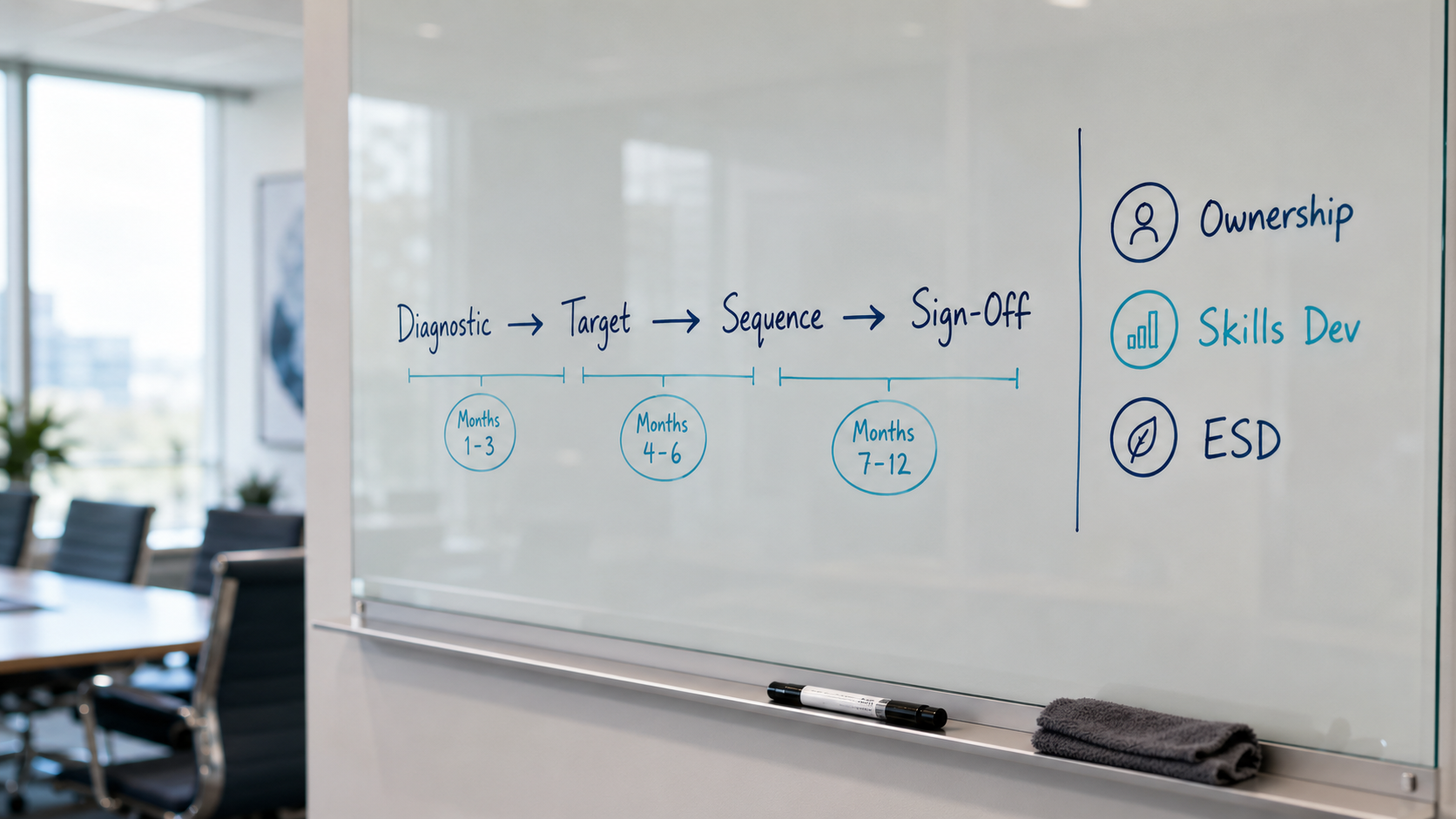
B-BBEE strategy development for an R50m+ corporate isn’t a slide deck. It’s a multi-cycle plan that ties scorecard targets to operational levers, costed at Rand level, sequenced against the verification calendar, and signed off by the executive committee before any spend lands.
Done well, it produces a Level 2 certificate that holds across three cycles. Done as a one-off project, it produces a Level 2 in year one that drifts to Level 4 by year three. The scorecard improvement work that follows depends entirely on whether the strategy underneath it is multi-year or single-cycle.
This guide explains what corporate-grade strategy work actually involves, what outputs to expect at each phase, where most strategies fail, and how to scope a brief that produces commercially defensible plans.
Quick Answer
B-BBEE strategy development is the process of translating a corporate’s commercial objectives into a multi-cycle scorecard plan — diagnostic of current position, target level identification, element-by-element sequenced moves, costed activity allocations, and executive committee sign-off. A defensible engagement typically runs 8 to 12 weeks for a single-entity Generic Codes corporate and produces an 18 to 36-month execution roadmap. The output isn’t the certificate; it’s the multi-year transformation programme the certificate certifies.
Need a costed multi-year B-BBEE roadmap? Get a structured strategy scoping call →
What B-BBEE Strategy Development Actually Produces
The output of credible B-BBEE strategy development isn’t a glossy document. It’s a working operating plan that the corporate’s executive committee, finance team, and HR leadership can execute against between verification cycles.
At minimum, a defensible strategy produces five concrete deliverables. A diagnostic of the current scorecard position with element-by-element points and sub-minimum risk flagged. A target level identification linked to specific commercial opportunities (tenders, customer panels, sector positioning).
An 18 to 36-month execution roadmap sequencing the element-by-element moves required to hit the target. A costed activity budget covering training spend, ESD contributions, SED contributions, and supplier panel restructuring. An executive committee briefing pack that translates the technical scorecard work into commercial language for board approval.
Anything less than this isn’t strategy. It’s a verification preparation document, and the distinction matters because verification preparation focuses on the next cycle while strategy focuses on the next three.
The Diagnostic Phase — Where B-BBEE Strategy Development Starts
Every credible strategy starts with a diagnostic of the current position. Without it, the target setting becomes wishful thinking. The diagnostic phase typically runs 2 to 3 weeks and produces a baseline scorecard model showing exactly where the corporate sits today.
The diagnostic tests four things. The current scorecard composition across all five elements — what’s earning points, what isn’t, and where bonus points are being missed. The sub-minimum risk on the three priority elements — Ownership, Skills Development, and ESD.
The methodology consistency between management estimates and SARS-reported figures, particularly Skills Development Leviable Amount and Preferential Procurement supplier B-BBEE certificate alignment. The evidence trail strength for the most recent certificate, which signals whether the existing scorecard can survive a more rigorous verification cycle.
What the diagnostic produces isn’t a verdict. It’s a starting position. A corporate that diagnoses at 76 points (Level 5) has different strategic options than one diagnosing at 92 points (Level 3) — different element gaps, different priority element risks, different runway to the next level.
Takeaway
The diagnostic isn’t a status check. It’s a structured test of whether the current scorecard reflects substantive transformation activity or accumulated documentation. Two corporates that both hold Level 3 certificates can have completely different diagnostic profiles — one earning every point legitimately, one with two sub-minimum misses about to surface. The strategy that follows looks nothing alike for these two starting positions.
Target Setting — The Step Most B-BBEE Strategy Development Engagements Get Wrong
The most common failure point in B-BBEE strategy development isn’t execution. It’s target setting. A corporate that targets Level 2 without first naming the three customers or tenders the Level 2 unlocks ends up overinvesting in the certificate and underinvesting in customer development.
Credible target setting tests three questions before any scorecard work is planned. Which specific commercial opportunities depend on the current level versus the targeted level? What’s the Rand value of those opportunities at the current level versus the targeted level? What’s the timeline of those opportunities relative to the verification calendar?
These three questions sit at the centre of any defensible B-BBEE strategy development engagement, and skipping them is the single most common reason mid-cycle strategies unravel.
Where the answers produce a clear commercial case, the target level is set and the strategy follows. Where the answers reveal that the certificate level isn’t actually load-bearing on revenue, the strategy pivots to Level 4 maintenance rather than upgrade work. Both outcomes are legitimate. The mistake is targeting Level 2 by default and only discovering after the engagement that the commercial case wasn’t there.
Sequencing the Element-by-Element Moves
Once the target is set, the strategy sequences the element-by-element moves required to reach it. This is where most generic B-BBEE strategy development templates fall apart — they treat all five elements as parallel workstreams when the priority element sub-minimum rule means they’re not parallel at all.
A credible sequence concentrates the first six months on the three priority elements: Ownership, Skills Development, and ESD. Sub-minimum risk on any of these three downgrades the entire certificate by one level regardless of total points scored. Spending three months building Management Control or SED points while a Skills Development sub-minimum sits unaddressed produces a worse outcome than concentrating on Skills Development alone.
The second six months address the remaining two elements and the bonus point opportunities — Skills Development training for people with disabilities, ESD support for Black-owned EME and QSE suppliers, ownership new-entrant bonus points. These moves are accessible once the priority element foundation is stable.
The final phase — months 13 to 18 — addresses methodology hardening: ensuring SARS Leviable Amount reconciliations are clean, that supplier B-BBEE certificates are tracked against invoice dates not financial year-end, that ESD outcomes are documented in beneficiary-impact terms rather than input-spend terms.
Sequencing priority elements against the verification calendar? Request a phased execution map →
Anchoring the B-BBEE Strategy Development to SA Demographic Data
Strategies built on aspirational demographic assumptions don’t survive verification. Strategy work anchored on current Stats SA data does. The Stats SA Quarterly Labour Force Survey publishes quarterly labour force participation and employment data by race, gender, and age that anchors any defensible Skills Development and Management Control planning.
The Q1 2026 QLFS data establishes the working context: a 42.2 million working-age population, 32.7% headline unemployment, 45.8% youth unemployment. These figures don’t determine scorecard targets directly, but they determine whether a Management Control plan that targets specific demographic percentages is achievable in the available talent pool, and whether Skills Development programmes need to source training cohorts from the broader NEET population rather than from the formally employed labour force.
Corporates whose strategies don’t reference current Stats SA data tend to set Management Control targets that can’t be filled from the available pool, then discover the gap at verification. Anchoring the targets to actual demographic data avoids the gap.
Costing the Activity Programme
The strategy must produce a Rand-level activity budget — not a category-level estimate, not a percentage-of-revenue benchmark, but a costed line-item plan that finance can integrate into the next 18 months of budgeting cycles. Credible B-BBEE strategy development treats this costing exercise as the deliverable that separates a working plan from a slide deck.
The activity budget covers five line items typically. Training spend (calculated as a percentage of SARS Leviable Amount, with a minimum threshold to clear the Skills Development sub-minimum). ESD contributions split between Preferential Procurement allocation (operational, supplier panel optimisation) and direct ESD spend (financial or non-financial support to qualifying beneficiaries).
SED contributions (targeting 1% of NPAT to qualifying Black beneficiaries). Ownership transaction costs if an ownership move is part of the strategy (legal, advisory, and any cash component). Verification cycle costs including consultant fees and SANAS-accredited agency fees.
For most R50m+ corporates, total annual activity spend lands at 1.2% to 2.8% of revenue, with consulting fees a small fraction of that figure. The strategy makes those allocations explicit and tied to the scorecard targets they support.
Why B-BBEE Strategy Development Fails Without Executive Sign-Off
The deliverable most often missed is the executive committee briefing pack. Strategy documents that sit with HR or compliance without exec-level sign-off don’t survive their first budget cycle — when finance is asked to allocate R3.5m of training spend in year one without exec-level commitment to the scorecard target, the allocation gets trimmed and the strategy unravels.
The brief to the executive committee translates technical scorecard language into commercial language. Instead of “We need to add 8 points on Skills Development to clear the priority element sub-minimum,” the brief reads “We need R3.5m of training spend over the next 18 months to defend the Level 3 certificate and unlock the R45m supplier panel slot at [named customer].” Same fact. Different language.
Skipping this translation layer is the single most common reason B-BBEE strategy development engagements stall at execution — the work is technically correct but commercially incommunicable.
Executives sign off on commercial cases, not scorecard mechanics. The strategy that gets executive backing is the one translated into the language executives use to allocate capital.
Takeaway
The single biggest predictor of strategy survival across three certificate cycles is the level at which it’s signed off. HR-only sign-off produces strategies that get cut in the first budget cycle. CEO + CFO sign-off produces strategies that survive — because both finance and operational leadership are committed to the activity allocations the strategy depends on.
Who This Is NOT For
Why Insignis Treats Strategy as a Capital Allocation Decision
Most B-BBEE consultants treat B-BBEE strategy development as a compliance exercise. Insignis treats it as a capital allocation decision. The R3.5m of training spend, the R8m of ESD allocation, the supplier panel restructuring — these are real Rand commitments that compete with every other capital decision the corporate makes. The strategy that wins exec sign-off is the one that articulates the commercial return on each Rand committed.
Dr. Este Welman’s CA(SA) and M.Comm in Taxation backgrounds shape this approach. Strategy briefs are scoped against the commercial logic finance teams use to evaluate any capital investment — IRR, NPV, optionality, downside risk — not against the soft language of compliance.
Our team works with R50m+ corporates and JSE-listed clients across mining, financial services, ICT, and the broader corporate sector from our Centurion office. For the strategy development engagement model, see our compliance strategy development service page.
Before-and-After: What a Re-Scoped B-BBEE Strategy Development Engagement Delivers
A mid-market industrial group engaged Insignis after two consecutive years of strategy work that didn’t translate into certificate improvement — Level 4 in year one, Level 4 in year two, despite R6.8m of cumulative activity spend across both cycles.
Diagnostic work identified the cause: spend was distributed evenly across all five elements without addressing a Skills Development sub-minimum that was discounting the level. Twelve months of restructured strategy work later, the same corporate held Level 2.
| Strategy Metric | Before Restructuring | After Restructuring |
|---|---|---|
| Certificate level | Level 4 | Level 2 |
| Annual activity spend | R3.4m (even distribution) | R2.9m (priority-element weighted) |
| Skills Development points | 6 of 20 (sub-min miss) | 17 of 20 |
| Strategy horizon | 12 months (annual reset) | 36 months (multi-cycle) |
| Exec committee sign-off | HR-only sign-off | CEO + CFO sign-off |
| Customer-facing recognition value | 100% (Level 4) | 125% (Level 2) |
The spend dropped by R500,000 while the certificate moved two levels. The driver wasn’t more money — it was priority-element-weighted allocation. The strategy that addressed the Skills Development sub-minimum directly produced more value than the strategy that distributed effort evenly across all five elements.
What Distinguishes Defensible B-BBEE Strategy Development
Defensible B-BBEE strategy development work shares five characteristics, and most generic engagements lack at least two of them.
Diagnostic-first methodology, not target-first. A strategy that opens with “We aim for Level 2” before testing whether the current position supports Level 3 produces aspirational planning, not execution-ready strategy.
Priority element sequencing, not parallel element work. Treating Ownership, Skills Development, and ESD as the first six months of work versus the back-half allocation produces materially different outcomes.
Rand-level activity costing, not category estimates. “Increase Skills Development spend” isn’t a strategy. “R3.5m of formal accredited training over 18 months, structured to deliver 17 of 20 Skills Development points” is.
SARS Leviable Amount methodology alignment. Skills Development calculations that don’t reconcile to the SARS-reported Leviable Amount produce verification disputes that cost points at certificate stage. The strategy must align finance, HR, and SARS reporting before training spend lands.
Executive committee sign-off, not departmental sign-off. Strategies signed off only at HR or compliance level don’t survive their first budget cycle. CEO + CFO sign-off is the minimum for any strategy expecting to survive the next 36 months.
Want a strategy brief structured for CEO sign-off? Request a board-level engagement brief →
Frequently Asked Questions on B-BBEE Strategy Development
How long does a strategy development engagement take?
A typical single-entity Generic Codes engagement runs 8 to 12 weeks from kickoff to executive committee sign-off. The diagnostic phase takes 2 to 3 weeks. Target setting and stakeholder alignment takes 2 to 3 weeks. Sequencing and costing takes 3 to 4 weeks. Executive committee preparation and sign-off takes 1 to 2 weeks.
Multi-entity groups and sector-coded entities run longer — typically 14 to 18 weeks for a group of 5 or more entities operating under a sector code.
What does a strategy engagement cost?
For R50m+ corporates, strategy development fees range from R85,000 to R220,000 depending on entity complexity. Single-entity Generic Codes engagements sit at the lower end. Multi-entity sector code groups sit at the upper end. Where strategy is part of a broader retainer engagement, the standalone phase pricing is typically lower because diagnostic work is integrated rather than billed separately.
Can we run strategy work in parallel with verification?
Better to run them sequentially. Strategy work undertaken during a verification cycle creates conflicting priorities — the verification team focuses on evidence pack defence while the strategy team plans forward moves. Sequence the strategy phase to complete 2 to 3 months before the next verification cycle starts, giving the corporate runway to execute the first phase of moves before evidence collection begins.
Should strategy work include the ownership element?
For corporates near the Ownership sub-minimum threshold, yes — and the strategy should test ownership options before any other element-level work. For corporates with stable ownership scoring well above the sub-minimum, the strategy work can focus on the other elements. Ownership transactions are the most expensive and time-consuming scorecard move available, with legal, advisory, and structuring costs typically running R600,000 to R3m+ depending on transaction size. They’re not undertaken lightly.
How often should strategy be revisited?
The strategy itself operates on a 36-month horizon, with annual refresh checks rather than annual rewrites. Each year, the diagnostic is re-run against the current certificate, the targets are re-tested against current commercial opportunities, and the sequencing is adjusted for any sector code or Codes of Good Practice amendments. A complete rewrite is only required when the corporate’s commercial strategy shifts materially — new customer segments, new sector entry, M&A activity.
Does the 2026 Codes amendment change strategy planning?
Yes. The 2026 Gazette 54032 amendments don’t change the five-element structure but do shift methodology inside ESD (toward outcome-based recognition), Preferential Procurement (toward 100% Black-owned and Black women-owned supplier weighting), and Skills Development (tightened beneficiary outcome measurement). B-BBEE strategy development work built on current Codes methodology needs to be re-tested against the amended methodology before the next verification cycle that runs under the amended framework.
Build a Strategy That Compounds Across Certificate Cycles
The right test of a B-BBEE strategy isn’t whether it produces a Level 2 in year one. It’s whether the Level 2 holds through year three. We scope strategy development engagements against that multi-cycle test before any commercial commitment is made.
Get a Free Strategy Scoping Conversation
Get a free initial conversation with Dr. Este Welman, CA(SA), and the Insignis team. We map the diagnostic-to-strategy runway for your entity, identify which executive stakeholders need to sign off, and quote a phase-priced engagement with defined deliverables. National delivery from our Centurion office.
No obligation. We will get back to you within 24 hours.
Request Your Scoping Conversation
About the Author
Dr. Este Welman, CA(SA) — Founding Director, Insignis Solutions
A Chartered Accountant (SA) with a PhD in Economic Transformation from the Da Vinci Institute, Dr. Welman holds an M.Comm in Taxation, a B-BBEE Management Diploma from Wits, and is a registered SAICA member.
Her combined CA(SA) and tax training shapes the Insignis approach to B-BBEE strategy development — every Rand of activity spend is treated as a capital allocation decision with a stated commercial return, not a compliance line item.