
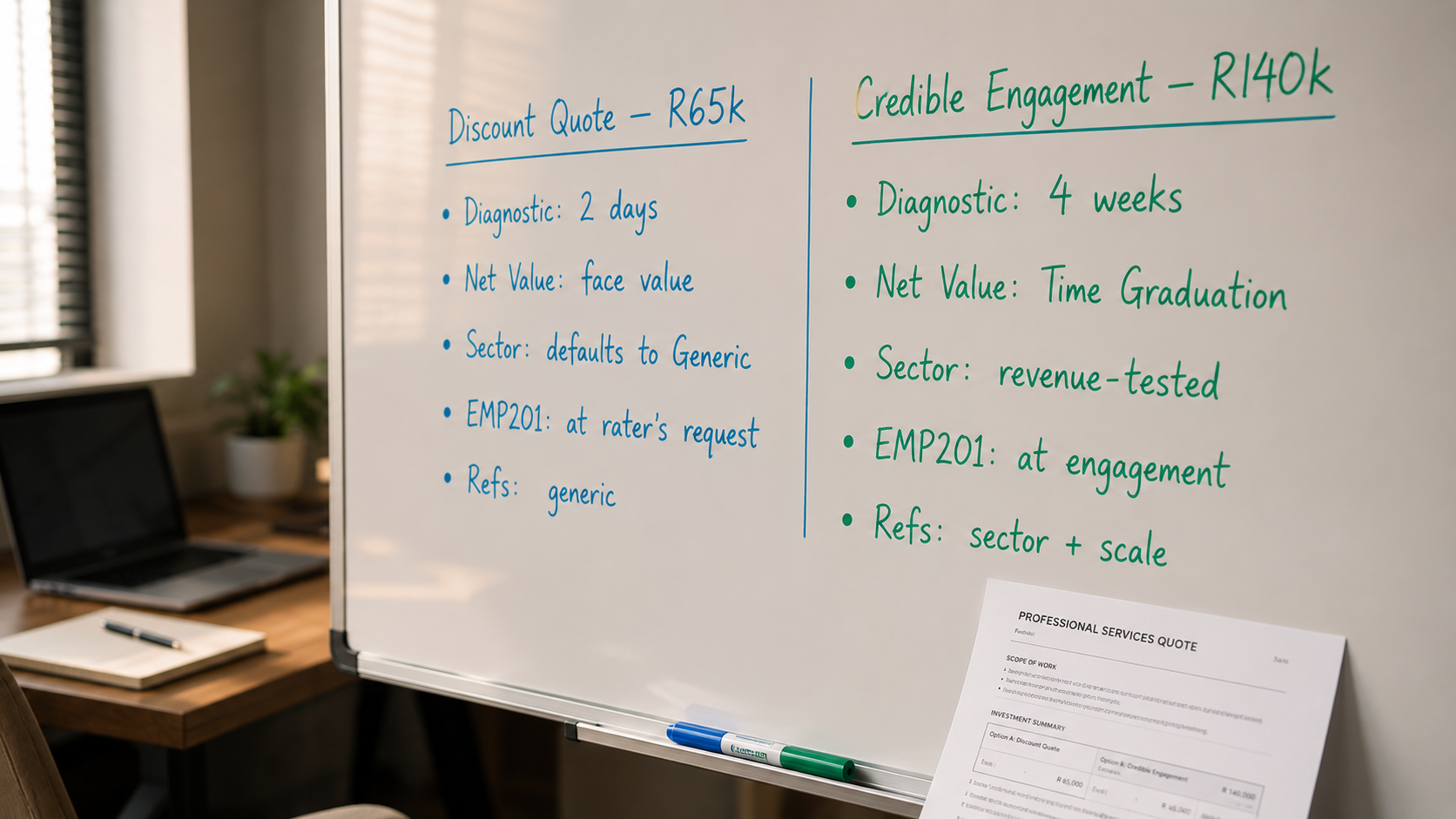
Cheap B-BBEE consulting is one of the most expensive decisions a R50m-plus corporate makes — not at the engagement letter, where the discount looks like a saving, but eighteen months later when a verification rating returns one level lower than projected, a state-owned-entity tender is lost on procurement-weighted scoring, and the legal team is investigating whether the previous advisor’s scorecard claims exposed the directors to fronting risk under Section 13O.
This guide unpacks the real cost of bargain-quote advisory engagements: where the shortcuts get taken, what they cost the corporate downstream, and how to evaluate quotes against the work that actually defends a scorecard at verification. The broader context on the B-BBEE certificate process in South Africa covers what a rated outcome requires; this article zooms in on the advisory standard that determines whether the rated outcome holds.
Quick Answer
Cheap B-BBEE consulting typically saves the corporate 30%-50% on advisory fees and costs three to seven times that amount in lost tender awards, certificate invalidations, Section 13O enforcement exposure, and re-engagement fees with a credible advisor to fix the prior work. The hidden cost is asymmetric — the saving is small, fixed, and visible at engagement letter stage; the cost is large, variable, and surfaces 12-24 months later when the consequences become irreversible.
Considering quotes that vary by 50%+ across providers? Request a quote-comparison conversation →
Why Cheap B-BBEE Consulting Misses the Diagnostic Phase
The discount fee comes from somewhere. In every bargain-quote advisory engagement the team examines, the shortcut is taken in the diagnostic phase — the first three to four weeks where a credible advisor maps the corporate’s structure, tests the ownership treatment under Modified Flow-Through, reconciles management accounts to SARS submissions, and identifies the priority elements that will drive the rated outcome.
A discount engagement compresses this phase from three weeks to three days or skips it entirely. The advisor arrives at the corporate, requests the previous certificate, asks for the current management accounts, and produces a recommended action plan within the same week. The plan looks complete on paper but rests on assumptions the diagnostic never tested.
The cost of the missing diagnostic typically surfaces at one of three later moments. At verification, the rater identifies an Ownership Net Value miscalculation the advisor never modelled. At tender award, a procurement counterparty rejects the certificate because the underlying evidence file cannot defend the headline level. At the Commission, an investigation under Section 13O begins because the scorecard claim cannot be reconciled to the corporate’s actual transformation activity.
According to SAnews coverage of the Commission’s findings against SAB&T BEE Services, the Commission has acted against verification professionals for conduct contrary to ethical standards expected from the role — including issuing two certificates for two periods using the same set of financial statements. The enforcement record is public, named, and dated.
The True Cost of a Bargain-Quote Engagement
Quote shopping treats advisory work as a commodity — every provider supposedly delivers the same deliverable, so the cheapest provider wins. The framing falls apart when the rated outcome is tested. Two engagements at the same headline scope can produce materially different verification outcomes depending on the depth of the diagnostic, the technical experience of the lead advisor, and the rigour applied to ownership modelling.
A R50m-turnover corporate that pays R45,000 for a discount engagement instead of R120,000 for a credible engagement saves R75,000. The saving is visible immediately. The hidden cost surfaces over the next two financial years.
One lost state-owned-entity tender on a procurement-weighted bid scoring system typically costs the corporate R800,000 to R3 million in revenue, depending on the contract size. One Section 13O investigation costs R150,000-R400,000 in legal fees regardless of outcome. One forced re-engagement to fix the prior work costs R140,000-R220,000 because the new advisor must rebuild the diagnostic the previous engagement skipped.
The asymmetry runs in one direction. The saving is bounded; the consequences are not.
Takeaway
The advisory-fee saving is fixed, small, and visible at engagement letter stage. The downstream consequences are variable, large, and surface twelve to twenty-four months later. By the time the corporate discovers the gap, the diagnostic the discount engagement skipped is now an emergency engagement at twice the cost. The asymmetry is structural — not the corporate’s fault for picking the cheaper quote, but a function of how the work compounds invisibly.
How to Spot Cheap B-BBEE Consulting Before You Engage
Five questions surface the diagnostic shortcut before the engagement letter is signed. Each takes minutes in a discovery call and reveals whether the prospective advisor has the technical depth to back the headline price.
Ask how the advisor models Ownership Net Value. A credible answer references the Time Graduation Factor, deemed-vested portions, debt-financed acquisition treatment, and the testing standard a SANAS-accredited rater will apply at verification. A discount answer references the share register and ownership percentage at face value.
Ask which sector code applies and why. A corporate with subsidiaries in different industries may have sector-code applicability questions that the Generic Codes pathway does not cover cleanly. A credible advisor walks through the revenue-source test, the dominant-activity test, and the sector-code scope of the rater the corporate will engage. A discount advisor defaults to Generic Codes without testing.
Ask how Skills Development claims will be reconciled to EMP201 submissions. The Skills Development element is where verification raters apply the most scrutiny because the SARS-reported numbers and the scorecard claims must match. A credible advisor sets up the reconciliation at engagement. A discount advisor mentions the EMP201 only when the rater asks for it.
Ask for client references on the corporate’s industry and scale. Sector experience compounds. An advisor with thirty Financial Sector Code engagements brings a depth of familiarity with FSC nuances that an advisor on their first FSC engagement does not have. The discount engagement may be the advisor’s training-ground on the corporate’s industry — at the corporate’s expense.
Ask about the diagnostic phase scope and duration. A credible advisor describes three to four weeks of diagnostic work with named deliverables — gap-analysis report, evidence-readiness checklist, priority-element action plan, ownership stress-test memo. A discount advisor describes the diagnostic in days, or rolls it into the implementation phase as a single combined deliverable.
| Engagement Indicator | Discount Quote Signal | Credible Engagement Signal |
|---|---|---|
| Diagnostic phase scope | Days or compressed into implementation | Three to four weeks with named deliverables |
| Ownership Net Value modelling | Share register at face value | Time Graduation Factor + deemed-vested + debt-financed treatment |
| Sector code applicability test | Defaults to Generic Codes | Revenue-source and dominant-activity tested |
| EMP201 reconciliation for Skills Development | Mentioned only when rater asks | Set up at engagement letter stage |
| Industry-scale client references | Generic references or none | Three+ named on corporate’s sector and scale |
| Fee structure transparency | Headline fee with scope-creep risk | Fixed against defined scope of work |
| Post-engagement support | Engagement ends at certificate issue | Through next renewal cycle |
Takeaway
The five-question discovery call surfaces the diagnostic shortcut every time. Advisors who can answer all five questions with technical specificity have priced the work to support that specificity. Advisors who answer in generalities have priced the work to skip what specificity requires. The discount is not a discount — it is a different scope of work bearing the same name.
Need help running the five-question discovery on shortlisted advisors? Schedule a discovery-call framework walkthrough →
When Lower Pricing Signals Genuine Value
Not every below-market quote is a shortcut. Three patterns can produce a lower headline fee on the same scope of work — and corporates evaluating quotes should distinguish these from the discount-by-shortcut pattern.
A boutique advisor with low overhead and senior personnel pricing at the partner rate can run a tight engagement at a lower total fee than a larger firm with multiple layers of staffing. The deliverable is the same; the fee structure is leaner.
A sector specialist on the corporate’s specific industry compresses the timeline because they already understand the sector code, the typical evidence patterns, and the rater conventions. Less time at the same hourly rate produces a lower total fee.
An advisor offering a multi-cycle engagement at a fixed annual fee may show a lower year-one number because the work compounds across years. The corporate gets continuity that single-cycle engagements cannot match.
The test is whether the advisor can answer the five discovery questions with technical specificity. If they can, the lower fee reflects efficiency or specialisation. If they cannot, the lower fee reflects work the corporate will pay for later.
The Five Hidden Costs Corporates Pay
The downstream consequences of a discount engagement crystallise across five categories. Each is hard to predict at engagement letter stage and material once it surfaces.
Lost tender awards on procurement-weighted scoring. A corporate whose verification rating returns one level lower than projected loses procurement recognition points with every customer running a transformation-weighted bid scoring system. For state-owned entities and JSE-listed corporates, the recognition difference between Level 2 and Level 4 typically equates to 4-8 percentage points of total bid score — enough to flip awards on competitive tenders.
Certificate invalidation or material findings. A scorecard claim that cannot be defended at verification produces either an invalidated certificate or a verification report with material findings that procurement counterparties read as red flags. The remediation cycle then takes six to nine months and consumes management bandwidth disproportionate to the original engagement.
Section 13O fronting investigations. Where the advisor’s scorecard claims overstate the corporate’s actual transformation position, the Commission’s complaints-handling process can trigger an investigation. Even where the outcome clears the corporate, the legal costs and reputational impact are substantial.
Re-engagement fees with a credible advisor. The corporate that recognises the gap typically engages a second advisor to fix the first one’s work. The new diagnostic must be built from scratch because the prior engagement’s deliverables cannot be relied upon. The total spend on advisory across both engagements often exceeds what a single credible engagement would have cost.
Internal opportunity cost. The corporate’s CFO, HR Director, and procurement lead each commit roughly 80-120 hours per verification cycle. A failed engagement doubles or triples that commitment because the team must rebuild evidence trails, defend findings, and brief the new advisor on the structure the prior engagement should have already mapped.
Who This Is NOT For
How Insignis Prices Against the Cheap B-BBEE Consulting Default
The Insignis fee structure sits in the upper-mid market for advisory engagements at R50m-plus turnover. The premium is not a positioning statement — it is a function of what the diagnostic phase requires when the advisor expects every Ownership Net Value calculation, every Skills Development claim, and every ESD beneficiary contract to be tested as if the SANAS-accredited rating body were already in the room.
Dr. Welman’s CA(SA) and M.Comm Tax credentials shape how the engagement is scoped. The financial-statement reconciliation runs against SARS-submitted EMP201s and IT14SD returns; the ownership modelling carries Time Graduation Factor and deemed-vested portions through to the certificate-defensibility test; the sector-code applicability runs against the corporate’s dominant-revenue trajectory rather than its historical Generic-Codes positioning.
The four-phase engagement that produces this level of defensibility is set out on the Insignis B-BBEE consulting service page. Corporates evaluating quotes that vary by 40%-60% across providers benefit from a direct comparison conversation before committing to the engagement letter.
A Quote Comparison That Saved a JSE-Listed Client R380k
A Johannesburg-headquartered services group with R420 million turnover had three quotes for a single verification cycle: R65,000 (boutique B-BBEE shop), R140,000 (Insignis), R195,000 (Big-Four advisory practice). The board procurement policy required a lowest-quote justification with documented trade-offs.
The Insignis discovery conversation walked the corporate’s CFO through the five-question framework against each bidding advisor. The R65,000 quote could not articulate Ownership Net Value modelling beyond “we’ll look at the share register”.
The R195,000 quote referenced Modified Flow-Through but staffed the engagement with two associates and one director — the Big-Four overhead structure was visible in the fee. The Insignis quote referenced Time Graduation Factor, deemed-vested debt treatment, and the EMP201 reconciliation against the corporate’s specific year-end calendar.
The board accepted the Insignis quote. The downstream outcome over the next eighteen months: certificate issued at projected Level 2 with zero material findings, three state-owned-entity tenders won where the B-BBEE recognition score was material to the bid, zero Section 13O exposure on the scorecard claims. The corporate avoided the estimated R380k cost of a remediation engagement that the R65,000 quote would have triggered.
| Engagement Outcome | Before Quote Comparison | After Discovery-Call Framework |
|---|---|---|
| Headline advisory fee selected | Defaulting to lowest at R65,000 | Insignis at R140,000 (mid-tier) |
| Diagnostic phase scope agreed | Two days, combined with implementation | Four weeks with five named deliverables |
| Ownership Net Value modelling depth | Share register at face value | Time Graduation + deemed-vested + debt-financed |
| Material findings in verification report | Projected 4-6 findings (based on diagnostic gaps) | Zero material findings |
| Certificate level outcome | Projected Level 3 (vs Level 2 target) | Level 2 achieved |
| Estimated total downstream cost avoided | R380k remediation engagement risk | R0 (remediation not required) |
The variable in row three drove every other row. Modelling Ownership Net Value at face value would have produced a Level 3 outcome under the rater’s testing standard, with the gap to the Level 2 target then triggering remediation. The diagnostic depth removed the gap before verification began.
Comparing quotes in Johannesburg, Cape Town, or Pretoria and need a credibility check on the diagnostic scope? Request a quote-comparison walkthrough →
Frequently Asked Questions
What does proper B-BBEE consulting cost for a R50m-plus corporate?
Credible engagement fees for a Generic-Codes measured entity at R50m-R500m turnover typically range from R120,000 to R220,000 for a complete cycle (diagnostic + implementation + verification support). Sector-code engagements (Financial Sector, Mining Charter, ICT) add R30k-R60k. JSE-listed multi-entity groups can exceed R350k. Engagements quoted below R80k for this turnover band rarely include a meaningful diagnostic phase.
Why do quotes vary so much between providers?
The deliverable named in the engagement letter looks similar across providers, but the underlying scope of work differs materially. The largest variable is the diagnostic phase — three to four weeks of testing the corporate’s structure against the rated outcome the rater will measure. Discount engagements compress this phase or skip it; credible engagements treat it as the foundation the rest of the work rests on.
Can I tell if the consulting was inadequate before the certificate issues?
Yes, three signals surface during the engagement itself. The advisor cannot articulate Ownership Net Value modelling beyond the share register. The Skills Development reconciliation to EMP201 is mentioned only when the rater requests it, not at engagement letter stage. The sector-code applicability defaults to Generic Codes without testing revenue-source or dominant-activity criteria. Any one signal warrants a remediation conversation before the certificate engages a rater.
What happens if I have already signed with a discount provider?
The remediation pathway depends on the engagement stage. If the diagnostic has not yet started, contract termination with notice may be feasible. If the diagnostic is complete but implementation has not started, a second-opinion engagement on the diagnostic itself can surface gaps before implementation locks them in. If implementation is underway, the priority shifts to stabilising the current cycle’s outcome rather than restarting — the rebuild engagement is then sequenced for the following cycle.
Does the B-BBEE Commission act against advisors for inadequate work?
The Commission has formal enforcement powers against verification professionals and rating bodies under Section 13O of the Act, with published findings and remedial recommendations on public record. The SAB&T BEE Services and Ismail enforcement case is one example: the Commission found conduct contrary to ethical standards expected from the role and recommended remedial steps including a public apology and an independent audit of certificates issued across multiple periods.
Should I always pay the highest quote?
No. Highest quote does not equate to highest quality. The discovery-call framework distinguishes high price from high value — a Big-Four advisory practice quoting double the mid-tier price for the same scope is often pricing for overhead, not depth. The credible signal is whether the advisor can answer the five technical questions with sector-specific specificity, not the headline fee level.
Get the Advisory Decision Right Before the Engagement Letter is Signed
An advisor chosen well sets the corporate up for cycles of clean certificates, defensible scorecards, and procurement recognition that holds across renewal periods. An advisor chosen badly costs the corporate verification fees that needed to be paid twice, tender awards lost to competitors during remediation gaps, and Section 13O exposure that should never have arisen.
Run the Discovery-Call Framework on Your Shortlisted Advisors
Schedule a no-cost initial conversation with Dr. Este Welman, CA(SA), and the Insignis team. We walk you through the five discovery questions against each bidding advisor, identify the diagnostic-shortcut signals, and map the trade-offs against your specific scorecard complexity and tender pipeline.
No obligation. We will get back to you within 24 hours.
Request Your Quote-Comparison Walkthrough
About the Author
Dr. Este Welman, CA(SA) — Founding Partner, Insignis Solutions
A Chartered Accountant (SA) holding a PhD in Economic Transformation from the Da Vinci Institute, an M.Comm in Taxation from North-West University, a B-BBEE Management Diploma from Wits, and registered SAICA membership.
Her advisory work routinely involves second-opinion engagements where corporates have inherited inadequate prior work from discount providers. The pattern is consistent: diagnostic shortcuts in the first engagement produce verification outcomes one level below target, which then require remediation cycles that consume more management bandwidth than a credible first engagement would have done.