
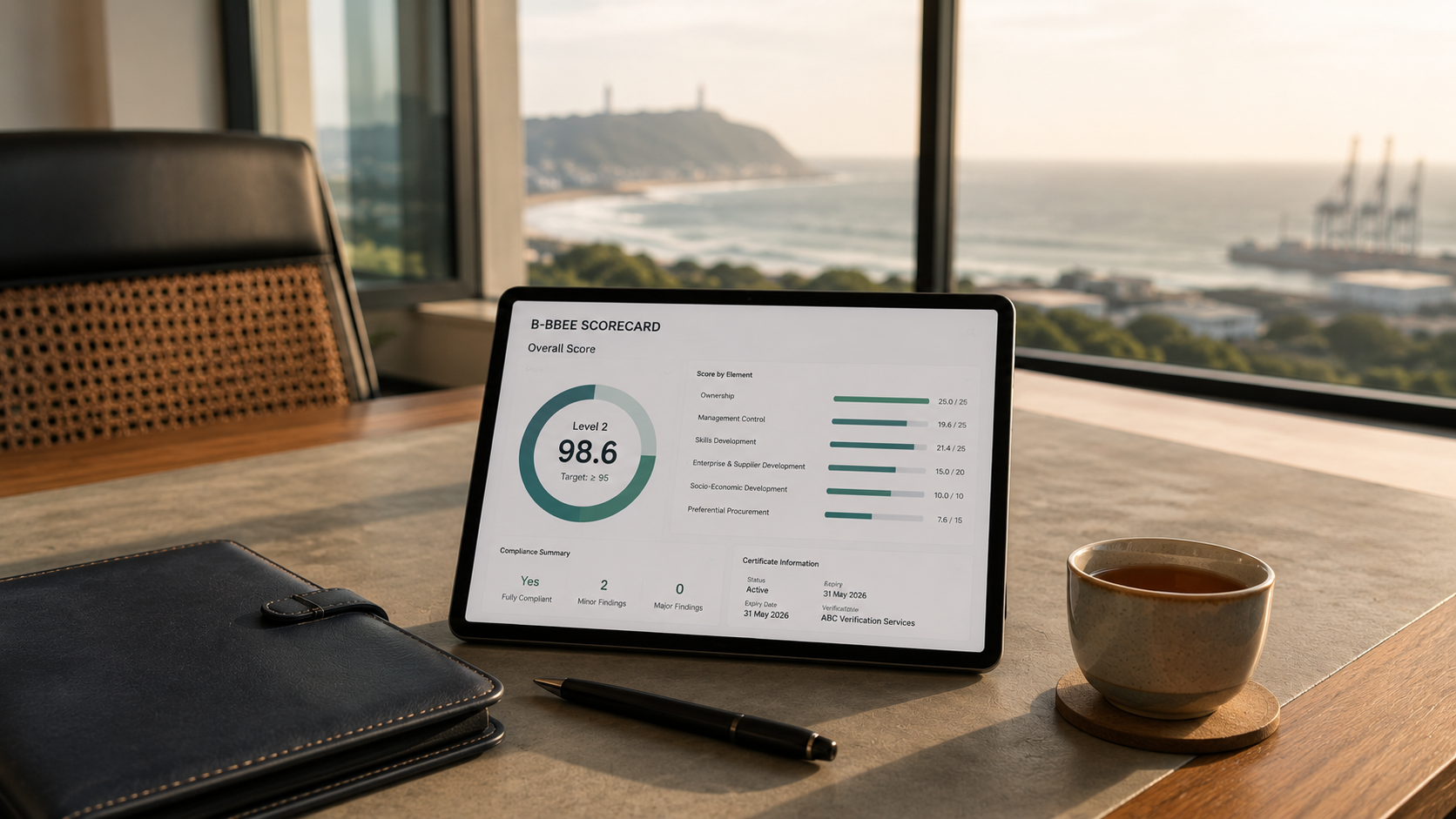
The market for B-BBEE consultants Durban corporates rely on sits at the intersection of three economic engines that don’t appear in the same combination anywhere else in South Africa. The Port of Durban handles SA’s largest container volumes and roughly 60% of the country’s automotive import-export traffic.
The KZN automotive cluster around Prospecton, Toyota’s Durban plant, and the Bell Equipment campus in Richards Bay forms one of SA’s most concentrated manufacturing zones. The Phoenix and New Germany industrial nodes carry the bulk of KZN’s mid-market industrial supply chain.
This guide explains how to choose a B-BBEE consultant working in Durban, what to expect on cost and scope, how KZN-specific factors shape engagement, and where the local market sits in 2026. The broader scorecard improvement framework applies, but Durban’s port-centric, manufacturing-heavy corporate context materially changes how engagement scopes get built.
Quick Answer
Engaging B-BBEE consultants Durban-side suits R50m+ corporates whose operations sit within the KZN economy — particularly the Port of Durban supply chain (logistics, freight forwarders, customs brokers), the automotive cluster (OEMs and tier-1 suppliers), the Richards Bay industrial complex (mining-adjacent processors and exporters), the sugar industry, and the manufacturing base across Phoenix, New Germany, Pinetown, and the South Coast industrial corridor. Typical engagement fees range from R125,000 to R380,000 annually depending on entity complexity and sector code exposure.
Need a consultant familiar with the KZN corporate sector? Request a Durban-focused engagement scope →
What Sets the Market for B-BBEE Consultants Durban Apart
Durban’s B-BBEE compliance market doesn’t look like Johannesburg’s, Cape Town’s, or Pretoria’s. Three structural features shape it, and anyone scoping work in the city needs to understand all three.
Port-driven supply chains are the first. The Port of Durban anchors a logistics, freight forwarding, customs brokerage, and warehousing sector whose customer-side B-BBEE pressure comes primarily from large multinational shippers and the SA automotive OEMs. These customers run rigorous supplier B-BBEE certificate currency checks against invoice dates — not financial year-end — which means the supplier panel drift that quietly costs Preferential Procurement points in other cities surfaces faster in KZN logistics relationships.
The automotive cluster is the second. Toyota’s Durban plant, the Bell Equipment campus in Richards Bay, the Volkswagen tier-1 supply network feeding through Durban port, and the broader OEM-supply-chain pyramid concentrate a specific kind of B-BBEE work in KZN. The Automotive Production and Development Programme (APDP) interacts with the Codes of Good Practice in ways that purely commercial supplier work doesn’t — and consultants without working knowledge of the APDP framework miss material recognition value.
The Richards Bay industrial complex and the surrounding mining-adjacent supplier base form the third feature. RBM (Richards Bay Minerals), the coal export terminal at the Port of Richards Bay, the aluminium sector, and the related infrastructure suppliers operate under a combination of Generic Codes and Mining Charter exposure depending on classification. Consultants whose practice is purely Generic Codes won’t be equipped for the Mining Charter overlay where it applies.
What B-BBEE Consultants Durban Engagements Typically Deliver
The engagement scope for R50m+ KZN corporates reflects the port-centric, manufacturing-heavy customer base. A defensible engagement covers four phases over a typical 12 to 18-month cycle.
Diagnostic work establishes the current scorecard position, sub-minimum risk on the three priority elements, and methodology consistency between management estimates and SARS-reported figures. For corporates operating in the port supply chain, the diagnostic also tests customs-related supplier flows — freight forwarders, clearing agents, transport contractors — whose B-BBEE certificate status flows through to the corporate’s Preferential Procurement calculation.
Strategy work translates the diagnostic into a Rand-level activity plan. For Durban-based corporates, the strategy phase typically includes specific Toyota-supplier panel analysis (for automotive tier-1 and tier-2 suppliers), Transnet-port-procurement panel analysis (for logistics and infrastructure suppliers), and supply-chain restructuring across the Phoenix-Pinetown industrial corridor.
Implementation oversight runs the year’s transformation activities — Skills Development programme alignment with SARS Leviable Amount, supplier panel restructuring toward higher-rated suppliers, ESD partnership monitoring, and SED programme management often weighted toward KZN community beneficiaries given the regional concentration of B-BBEE-conscious customer relationships.
Pre-verification work prepares the evidence pack in the four to eight weeks before the SANAS-accredited agency arrives. KZN has a smaller pool of locally-based verification agencies than Johannesburg, which means engagement scoping often includes scheduling analysis to align with available agency capacity.
Takeaway
Durban’s defining feature isn’t its sector mix — it’s the port-centric supply chain that connects KZN corporates to global trade and to the SA automotive sector simultaneously. A B-BBEE consultant who can’t speak to APDP interactions, Transnet supplier panel mechanics, and the Mining Charter overlay on Richards Bay industrial work isn’t equipped for the upper end of the KZN market. Verify these specifics before signing — generic Codes-only practitioners aren’t the right fit for corporates whose customer base sits inside these supply chains.
Fee Profiles for B-BBEE Consultants Durban Corporates Engage
Engagement fees in the Durban market sit at the lower-middle of the SA city band, partly because the typical engagement involves less multi-entity complexity than Johannesburg work and less dual-sector code exposure than Cape Town agribusiness work. Where APDP automotive or Mining Charter overlay applies, fees move upward toward the Johannesburg band.
| Engagement Profile | Typical Annual Fee Range | Common Inclusions |
|---|---|---|
| Single-entity Generic Codes, Phoenix or Pinetown mid-market industrial | R125,000 – R195,000 | Diagnostic, strategy, evidence preparation, agency selection support |
| Port-supply-chain entity (logistics, customs brokerage, warehousing) | R165,000 – R260,000 | Above plus customs/port supplier flow modelling, Transnet panel positioning |
| Automotive tier-1 or tier-2 supplier, APDP-exposed | R220,000 – R340,000 | APDP overlay, OEM customer-side scorecard alignment, Toyota/VW supplier panel mechanics |
| Richards Bay industrial or mining-adjacent corporate | R240,000 – R380,000 | Mining Charter overlay where applicable, RBM supplier panel work, coal corridor logistics |
Verification agency fees add a separate R55,000 to R175,000 annually depending on entity complexity. KZN’s verification agency pool is smaller than Johannesburg’s, so timing engagement against agency availability matters more — particularly for corporates whose verification cycle runs in the Toyota or Volkswagen procurement window when local agency demand peaks.
How the Port of Durban Shapes Local B-BBEE Compliance Work
For corporates whose revenue runs through the Port of Durban — freight forwarders, customs brokers, container depot operators, warehousing groups, and the logistics layer serving the automotive cluster — B-BBEE compliance work has a distinct rhythm shaped by the customs and shipping calendar rather than the financial year.
The SARS Customs and Excise framework governs the documentation, declarations, and goods-movement processes that port-supply-chain corporates handle daily. The customs compliance discipline interacts with B-BBEE compliance discipline more directly than corporates in other industries experience — supplier B-BBEE certificate validation flows into customs-cleared transactions, and the audit trails feed both compliance domains simultaneously.
Practical effect: a port-supply-chain corporate that runs tight customs compliance discipline typically has the evidence infrastructure to run tight B-BBEE compliance evidence collection. The gap that B-BBEE consultants Durban-side commonly find appears in tracking supplier B-BBEE certificate currency against invoice dates rather than financial year-end — a gap that surfaces at every verification cycle if the consultant doesn’t structure the supplier panel evidence collection accordingly.
Operating in the Port of Durban supply chain? Request a port-supply-chain engagement scope →
Automotive Sector Work in the KZN Cluster
For corporates supplying into Toyota, Volkswagen, Bell Equipment, or the broader automotive tier-1 and tier-2 supply network, B-BBEE compliance work runs alongside Automotive Production and Development Programme positioning. The two frameworks interact — OEM supplier panels weight B-BBEE certificate levels heavily, and APDP-recognised suppliers gain customer-side preference that compounds with B-BBEE recognition value.
The strategy work for these corporates concentrates on Preferential Procurement supplier panel restructuring (sourcing higher-rated local suppliers where possible), Skills Development programmes aligned with technical and artisan training (the SETA framework most relevant to automotive engineering training), and ESD programmes targeting Black-owned engineering and manufacturing SMMEs in the KZN automotive supply chain.
Customer-side recognition value moves materially with level upgrades for automotive suppliers. The difference between Level 4 and Level 2 isn’t just scorecard arithmetic — it’s the difference between maintaining a supplier panel slot and being displaced by a competitor with stronger compliance.
Takeaway
The B-BBEE consultants Durban automotive corporates need are not the same as the consultants that serve generic Phoenix industrial entities well. APDP overlay knowledge, OEM supplier-panel mechanics, and the customer-side recognition value modelling that drives Toyota and Volkswagen tier-1 decisions are specialised competencies — not a general extension of Codes-of-Good-Practice work. Verify that competency explicitly before committing to an engagement letter for any KZN automotive-exposed scorecard.
Who This Is NOT For
The Insignis Methodology for KZN Sector-Overlay Work
Insignis Solutions serves Durban and KZN corporates from our Centurion base, with regular in-person engagement support for clients across the Durban metro, Richards Bay industrial complex, and the Pietermaritzburg professional services cluster. The remote-engagement model handles most of the diagnostic and strategy phases efficiently, but we travel for executive committee briefings, ownership transaction structuring, and any work where on-site presence in the KZN environment materially changes the engagement outcome.
Dr. Este Welman’s CA(SA) and M.Comm in Taxation backgrounds anchor the methodology across all KZN work. Where B-BBEE consultants Durban corporates engage often default to generic Codes methodology regardless of sector exposure, the Insignis approach treats APDP-exposed automotive engagements, Mining Charter overlay work at Richards Bay, and port-supply-chain compliance as distinct engagement types.
Each receives the same primary-evidence testing discipline — SARS Leviable Amount reconciliation, supplier B-BBEE certificate currency verification, beneficiary-outcome documentation — layered with the sector-specific overlay each engagement requires.
For the general consulting engagement model, see our B-BBEE consulting service page. APDP automotive and Mining Charter engagements are scoped against the relevant sector methodology rather than the Generic Codes default.
What a Multi-Cycle KZN Engagement Delivers
A Durban-based automotive tier-1 supplier engaged Insignis after holding Level 4 for two consecutive cycles despite consistent activity spend across all five elements. Diagnostic work identified that the corporate was missing material Preferential Procurement points by claiming spend against suppliers whose B-BBEE certificates had expired mid-cycle, and that the APDP-recognised supplier overlay was not being correctly applied to the scorecard. Twelve months of restructured engagement work later, the same corporate held Level 2.
| Scorecard Metric | Before Engagement | After 12 Months |
|---|---|---|
| Certificate level | Level 4 | Level 2 |
| Preferential Procurement points | 13 of 25 | 22 of 25 |
| Skills Development points | 9 of 20 | 17 of 20 |
| Customer-facing recognition value | 100% | 125% |
| Toyota tier-1 supplier panel position | At risk of displacement | Secured, multi-year contract extension |
| Annual customer-side recognition uplift | — | R15m+ in recognition value |
The level upgrade secured the Toyota tier-1 supplier panel position the corporate had been at risk of losing — the immediate commercial outcome that justified the engagement. Most of the gain came from supplier B-BBEE certificate currency discipline and APDP-overlay correction, not from new activity spend. That’s the kind of gap that surfaces in the first three weeks of diagnostic work when the consultant knows what to look for in the KZN automotive supplier context.
Four Tests Before Engaging the B-BBEE Consultants Durban-Side
Four questions separate KZN consultancies that produce multi-cycle outcomes from those that produce decorative paperwork. Apply all four before any commercial commitment.
Ask about APDP automotive experience. Request specifics on Toyota, Volkswagen, or BMW SA supplier-panel work the consultant has delivered, the APDP-overlay interactions they’ve navigated, and the customer-side recognition value modelling they’ve prepared. Vague answers signal the consultant treats automotive work as Generic Codes plus customer name.
Probe the Mining Charter familiarity for Richards Bay work. If your corporate sits in the Richards Bay industrial complex or the coal export corridor, ask the consultant to walk through Mining Charter sub-minimum thresholds versus Generic Codes thresholds — and the methodology differences on Ownership specifically. Anyone unable to answer this shouldn’t be scoping Richards Bay work.
Verify port-supply-chain experience for logistics, customs brokerage, and freight forwarding corporates. The compliance interaction between B-BBEE and SARS Customs requirements is distinct. Consultants without working familiarity with both compliance streams aren’t equipped for the upper end of this work.
Confirm KZN-based SANAS-accredited agency familiarity. The local agency pool is smaller than Johannesburg’s, and timing engagement against agency capacity creates real scheduling value. Consultants who can name three local agencies and describe their verification styles bring practical scheduling discipline to the work.
Want to run these four tests on a phase-priced proposal? Request a KZN engagement brief →
Frequently Asked Questions on B-BBEE Consultants Durban
Do Durban consulting fees differ from Johannesburg fees?
For comparable scopes, Durban fees run roughly 12-18% lower than Johannesburg fees on single-entity Generic Codes work. The fees charged by B-BBEE consultants Durban-side close the gap on APDP automotive and Mining Charter-overlay work because the sector code complexity adds genuine engagement hours. The hourly rate is broadly comparable across SA cities — what varies is the engagement scope and the multi-entity complexity of the typical KZN corporate.
Should a Pietermaritzburg or Richards Bay corporate use a Durban consultant?
Generally yes, though the answer depends on operational footprint. Pietermaritzburg professional services firms typically benefit from a Durban metro consultant given the regular Durban customer-side procurement interactions. Richards Bay industrial corporates often need consultants with explicit Mining Charter overlay experience — verify that capability specifically rather than assuming general KZN coverage is sufficient.
How quickly can a Durban consultant engage before verification?
If verification is 6 to 9 months away, the runway supports full diagnostic, strategy, and remediation work. Inside 8 weeks, the engagement compresses and diagnostic findings can’t be fully remediated. Inside 4 weeks, the work becomes evidence-pack defence. For automotive tier-1 engagements where Toyota or Volkswagen supplier-panel re-qualification is involved, plan an additional 4 to 6 weeks beyond the standard verification timeline.
What’s the difference between Durban metro and KZN for engagement scoping?
Durban metro covers the eThekwini municipality including the CBD, Berea, Westville, Phoenix, Pinetown, Umhlanga, and the South Coast industrial corridor. KZN extends to Pietermaritzburg, Richards Bay, the Drakensberg agricultural areas, and the broader Midlands. For engagement purposes, the distinction matters when sector exposure shifts — Richards Bay industrial work needs Mining Charter capability that Durban metro automotive work doesn’t require.
Does the 2026 Codes amendment affect KZN work specifically?
Yes, particularly on Preferential Procurement weighting for port-supply-chain corporates and ESD outcome measurement for automotive sector work. The amendment-driven shift toward 100% Black-owned and Black women-owned supplier recognition affects KZN supplier panels in distinct ways — the port logistics sector has historically had stronger Black-owned representation than heavy industrial sectors, which means KZN corporates often benefit more from the amendment than counterparts in other regions.
Can a Johannesburg-based consultant serve Durban clients effectively?
Yes, provided the consultant has demonstrated APDP automotive depth, port-supply-chain experience where relevant, Mining Charter capability for Richards Bay work, and has worked with the SANAS-accredited agencies operating in the KZN market. Geographic location matters less than these four competencies. The harder question is whether the consultant treats KZN engagements as full-attention work or as an add-on to a Gauteng-centred practice.
Get a Durban Engagement Scope That Reflects the KZN Market
The right test of any of the B-BBEE consultants Durban corporates evaluate — local or otherwise — is whether the engagement scope translates directly into level movement at the next verification, with the right sector overlay applied. We scope Durban engagements against that test before any commercial commitment is made.
Request a Durban Scoping Conversation
Get a free scoping conversation with Dr. Este Welman, CA(SA), and the Insignis team. We map your KZN market exposure, verify the correct sector methodology for your operational profile (Generic Codes, APDP overlay, Mining Charter where applicable), and quote a phase-priced engagement with defined deliverables. National delivery from our Centurion office with travel to Durban for material engagement milestones.
No obligation. We will get back to you within 24 hours.
Request Your Durban Scoping Call
About the Author
Dr. Este Welman, CA(SA) — Founding Director, Insignis Solutions
A Chartered Accountant (SA) with a PhD in Economic Transformation from the Da Vinci Institute, Dr. Welman holds an M.Comm in Taxation, a B-BBEE Management Diploma from Wits, and is a registered SAICA member.
The Insignis KZN practice serves Durban metro, Richards Bay industrial, and Pietermaritzburg professional services clients with the same audit-grade methodology applied to Generic Codes, APDP automotive overlay, and Mining Charter engagements.