
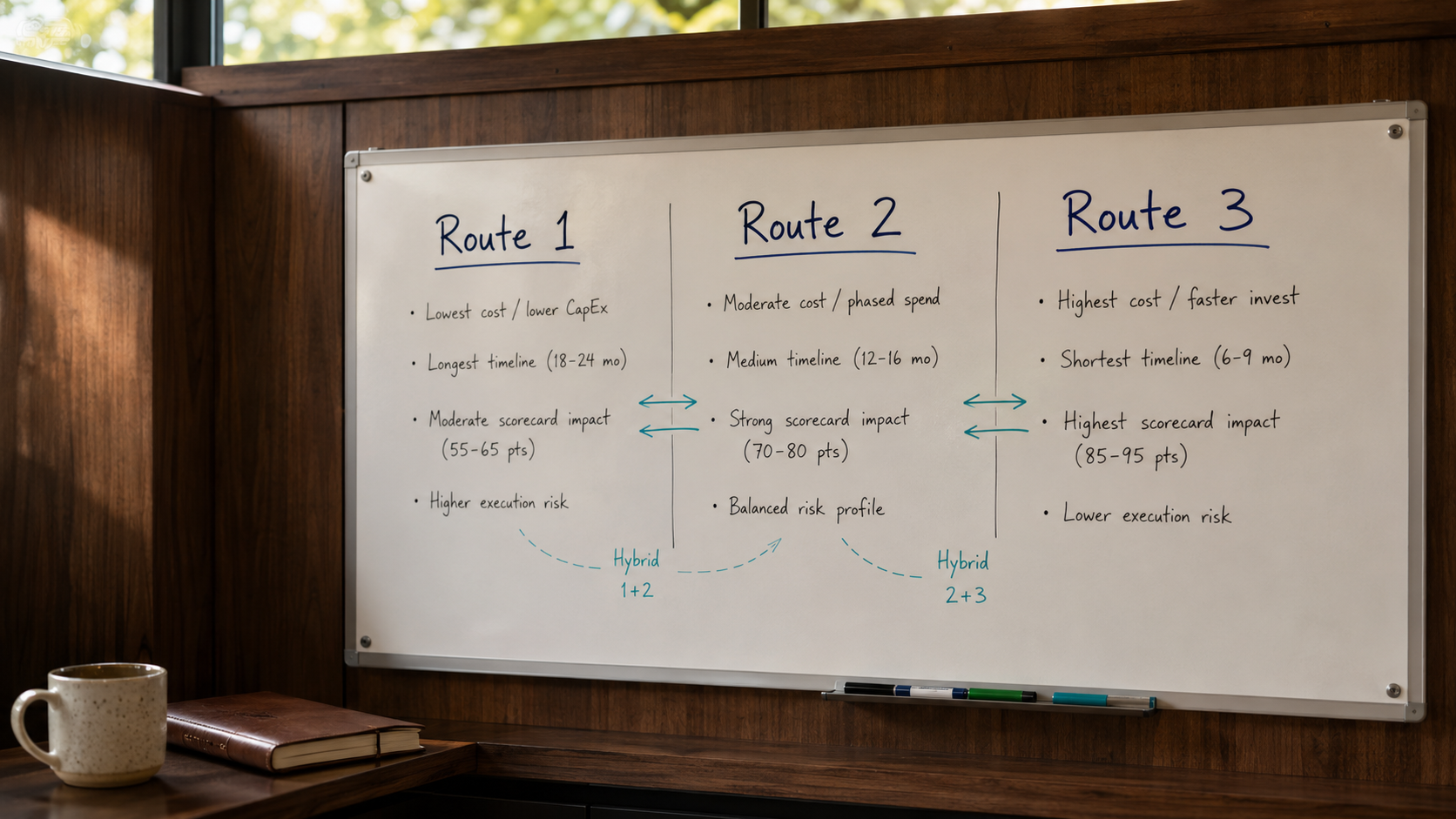
B-BBEE ownership structures are not interchangeable. The Codes recognise three primary mechanisms for earning black-shareholding scorecard points, and the choice between them determines transaction cost, tax consequence, board-governance impact, and the realistic rating ceiling for the next decade. Corporates that treat the three routes as substitutes end up with the wrong vehicle for their commercial situation and pay for that decision across multiple verification cycles.
This guide compares the three primary black-shareholding recognition routes — direct equity sale, Broad-Based Ownership Schemes, and the Equity Equivalent Investment Programme — with the tax and Companies Act mechanics that determine which route fits which corporate. The pillar reference for B-BBEE scorecard elements in South Africa sits alongside this for the broader element-by-element context.
Quick Answer
B-BBEE ownership structures under the Amended Codes fall into three primary categories: direct equity sale (Statement 100 paragraph 3, covering sale of asset, equity instruments, and business), Broad-Based Ownership Schemes (BBOS) for employee or community beneficiaries, and the Equity Equivalent Investment Programme (EEIP) for entities whose parent-company constraints preclude direct equity transfer. Each mechanism delivers up to 25 Ownership scorecard points, but the transaction cost signature, tax consequences, and control-retention profiles differ materially. Advisory-fee cost typically runs 4%–8% of equity value for direct equity sales, R1m–R2m for well-structured BBOS setups, and 6%–9% of annual programme value across the ten-year EEIP horizon.
Weighing the three Ownership-element routes and need a comparative framework before board sign-off? Request a route-comparison diagnostic conversation →
How the Ownership Element Delivers 25 Points
The Ownership element accounts for 25 of the 109 points on the Generic scorecard and is one of the three priority elements (alongside Skills Development and Enterprise & Supplier Development) whose sub-minimums must clear independently for the overall rating tier to hold. Missing this element’s sub-minimum triggers an automatic one-band discount regardless of total points.
The scorecard measures three dimensions of black shareholding: voting rights (a maximum of 3 points), economic interest (a maximum of 4 points on standard categories, with additional weighting for designated groups), and net value (a maximum of 8 points based on the value of shares actually paid for by black shareholders).
Bonus point categories cover new entrants, involvement in operations, and specific designated-group holdings. Together these deliver up to 25 total element points before applying any priority-element discount.
What the scorecard rewards is measurable, sustained black shareholding at the operating-entity level — not aspirational intent, not conditional commitments, and not paper arrangements that fail to deliver economic value to the black shareholder over time. This is why the choice of recognition mechanism matters: each of the three primary routes delivers the same 25-point maximum but does so through different economic-interest arrangements and different long-term sustainability profiles.
The Amended Codes also allow for hybrid combinations — a corporate can use direct equity sale for 12%–15% of the shareholding, a BBOS for 8%–10%, and layered arrangements for the remainder. In practice, most well-structured transactions combine two or more of the primary routes rather than relying on a single mechanism.
The Three Primary Recognition Mechanisms Compared
The three routes share the same 25-point ceiling but operate through fundamentally different economic mechanisms. The choice between them typically comes down to four factors: whether direct equity transfer is commercially and legally feasible, whether the corporate has a suitable beneficiary population for a broad-based scheme, whether the corporate is subject to global parent-company constraints, and what the tax and CGT consequences look like under the corporate rules in the Income Tax Act.
| Recognition Mechanism | Primary Applicability | Typical Advisory-Fee Cost |
|---|---|---|
| Direct equity sale (Statement 100 §3) | Locally-controlled corporates with commercially viable equity to transfer | 4%–8% of equity value |
| Broad-Based Ownership Scheme (BBOS) | Corporates with defined employee or community beneficiary populations | R1m–R2m setup + R150k–R400k annual admin |
| Equity Equivalent Investment Programme (EEIP) | Foreign-owned entities whose parent constraints preclude direct transfer | 6%–9% of annual programme value across ten years |
| Hybrid (two or more routes combined) | Mid-market corporates seeking distributed governance load | Blended per component |
The comparative economics rarely make one route uniformly cheaper than the others. What differentiates them is the fit with the corporate’s underlying situation — the shareholder base, the customer requirements, the tax posture, and the governance objectives.
Route One: Direct Equity Sale (Sale of Asset, Equity Instruments, and Business)
Direct equity sale under Statement 100 paragraph 3 is the most commonly used recognition route. The mechanism is straightforward: the corporate sells or issues equity to identified black shareholders at market-related pricing, supported by an independent valuation. The scorecard then measures the resulting voting rights, economic interest, and net value contribution.
The Amended Codes recognise three variants under this route. The first is a sale of equity instruments (typically ordinary shares) directly to black shareholders. The second is a sale of a business or business unit to a black-owned entity. The third — sometimes overlooked — is a sale of specific assets to a black-owned entity in exchange for equity in that entity or in a new joint-venture vehicle.
The recognition mechanics differ slightly across these variants but the common thread is that measurable value transfers from the historic shareholder base to the black shareholder base. The Codes are alert to arrangements that look like value transfer on paper but leave the black shareholder without meaningful economic upside — these get downgraded at verification stage.
Direct equity sale works cleanly for mid-market locally-controlled corporates where the shareholder base has both the capacity and the appetite to dilute. It becomes more complex where multiple family shareholders disagree on valuation, where the sale requires third-party debt to fund the black shareholder’s purchase, or where the historic shareholders want ongoing operating-control preservation through voting-trust arrangements. The B-BBEE family business ownership structuring guide covers these closely-held-corporate considerations in detail.
Route Two: Broad-Based Ownership Schemes
Broad-Based Ownership Schemes hold equity for the benefit of a defined class of beneficiaries — typically employees of the corporate, sometimes community members adjacent to the corporate’s operations. The BBOS itself is the legal shareholder; beneficiaries receive distributions and other benefits per the scheme rules.
The Amended Codes recognise BBOS arrangements provided they meet governance, beneficiary-identification, and benefit-flow requirements set out in the scheme guidelines. Governance requirements include an independent trustee majority, transparent scheme rules, and annual audited financial statements. Beneficiary-identification requirements include a defined black beneficiary population that maps to a real transformation objective. Benefit-flow requirements include measurable annual distributions or other tangible value moving from the scheme to beneficiaries.
Where a BBOS meets all three requirements, the scorecard recognises the resulting economic interest as black shareholding. Where it fails any of the three requirements, the recognition is either capped below the theoretical maximum or withdrawn entirely at verification.
BBOS arrangements work well for corporates with large stable employee bases (200+ employees) where the transformation objective of employee wealth participation is genuine. They work less well for small or transient employee populations, and they require substantial upfront transaction costs plus ongoing administrative discipline (audit costs, trustee fees, beneficiary reporting). The closely-held ownership structuring guide also covers BBOS mechanics in the family-controlled corporate context.
Route Three: The Equity Equivalent Investment Programme
The Equity Equivalent Investment Programme (EEIP) is the mechanism the Codes provide for multinationals whose global-parent constraints preclude direct equity transfer to South African black shareholders. Under the EEIP, the local corporate commits to an investment programme equivalent to 25% of the value of its South African operations or 4% of total South African turnover, channelled through approved transformation initiatives across enterprise-and-supplier development, critical skills development, black industrialist support, and research-and-development.
The programme runs for a ten-year term, and dtic Ministerial approval is required before the EEIP scorecard recognition activates. Once approved, the EEIP delivers up to the full 25 scorecard points for the duration of the programme, subject to annual delivery verification and continued dtic recognition.
The EEIP is not a shortcut. The investment commitment for a mid-sized multinational local arm typically lands at R80m–R200m over the ten-year period, averaging R8m–R20m per annum. The B-BBEE multinational subsidiaries guide covers the EEIP approval mechanics and the strategic decision framework in detail.
The Route Selection Reality
Locally-controlled corporates almost never use the EEIP — direct equity sale or BBOS is available and cheaper. Foreign-owned local arms almost never use direct equity sale — the parent-company constraints that make the EEIP relevant also make direct equity transfer legally or commercially impossible. BBOS structures are available to both categories but require the beneficiary population and administrative discipline to sustain. The route selection is often less strategic than it looks — the corporate’s underlying situation typically pre-determines the viable options.
Locally-controlled corporate deciding between direct equity sale and BBOS routes? Book a strategic comparative diagnostic →
B-BBEE Ownership Structures: Tax Consequences Under the Corporate Rules
The tax treatment of the transaction often shapes the optimal route more than the pure scorecard mechanics. The Income Tax Act’s corporate rules (sections 41 to 47) provide specific tax-deferral treatment for qualifying transactions, and the availability of these rollover provisions can materially reduce the immediate tax cost of an empowerment transaction.
Section 42 is the most commonly relevant provision. It allows a taxpayer disposing of an asset in exchange for equity shares in the acquiring company (or, in some arrangements, cash consideration up to specified thresholds) to defer the capital gains tax on the disposal until the equity shares themselves are later sold.
SARS guidance on section 42 applications is set out in numerous binding private rulings — the SARS Binding Private Ruling 408 on section 42 corporate restructuring provides a representative illustration of the qualifying-transaction criteria.
The tax implications vary substantially by route.
| Tax Dimension | Direct Equity Sale | BBOS Setup | EEIP Route |
|---|---|---|---|
| Capital gains tax on transaction | Section 42 rollover available where structured as asset-for-share | N/A (no equity disposal by original shareholders) | N/A (no equity movement) |
| Securities transfer tax | 0.25% on share transfers | 0.25% on shares moved into scheme | N/A |
| Donations tax exposure | Where transfers to family trusts are involved | Where beneficiary designations use trust structures | N/A |
| Dividends tax on distributions | 20% on ordinary shareholder distributions | 20% on scheme distributions to beneficiaries | N/A (contributions treated as investment) |
| Corporate income tax treatment | Standard rules apply | Scheme is typically taxed as a special-purpose vehicle | EEIP contributions may qualify as deductible where structured correctly |
| Section 41-47 corporate rules availability | Yes, subject to qualifying-transaction tests | Limited applicability | N/A |
The section 42 rollover is often the decisive tax advantage for a direct equity sale. Where a family shareholder is disposing of shares that would otherwise trigger a substantial CGT liability, structuring the transaction as an asset-for-share arrangement can defer the tax until the eventual disposal of the acquired shares — often decades later.
For BBOS arrangements, the tax treatment turns on the specific scheme vehicle and beneficiary designations; well-structured BBOS setups minimise donations tax and preserve estate-planning flexibility.
How to Choose the Route That Fits Your Corporate
The route selection is a three-factor decision: viability (which routes are legally and commercially available), fit (which route matches the corporate’s shareholder-base and governance objectives), and tax posture (which route minimises the immediate and lifetime tax cost of the transaction).
| Corporate Situation | Recommended Primary Route |
|---|---|
| Locally-controlled corporate with stable shareholder base, 200+ employees, section 42 rollover available | Hybrid: direct equity sale 12%–15% + BBOS 10%–12% |
| Closely-held corporate with founding-shareholder control preservation as priority | Direct equity sale with voting-trust arrangement |
| Foreign-owned local arm with global-parent equity-transfer constraints | EEIP with dtic-approved investment programme |
| Corporate with small employee base and no available equity to transfer | Direct equity sale to external empowerment partner |
| Corporate with substantial community-benefit programmes already running | BBOS with community-beneficiary structure |
The recommendations above are starting points, not final answers. Every credible route-selection exercise involves modelling the tax cost, the transaction cost, the scorecard-recognition timing, and the multi-cycle sustainability under actual verification-agency scrutiny. The corporate-rules tax analysis often reshapes the optimal structure — a route that looks cheaper on transaction cost can become more expensive on a lifetime-tax basis if section 42 rollover is unavailable.
The Sequencing Principle
The right sequence is: tax analysis first, structure design second, verification-agency validation third. Corporates that design the structure and then run the tax analysis often discover that the chosen route triggers avoidable tax costs — sometimes 10%–15% of the transaction value. Running the tax analysis in parallel with the structural design (or ahead of it) usually produces a materially better outcome across the ten-year horizon.
Who This Article Is NOT For
EMEs below R10 million turnover. The Codes treat EMEs at default ratings (Band 4 baseline, with auto-upgrades for black-owned EMEs). No measured Ownership-element scorecard applies at this turnover tier. The route-selection framework in this guide does not apply.
QSEs comfortable with the affidavit route. A 51%-or-more black-owned QSE between R10m and R50m turnover qualifies automatically for the second band by sworn affidavit. Structuring a formal Ownership-element mechanism for a QSE that already qualifies through the affidavit route is structurally inferior — it costs more and delivers no incremental rating benefit.
Corporates with no immediate rating pressure. Where customer scorecards, state contracting, and supplier-scorecard requirements produce no material commercial pressure on the rating, the transaction cost of any of the three primary routes is not commercially justified. A conscious decision to defer the empowerment work is legitimate where the commercial case does not yet support the investment.
Corporates in current M&A activity or business rescue. Empowerment transactions require eighteen-to-thirty months of stable governance to close cleanly. Corporates in active M&A processes, business rescue, or major restructuring should complete those processes before entering the route-selection work — the M&A counterparty’s own view of the empowerment structure often becomes a material variable in that context.
Why Insignis Combines the Rating Framework With Tax Expertise
Insignis runs B-BBEE ownership solutions engagements where the rating framework and the corporate-rules tax analysis run as a single integrated exercise rather than sequentially. The engagement model differs from routine transaction advisory because the tax layer often determines the optimal structure, not just the tax cost of the chosen structure.
Dr. Este Welman leads these engagements with a Chartered Accountant (SA) background, an M.Comm in Taxation from North-West University, a PhD in Economic Transformation from the Da Vinci Institute, a B-BBEE Management Diploma from Wits, and SAICA membership.
Her advisory work sits at the intersection of the tax and empowerment domains — the section 42 rollover analysis, the securities-transfer-tax modelling, the donations-tax exposure on trust structures, and the dividends-tax treatment of scheme distributions all inform the route-selection recommendation.
The Insignis approach for route-selection engagements runs a two-phase diagnostic: a route-viability screen that identifies which of the three primary mechanisms are available and appropriate, followed by a tax-and-structural design phase that models the section 42 corporate rules, the securities-transfer-tax exposure, and the ten-year cash-flow profile of the recommended route. Engagement scope is typically 3.5%–5% of transaction value for direct equity sales and BBOS setups, plus a small monthly retainer during the transaction-execution phase.
Board-level decision imminent on the Ownership-element route and want an integrated CA(SA) analysis alongside the empowerment structure? Speak to Dr. Welman directly →
Frequently Asked Questions
Can a corporate use more than one of the three routes simultaneously?
Yes. Most well-structured mid-market shareholding transactions combine two or more of the primary mechanisms. A typical hybrid runs 12%–15% direct equity sale to a strategic empowerment partner, 8%–12% through a BBOS for the corporate’s employee base, and layered arrangements for the remainder. Hybrids distribute governance load across multiple structures and reduce single-point dependency on any one empowerment counterparty.
Does the section 42 rollover apply to all direct equity sales?
Not automatically. Section 42 requires the transaction to meet specific qualifying-transaction tests set out in the Income Tax Act. The most important tests include the requirement that the asset disposed of qualifies as either a capital asset or trading stock, that the acquirer issues equity shares as consideration, and that the acquirer holds the asset on a capital-account basis after the transaction.
Where the qualifying-transaction tests are not met, standard CGT rules apply and the deferral is unavailable. Getting the qualifying-transaction tests right is a technical exercise best handled at the structuring stage rather than post-transaction.
What are the ongoing administrative costs of a Broad-Based Ownership Scheme?
Typically R150,000 to R400,000 per annum for a well-structured BBOS. The line items include independent trustee fees (R60,000 to R150,000), annual audit costs (R40,000 to R100,000), beneficiary administration and reporting (R30,000 to R80,000), and compliance-and-filings costs (R20,000 to R70,000).
Costs scale with the beneficiary count and the complexity of the scheme rules. Very simple BBOS arrangements with small beneficiary populations can run below R150,000 annually; complex arrangements with multiple beneficiary classes and community-benefit reporting can exceed R400,000.
How does the EEIP differ from a normal enterprise-and-supplier development programme?
The EEIP is a specific dtic-approved investment programme that delivers Ownership-element scorecard recognition. A normal enterprise-and-supplier development programme delivers ESD-element scorecard recognition. Both involve investment flowing to designated beneficiaries and both require annual delivery evidence, but they anchor on different scorecard elements and follow different approval and recognition mechanics. The EEIP is available only to entities whose parent-company constraints preclude direct equity transfer, whereas ESD programmes are available to any corporate.
What percentage of black shareholding does the priority sub-minimum require?
The Ownership priority sub-minimum requires the corporate to achieve at least 40% of the available element sub-points, calculated on the specific weighting formulas set out in Statement 100 of the Amended Codes.
In practice, this typically requires measurable black shareholding at or above 20%–25% at the operating-entity level, depending on the specific voting-rights, economic-interest, and net-value calculations that apply. Most credible route-selection exercises target 26%–30% to provide comfortable margin above the priority sub-minimum.
How long does a route-selection and transaction-execution exercise typically take?
For direct equity sale transactions in mid-market corporates, twelve to twenty-two months from initial route-viability screen through to legally-executed transaction and post-verification cycle. BBOS setups typically take fifteen to twenty-four months because the scheme design, trustee appointment, and beneficiary-identification work adds to the timeline.
EEIP approvals take eighteen to twenty-four months because the dtic engagement runs on its own calendar. Corporates that plan for a shorter timeline usually miss key sequencing steps and end up with sub-optimal outcomes.
Combine the Rating Framework With Integrated Tax Analysis
The element route selection is inseparable from the corporate-rules tax analysis. The diagnostic conversation runs the section 42 qualifying-transaction screen, models the securities-transfer-tax and dividends-tax exposure, and identifies which of the three primary mechanisms delivers the best combination of rating recognition and lifetime tax cost.
Dr. Este Welman or a senior Insignis advisor will run the initial route-comparison diagnostic. No obligation. We will get back to you within 24 hours of your enquiry.
Book a Route-Comparison Diagnostic
About the Author — Dr. Este Welman, CA(SA)
Founding Partner, Insignis Solutions. Chartered Accountant (SA), M.Comm in Taxation (North-West University), PhD in Economic Transformation (Da Vinci Institute), B-BBEE Management Diploma (Wits), SAICA member.
Dr. Welman leads black-shareholding engagements where the rating framework and the corporate-rules tax analysis run as a single integrated exercise, with particular focus on the section 42 qualifying-transaction tests and the lifetime-tax modelling that determines whether a transaction structure delivers value across its full ten-to-fifteen-year horizon.