
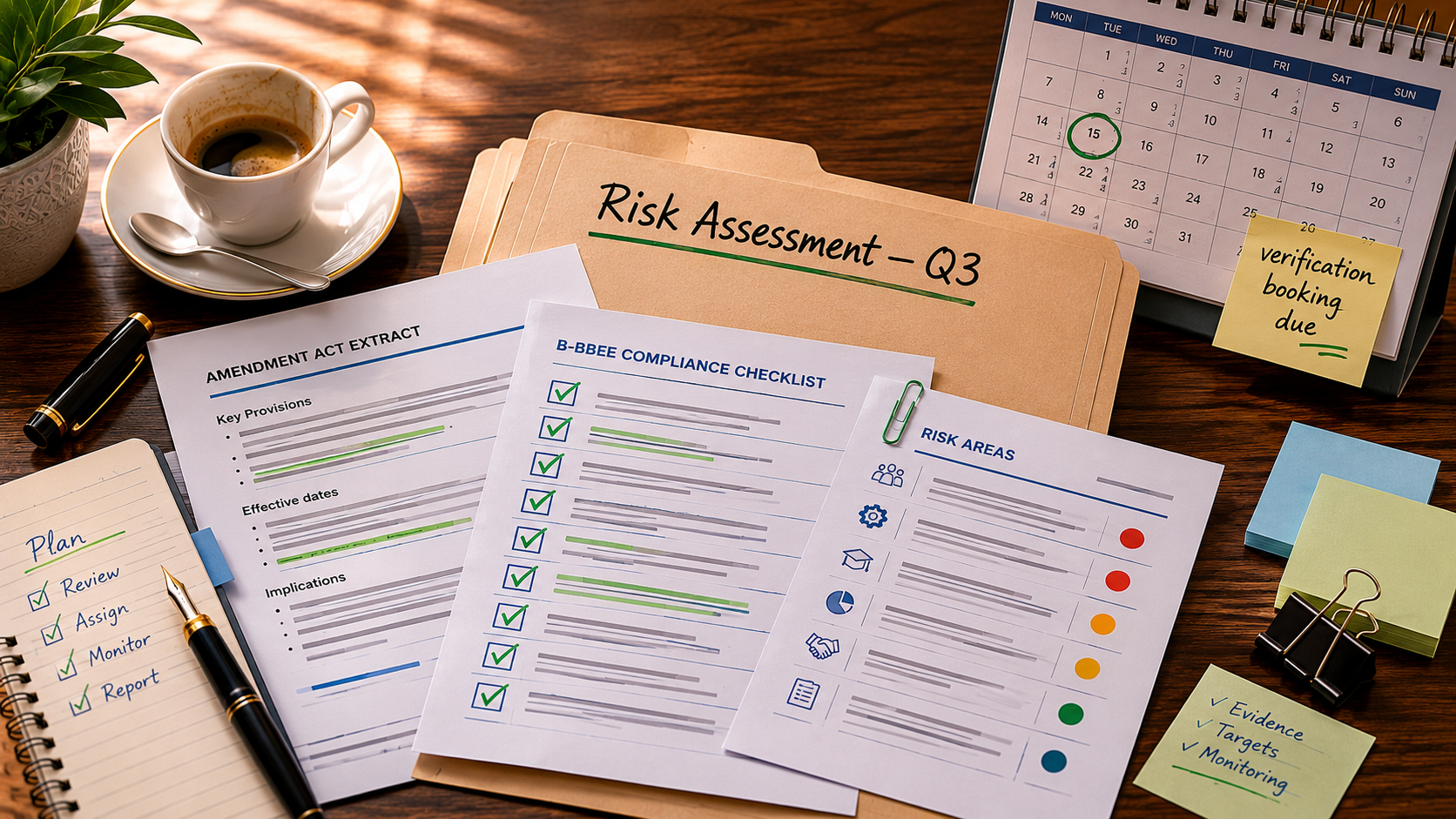
B-BBEE non-compliant risks are not a hypothetical concern for South African corporates — they are a measurable exposure that shows up the moment a verification cycle returns “below the scoring floor” or the certificate lapses without renewal. The fallout has commercial, contractual, and statutory dimensions that compound rather than reset each cycle.
This guide walks through what happens when a business slips below the rating threshold, how the consequences cascade across customer relationships and state contracting, and what a realistic recovery programme looks like over the following twelve to eighteen months. The pillar for B-BBEE levels in South Africa sits alongside this for the broader rating context.
Quick Answer
B-BBEE non-compliant risks fall into three buckets: commercial (lost customer contracts, supplier scorecard penalties, exclusion from preferential procurement bids), statutory (fronting prosecutions under the Amendment Act 46 of 2013 carrying up to ten years imprisonment or fines of up to 10% of annual turnover, plus a ten-year ban on state contracting for convicted parties), and reputational (visible supplier-dashboard ratings flagged to corporate procurement teams). Recovery from below the scoring floor typically takes twelve to eighteen months and R800,000 to R2 million in programme investment.
Just learned your latest verification returned below the threshold? Request a recovery-path diagnostic conversation →
How Businesses End Up Below the Scoring Floor
An unrated outcome rarely arrives as a surprise to people inside the business, but it often arrives as a surprise to the board. The slippage builds across cycles before the rating cliff finally registers in the verification report.
The four most common entry routes into below-threshold territory:
Lapsed certification. The previous certificate expired and no fresh verification was booked. The business is treated as below the scoring floor by default until a new certificate is issued. This is the most common entry route — purely administrative, fully recoverable, but commercially damaging in the interim.
Element collapse during the measurement year. A priority element sub-minimum was missed (Ownership, Skills Development, or ESD), triggering an automatic discount that pushed an already-marginal score below the rating floor. The technical scorecard mechanics work out badly even when total points were close to acceptable.
Affidavit-route invalidation. EMEs and qualifying QSEs that relied on the affidavit route discover that a verification agency or major customer has rejected the affidavit on substance grounds. The fallback measured-scorecard route then produces a low rating because no operational programme was running.
Fronting finding. The B-BBEE Commission or a verification agency identifies fronting practices — most commonly inflated black-ownership claims or “stooge” appointments — and the rating is voided. This entry route carries the most severe consequences because it triggers the statutory penalty regime as well as the rating fallout.
The B-BBEE Non-Compliant Risks Across Commercial and Legal Domains
The consequences run across three distinct domains. Each operates on its own timeline, and the operational responses differ.
Commercial Exposure
Most large corporates run supplier scorecard programmes that automatically discount unrated suppliers in renewal-cycle assessments. The exposure shows up as quiet contract non-renewal rather than sudden termination — the supplier simply loses preferential placement and watches share-of-wallet shrink across two to four quarters.
Tender exclusion is the sharpest commercial consequence. Under the Preferential Procurement Regulations, organs of state apply 80/20 or 90/10 point systems where unrated suppliers score zero on the preference component. On a competitive R20 million tender, the eight to twenty preference points often decide the outcome.
Procurement recognition that flows to the supplier’s customers also collapses. A customer scoring its own scorecard cannot recognise procurement spend with an unrated supplier — which means the supplier becomes commercially expensive for that customer to retain at any volume.
Statutory Exposure
The Amendment Act 46 of 2013 codifies offences and penalties specifically targeting fronting and the misrepresentation of empowerment status. The full text of the B-BBEE Amendment Act 46 of 2013 on the SA Government site establishes the Commission as the enforcement body and sets out the penalty framework.
Three statutory exposures matter most:
Fronting prosecutions. Conviction for fronting carries imprisonment of up to ten years for individuals, or fines of up to 10% of annual turnover for the entity. The threshold for prosecution is significant misrepresentation of black-ownership or management-control status — not technical scorecard errors.
Organ-of-state contracting ban. Convicted parties cannot contract with organs of state for ten years following conviction. For businesses that derive significant revenue from public-sector procurement, this is often a more material consequence than the financial penalty itself.
Contract cancellation. The Act provides for cancellation of contracts entered into on the basis of misrepresented empowerment status. A government contract awarded on the strength of an inflated rating can be cancelled retroactively, with restitution obligations.
Reputational Exposure
Corporate procurement teams increasingly use supplier scorecards that surface BEE ratings directly to category managers. An unrated status is visible inside the customer organisation, often months before any contractual action is taken. The supplier’s relationship managers find themselves having harder renewal conversations with less ability to compete on the empowerment dimension.
| Penalty Type | Triggering Conduct | Maximum Exposure |
|---|---|---|
| Individual criminal penalty | Fronting practice or material misrepresentation | 10 years imprisonment |
| Corporate fine | Fronting practice by an entity | 10% of annual turnover |
| Organ-of-state contracting ban | Conviction for fronting offences | 10 years from conviction date |
| State contract cancellation | Contract awarded on misrepresented rating | Full cancellation plus restitution |
| Preference points exclusion | Unrated status at tender submission | 8-20 preference points forfeited per tender |
| Customer procurement recognition | Unrated status during measurement year | Zero procurement recognition value |
The Real-World Hierarchy
For most generic corporates, the commercial exposure (customer churn, tender exclusion, procurement recognition collapse) materialises faster and bigger than the statutory exposure. Statutory penalties matter most where fronting is involved — they apply to a smaller population of businesses but with severe individual and corporate consequences. The reputational exposure compounds both.
Sitting with a rating gap and weighing the commercial fallout against the cost of a recovery programme? Book a strategic recovery conversation →
The Recovery Path from Below the Threshold
A recovery engagement runs on a different rhythm from a routine rating-improvement programme. The first ninety days are diagnostic and stabilisation work; the next nine to twelve months are operational element build; the final three months are verification readiness.
A Gauteng-based engineering services firm with R210 million annual turnover entered a recovery engagement after its previous certificate lapsed and a subsequent verification placed the business at the scoring floor. The recovery programme delivered a rated outcome within fifteen months.
| Recovery Stage | Before — Below Threshold State | After — Rated Outcome |
|---|---|---|
| Certificate status | Lapsed; no current rating | Valid certificate; mid-band rating |
| Ownership element | Unmeasured; no current evidence | 40% verifiable black ownership documented |
| Skills Development spend | R85k unbudgeted; ad-hoc training | R520k structured through SETA learnerships |
| ESD beneficiary contracting | None active | 3 contracted beneficiaries at R420k total spend |
| Customer renewal status | 2 renewals at risk; 1 lost | All retained renewals; 1 new tender won at R8.5m |
| Tender preference scoring | 0 points on 8 active tenders | 12-14 points active on new submissions |
| Total programme investment | baseline | R1.42 million over 15 months |
The defining work was the ESD beneficiary identification and contracting in the first three months. Starting ESD early is the leverage move — the twelve-month beneficiary recognition window forces the timing. Skills Development followed in months three to nine, and Ownership documentation in the final stages before verification.
Patterns That Lead Businesses Into Slippage
Treating verification as an annual administrative task. Businesses that book verification ninety days before the certificate expires, with no operational programme running during the measurement year, almost always slip. The scorecard requires twelve months of measurable evidence, not a ninety-day evidence sprint.
Affidavit complacency. EMEs and 51%+ black-owned QSEs that rely on the affidavit route without keeping the supporting documentation current find themselves rejected during major customer audits. The affidavit route is administratively light but legally substantive — it has to be defensible if challenged.
Misreading the priority element thresholds. Many businesses focus on total points and forget that priority element sub-minimums apply independently. A business scoring 65 total points but missing the Skills Development sub-minimum is rated below 65 — often well below — because the priority discount applies first.
Fronting expediency. The single most damaging pattern is short-cut ownership arrangements designed to look like genuine empowerment for the purposes of the verification cycle. The Amendment Act regime is specifically designed to identify and prosecute these arrangements, and verification agencies have improved substantially at flagging them.
The Recovery Window Compounds
Every quarter spent below the scoring floor adds further commercial drag — lost tender preference points, renewal-cycle volume erosion, and harder customer conversations. The cost of waiting three months before starting a recovery programme is rarely smaller than the cost of starting immediately, even where the budget conversation has not yet concluded inside the business.
Who This Article Is NOT For
Businesses contemplating fronting as a short-term workaround. Fronting is a criminal offence under the Amendment Act with personal imprisonment exposure for directors and corporate fines up to 10% of annual turnover. No commercial pressure justifies the risk. A genuine empowerment transaction, even at lower percentages, is structurally superior to any fronting arrangement.
EMEs below R10m turnover that have never been formally rated. The Codes treat EMEs with default ratings (typically Level 4, or Level 2 for 51%+ black-owned, or Level 1 for 100% black-owned). There is no scoring-floor scenario for a properly documented EME. The recovery framework in this guide does not apply at this turnover tier.
Businesses where the customer base has zero state-procurement exposure and no major-corporate supplier scorecard requirements. The commercial fallout from below-threshold status is concentrated in state contracting and corporate-procurement environments. A purely B2C business with no scorecard-driven customers faces materially smaller commercial exposure (the statutory exposure still applies).
Companies in liquidation or business rescue. A recovery programme requires twelve to fifteen months of operational programme investment. Distressed entities should resolve the underlying solvency situation before treating rating recovery as the strategic priority. The Codes framework is not designed to operate alongside a Business Rescue Practitioner.
Why Insignis Treats Recovery Engagements Differently
Insignis runs B-BBEE compliance strategy development as a structured recovery offering for entities returning from below-threshold positions. The engagement model differs from a routine rating-improvement programme — the diagnostic phase is longer, the ESD timing pressure is higher, and the verification-readiness work involves more documentation reconstruction than a continuous-cycle entity needs.
Dr. Este Welman leads recovery engagements with a Chartered Accountant (SA) background, a PhD in Economic Transformation from the Da Vinci Institute, an M.Comm in Taxation from North-West University, a B-BBEE Management Diploma from Wits, and SAICA membership. Her recovery work focuses specifically on the timing sequencing that determines whether a fifteen-month programme delivers a sustainable rated outcome or merely a one-cycle peak.
The Insignis approach for recovery clients runs a mandatory diagnostic phase in the first ninety days, ESD beneficiary contracting in the first three months without exception, and a board-level escalation protocol if any priority element shows risk of missing its sub-minimum by month nine. Engagement scope is typically 10-14% of total programme value for recovery work, higher than ongoing rating maintenance.
Recovering from a below-threshold verification cycle and need a fifteen-month programme that actually holds? Talk to a senior Insignis advisor today →
Frequently Asked Questions
What does the term non-compliant actually mean on a B-BBEE scorecard?
The term applies in two practical situations. The first is where a measured scorecard returns a score below the Level 8 threshold — under 30 points on the 109-point generic scorecard. The business is then rated as below the scoring floor and receives no procurement recognition.
The second situation is where a certificate has lapsed without renewal. The business is treated by customers and state buyers as if it were below the floor until a fresh rating is issued. The two situations have different remediation paths but identical commercial consequences.
How quickly do commercial consequences hit after a below-threshold verification?
The fastest consequence is tender exclusion — preference points are scored at the moment of submission, so an unrated supplier loses eight to twenty points on any tender submitted from that point. Customer renewal conversations typically shift within one quarter as procurement teams update supplier scorecards. Volume drift from existing customers accelerates over two to four quarters as renewal cycles cumulate.
What is the difference between a low rating and being below the scoring floor?
A Level 8 rating delivers 10% procurement recognition — meaningful for the supplier and not catastrophic for the customer. Below-floor status delivers zero recognition and counts as if the supplier had no rating at all. The gap between Level 8 and below-floor is therefore much larger than the gap between any two adjacent rated levels, because the recognition cliff is at the floor itself, not at each level boundary.
Can a fronting allegation be defended?
Yes, where the underlying ownership and management structure is genuine and the documentation supports the empowerment claim. Defending a fronting allegation requires producing the original transaction documentation, the operational evidence of black control (board minutes, decision rights, dividend flows), and the verification agency’s working papers.
Where the structure is genuine but documentation is weak, the defence is harder but not impossible. Where the structure itself is fronting, defence is rarely viable and early settlement may be preferable.
Is recovery possible without an ownership change?
Yes, in most cases. Recovery to a mid-band rating from below the threshold typically does not require an ownership transaction. The leverage comes from Skills Development, ESD, and procurement rebalancing. Ownership work is usually layered in later cycles, once the rating has stabilised in the mid-band. Recovery to the second band or above typically does require some Ownership-element work, but recovery from the floor to Level 4-5 generally does not.
What does a recovery engagement typically cost?
For a generic entity with R100 million to R300 million turnover, total recovery programme cost runs R800,000 to R2 million across twelve to eighteen months. The largest line items are Skills Development (R400,000-R800,000), ESD beneficiary contributions (R300,000-R700,000), and verification-readiness documentation reconstruction (R100,000-R300,000). Advisory fees for recovery work are typically 10% to 14% of total programme value — higher than ongoing rating maintenance because the diagnostic and documentation reconstruction effort is higher.
Map the Recovery Path Before the Next Tender Cycle Hits
Below-threshold status compounds quickly once tender exclusions and customer-renewal conversations start landing. The recovery diagnostic identifies whether the fifteen-month programme is the right response or whether a different structural intervention is required — and quantifies the trade-off between recovery investment and continued commercial drift.
Dr. Este Welman or a senior Insignis advisor will run the initial recovery diagnostic. No obligation. We will get back to you within 24 hours of your enquiry.
Book a Recovery Diagnostic Call
About the Author — Dr. Este Welman, CA(SA)
Founding Director, Insignis Solutions. Chartered Accountant (SA), PhD in Economic Transformation (Da Vinci Institute), M.Comm in Taxation (North-West University), B-BBEE Management Diploma (Wits), SAICA member.
Dr. Welman runs recovery engagements for generic-tier corporates returning from below-threshold positions, with particular focus on the ESD and Skills Development sequencing that determines whether a recovery programme produces a sustainable rated outcome rather than a one-cycle stabilisation.