
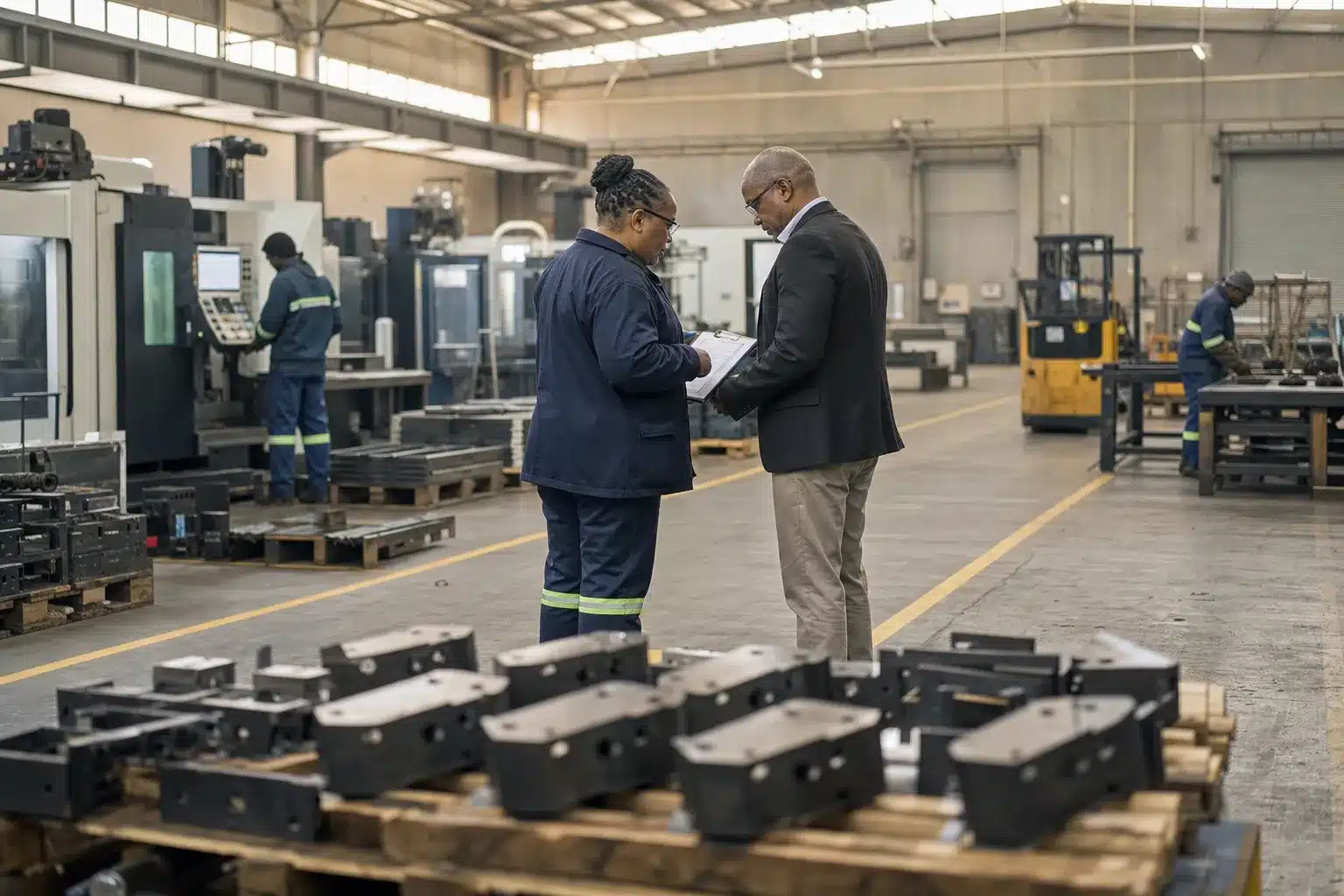
Black industrialist programme B-BBEE alignment is one of the rare places where a corporate’s procurement budget, its scorecard and its supply-chain resilience all pull in the same direction. The state funds majority-owned manufacturers to build capacity, and the Codes reward the corporates that buy from them, develop them and help them scale. How that plays out differs by industry, which is why your applicable sector code matters before any rand moves.
Most corporates meet the dtic’s industrialists scheme by accident: a supplier mentions a grant application and asks for a letter of intent. Treated as a favour, that letter is paperwork. Treated as a strategy, it is the start of a relationship that can move a scorecard by two levels and shorten a lead time by months.
This guide explains what the state actually funds, where the scorecard points come from, and how to engage without drifting into fronting.
Quick Answer
Black industrialist programme B-BBEE engagement means a corporate deliberately partnering with manufacturers that are more than 51% owned and managed by designated-group South Africans, usually those backed by the dtic’s Black Industrialists Scheme (BIS). The scheme co-funds 30% to 50% of an approved investment, capped at R50 million. Corporates that buy from, develop or co-invest with these manufacturers earn preferential procurement, supplier development and enterprise development points, and often gain a closer, more reliable local supplier.
A supplier has asked you for an offtake letter and you are not sure what you are signing up to? Talk it through with a transformation strategist first →
What the Black Industrialist Programme B-BBEE Connection Actually Is
Start with the policy, because the scorecard logic only makes sense once you see what government was trying to fix.
Cabinet approved the Black Industrialists Policy in 2015. The concern was simple: decades of empowerment deals had shifted shares in existing companies, but very few new factories were owned and run by the people the Codes were written for. Ownership transactions moved paper. The policy set out to move production.
The dtic launched the grant instrument, BIS, in 2016. It sits inside a wider support package built on three pillars: access to funding, access to markets and non-financial support such as business development services. Development finance institutions carry most of the loan funding, with the Industrial Development Corporation and the National Empowerment Fund as the main lenders.
The scale is larger than many boards realise. By mid-2022 the dtic reported support for more than 1,000 industrialists and empowered businesses over seven years, with R36.7 billion approved. That total was made up of R27.4 billion in IDC loans, R4.2 billion in BIS grants and R5 billion in mostly loan funding from the NEF.
For a corporate, the important point is this: every one of those businesses needs customers. The state can co-fund a plant, but it cannot fill the order book. That is where your procurement and supplier development budgets come in.
How the Scheme Works in Practice
BIS is a cost-sharing grant, not a loan, and it never funds a project alone. The applicant must bring co-funding from a commercial bank or a development finance institution, and the grant is released in line with that lender’s disbursements.
| Feature | What the scheme provides |
|---|---|
| Cost-sharing grant | 30% to 50% of qualifying costs |
| Overall grant cap | R50 million per approved project |
| Feasibility studies | Capped at R3 million |
| Business development services | Capped at R2 million |
| Post-investment support | Capped at R500,000 |
| Ownership test | More than 51% designated-group ownership, with management control |
Eligible projects sit in manufacturing and value-adding sectors aligned with national industrial policy: agro-processing, chemicals and pharmaceuticals, automotive and rail components, clean energy, mineral beneficiation, textiles and leather, ICT hardware and a handful of others. The owner must be hands-on, carry personal risk and commit for the medium to long term.
Applications now run through the dtic’s Online Incentive Solution platform, which became mandatory on 1 June 2026. Email submissions are no longer accepted.
One detail matters more to corporates than any other. Applicants must show a credible route to market. An offtake agreement or a letter of intent from a creditworthy buyer is often the document that turns an interesting proposal into a fundable one.
Where Black Industrialist Programme B-BBEE Points Come From
Nothing in the Codes awards points simply for knowing a state-backed manufacturer. The value comes from three measurable lines on the Enterprise and Supplier Development scorecard, plus a possible ownership angle. Our enterprise and supplier development guide covers the element in full; here is the short version.
Preferential procurement. Spend with suppliers that are at least 51% owned by designated-group South Africans carries 11 of the 25 procurement points, against a target of 50% of total measured procurement spend. It is the heaviest single line in the category. A manufacturer that replaces an imported component can shift this number quickly, as our preferential procurement breakdown shows.
Supplier development. The target is 2% of net profit after tax, spent developing suppliers already in your chain. Funding a qualifying manufacturer’s quality certification, tooling or working capital counts here, provided it is documented.
Enterprise development. The target is 1% of net profit after tax, spent on businesses outside your supply chain. Early-stage support for a manufacturer you do not yet buy from sits here.
Bonus points. The element adds a point for graduating an enterprise development beneficiary into your supplier base, and another for jobs created through these initiatives. A manufacturing partnership of this kind is one of the cleanest ways to earn both.
Points follow spend, not goodwill
A partnership with a state-backed manufacturer earns nothing on its own. The scorecard rewards what you buy from it, what you invest in developing it, and the jobs and supplier graduation that result. Because Enterprise and Supplier Development is a priority element, falling below 40% of any of its three sub-targets discounts your level by one. A well-structured manufacturing partnership often fixes that discount outright.
Four Ways Corporates Engage With Industrialists
The right route depends on what you buy, how much capital you can commit and how much control you are willing to give up. Most mature programmes combine two of these.
As an anchor buyer. You commit to a volume of purchases, often through a multi-year offtake agreement. This is the lightest route and the one lenders value most, because it de-risks the investment case. Your procurement score benefits from the first invoice.
As a supplier development partner. You fund specific capabilities the manufacturer needs to serve you: ISO certification, tooling, process engineering or a working-capital facility on preferential terms. The spend counts toward your 2% target and strengthens a supplier you depend on.
As a minority co-investor. You take a minority stake in the new plant while the majority stays with the founder. This suits corporates that want security of supply for a critical input. It needs careful structuring, and our ownership structures comparison sets out the trade-offs.
As an early-stage developer. You support a manufacturer before it is ready to supply you, through enterprise development spend and mentoring, then graduate it into your supply chain. It is the slowest route and the one that earns the graduation bonus.
Not sure whether your spend belongs under procurement, supplier development or enterprise development? Ask for a quick ESD allocation check →
The Offtake Letter Is the Real Currency
Here is the part most procurement teams underestimate. When a manufacturer applies for BIS support, the lenders and the dtic want evidence that someone will buy what the new plant produces. A signed letter of intent from a large corporate often carries more weight in that assessment than a polished business plan.
That gives the corporate real leverage, and it should be used responsibly. Before you sign, agree on the specification, the quality standards, the price mechanism and the volumes you can realistically take. A vague letter helps no one: it overstates demand to the lender and sets the manufacturer up for a shortfall.
A good letter of intent is specific about three things. It names the product and the standard it must meet. It gives an indicative annual volume, with a range rather than a promise. And it sets out the conditions under which the commitment would firm up, such as passing a first-article inspection.
Handled this way, the letter protects both sides. The manufacturer gets a credible market story for its funders. You get a supplier whose capacity was built around your needs, with state money covering up to half of the capital cost.
Why procurement and transformation must sit together
In many companies the offtake decision sits with procurement while the scorecard sits with a transformation manager. The two rarely meet until verification season. That split is how corporates end up signing letters that earn no points, or chasing points from suppliers who cannot meet the specification.
The fix is a joint decision gate. Before any letter goes out, procurement confirms the commercial fit and the transformation lead confirms how the spend will be recognised. Ten minutes of alignment at that point saves months of reconstruction later.
Fronting Risk: Where Good Intentions Go Wrong
The ownership test is strict for a reason. The scheme targets businesses that are genuinely owned, managed and run by its founders, and the Codes apply the same logic to every point you claim.
The B-BBEE Act treats fronting as a criminal offence. A company found guilty can face a fine of up to 10% of its annual turnover, and individuals can face imprisonment of up to ten years. The B-BBEE Commission investigates complaints and publishes its findings.
The warning signs in a manufacturing partnership are familiar. The majority owner has no real say in operations. The corporate partner controls the bank account, the key hires or the customer relationships. Profits flow back to the corporate through management fees or inflated rentals. Any one of these can turn a legitimate partnership into a fronting finding.
The safest structures leave control where the ownership sits. Your influence should come through the contract, the specification and the quality standards, not through the boardroom of a business you do not own.
A Black Industrialist Programme B-BBEE Partnership in Numbers
The figures below are an illustrative composite based on mid-sized manufacturing mandates in Gauteng. The corporate has an annual turnover of about R600 million and net profit after tax of roughly R60 million.
| Measure | Before the partnership | After the partnership |
|---|---|---|
| Supplier development spend | R400,000 in scattered small grants | R1.2 million focused on one plant expansion |
| Spend with majority-owned suppliers | 18% of measured procurement | 41% of measured procurement |
| ESD sub-minimum | Missed, level discounted | Met, discount removed |
| Overall scorecard | Level 5 | Level 3 |
| Lead time on the key component | 14 weeks, imported | 4 weeks, made locally |
| Supplier’s funding position | Grant application stalled for lack of a buyer | BIS grant approved at 40% cost-sharing |
The corporate did not increase its total spend. It redirected supplier development money it was already spending, and moved one component from an overseas supplier to a local one. The level jump came mainly from removing the priority-element discount.
The lead time is the argument that wins the board
Scorecard gains open the conversation, but supply-chain resilience closes it. A local manufacturer built around your specification cuts lead times, reduces currency exposure and shortens the distance between a quality problem and its fix. When the same decision also lifts your level, the business case writes itself.
Who This Is NOT For
Exempt micro enterprises. If your turnover sits below the EME threshold, a plant partnership is out of proportion to what your scorecard needs. A sworn affidavit already covers you.
Corporates with nothing to buy. The model rests on real procurement. A pure services business with no manufactured inputs will struggle to create an offtake relationship that stands up commercially.
Anyone wanting control without ownership. If the plan depends on running the plant from behind a majority owner, stop. That is the definition of fronting, and the penalties are severe.
Buyers chasing this year’s certificate only. Plant investments take 18 to 36 months to reach steady output. A corporate that needs points before its next verification should fix its existing spend first.
Who this does suit: manufacturers, retailers and resources groups with meaningful local procurement, measured entities missing the ESD sub-minimum, and any corporate whose supply chain relies on imported components that a local plant could make.
Why Insignis Treats Manufacturing Partnerships as Supply-Chain Decisions
We start with your bill of materials, not your scorecard. The partnerships that last are the ones built around a component you genuinely need, made to a standard you can verify, at a price that holds up without the points. Once that commercial core is right, the scorecard recognition follows almost mechanically.
From there we map each rand to the correct scorecard line, draft the evidence file the verification agency will ask for, and review the governance so the partnership can never be read as fronting. Offtake letters, supplier development agreements and minority stakes each get checked against the same test: who really controls this business?
Because the numbers must survive a verification audit and a board challenge at the same time, we run the work with the rigour of a financial review. Our B-BBEE consulting team supports corporates from the first supplier conversation through to verification.
If manufacturing is your core industry, our manufacturing compliance guide covers the wider scorecard context. For the official policy position and current support instruments, the dtic’s page on the industrialists support package is the primary source.
Thinking about moving an imported component to a local manufacturer? Get a scorecard and supply-chain view before you commit →
Frequently Asked Questions
What does the BIS grant actually fund?
It co-funds 30% to 50% of qualifying costs for an approved manufacturing project, capped at R50 million. Qualifying costs include capital investment, feasibility studies up to R3 million, business development services up to R2 million and post-investment support up to R500,000.
Who qualifies for support under the scheme?
A South African business more than 51% owned and managed by designated-group South Africans, operating in manufacturing or a value-adding sector aligned with industrial policy. The owner must be involved in day-to-day management and carry personal risk.
Can a corporate apply for the grant itself?
No. The applicant is the majority-owned manufacturer. A corporate supports the application indirectly, usually through an offtake agreement, supplier development funding or a minority co-investment.
Which scorecard points can a corporate earn from these partnerships?
Mainly Enterprise and Supplier Development points: preferential procurement from majority-owned suppliers, supplier development spend against 2% of net profit after tax, enterprise development spend against 1%, and bonus points for supplier graduation and job creation.
Does a letter of intent commit us to buy?
That depends on how it is drafted. A well-written letter gives an indicative volume range and sets the conditions for a firm commitment, such as passing a first-article inspection. Legal review before signing is always sensible.
How do we avoid fronting in a manufacturing partnership?
Leave operational and financial control with the majority owner. Your influence should come through the supply contract, specifications and quality standards. Avoid management fees, control of bank accounts or key appointments, and any arrangement that routes profits back to you.
Build a manufacturing partnership that earns its points
A manufacturing partnership review maps your procurement and ESD spend, identifies the components a local manufacturer could supply, and shows the likely level impact before you sign anything. You get a clear view of the points, the risks and the supply-chain gains.
No obligation. We will get back to you within 24 hours.
Request a partnership review
Dr. Este Welman, CA(SA)
Founding Partner, Insignis Solutions
Dr. Welman is a Chartered Accountant holding a PhD in Economic Transformation from the Da Vinci Institute, an M.Comm in Tax from North-West University, and a B-BBEE Management Diploma from Wits. She reviews supplier partnerships the way an auditor reviews a related-party transaction, testing who holds control before anyone counts the points.